Exploring alternatives for Ground improvement and geotechnical hazards in the GCC
This webinar was presented on Dec 9, 2025 in the UAE.
Introduction
Host: My name is Professor Ghanim Kashwami, and today it is such an honor to introduce not only a great scientist and a great engineer but also a brother and a former classmate, Dr. Mohamed Wehbi. Dr. Mohamed Wehbi did his bachelor's at the American University of Sharjah, then he did his Master's and PhD at Birmingham University in Civil Engineering.
He is one of the few people who balances between academia and industry, and this is something I miss, to be honest—I am a pure academic, so I hope I learn a lot from Mohamed. He is also a Chartered Engineer from the Engineering Council in the UK and a Fellow of the Pavement Way Institute, which is one of the institutes highly recognized, especially in Civil Engineering, like ICE and IStructE.
Today's topic is about Geobear and what they are doing. Geobear is an international company; they have many success stories that I personally witnessed, and I really want to share them with you guys.
Presentation by Dr. Mohamed Wehbi
Dr. Mohamed Wehbi: Thank you very much, Professor Ghanem. Thank you so much, and I do apologize to everyone for this inconvenience; we had a technical problem. Today I'll be talking to you about Geobear solutions and technologies to treat geotechnical hazards in the GCC.
Who is Geobear?
Geobear is a global leader in non-destructive solutions. We specialize in treating subsidence and foundation problems. The company was originally established in Finland in the early 80s, and our current headquarters is in the UK. We established our UAE part of the business in 2023, and we've completed over 200,000 projects worldwide.
Common geotechnical problems
The two types of problems that we basically tackle in the GCC are related to foundation settlement, utility settlement, water seepage, issues related to improper man-made fills, the rise of water tables, liquefaction in reclaimed land, and the treatment of saline layers.
What are geopolymers?
Geopolymers are expandable resins that can be injected into the ground using specialized injection equipment for the purpose of either void filling or soil stabilization. When the material is injected, it is injected in a liquid state and in a matter of seconds it expands and solidifies.
Expansive geopolymers have different properties; we have about 30 different types of geopolymers. Some of them have a very high expansion rate; some of them barely expand. The strength of the material ranges from about 150 kPa all the way to about 15 MPa in compressive strength.
The stiffness of the material ranges from 10 MPa to 300 MPa. It has unique characteristics of rapid hardening—it hardens in a matter of seconds—and it's a water-free solution, so it does not require water to initiate the chemical reaction. Finally, it's a super lightweight material that is 10 times lighter than conventional concrete and five times lighter than conventional grout.
Geopolymers also have an excellent ability to resist cyclic damage due to cyclic loading. So if you're using it under pavement or a railway line, it can sustain the cyclic loading and can last for a very long time. If you compare the performance of a geopolymer material against the performance of engineering fill materials, you will see that it super-exceeds it and can have a fatigue life of 100 to 150 years with no issues.
We've also done numerous studies on the sustainability of the material by third-party consultancies. Geopolymers are well known for their stable molecular structure; they don't mix with water, they're hydrophobic, and they don't contaminate any underground water or emit any hazardous substances into the soil.
Over the years, we've accumulated a number of credentials such as the BBA certification from the UK, the HAPAS certification from the Highway Agency, and other local and international certifications.
The application process
Geopolymer is applied via three simple steps. The first step includes drilling through the foundations or the slabs. Secondly, inserting a very small 12-millimeter diameter tube. And then connecting that tube is connected to an injection unit, which is then used to pump the material in.
The process is basically simple: we start by marking the injection positions, then we scan the injection positions to make sure that there are no buried services or utilities, and then we start drilling, inserting the injection tubes, and injecting. While we're injecting, we monitor the injection process—we monitor the heat introduced to the surface and the amount or quantity that we inject into the system.
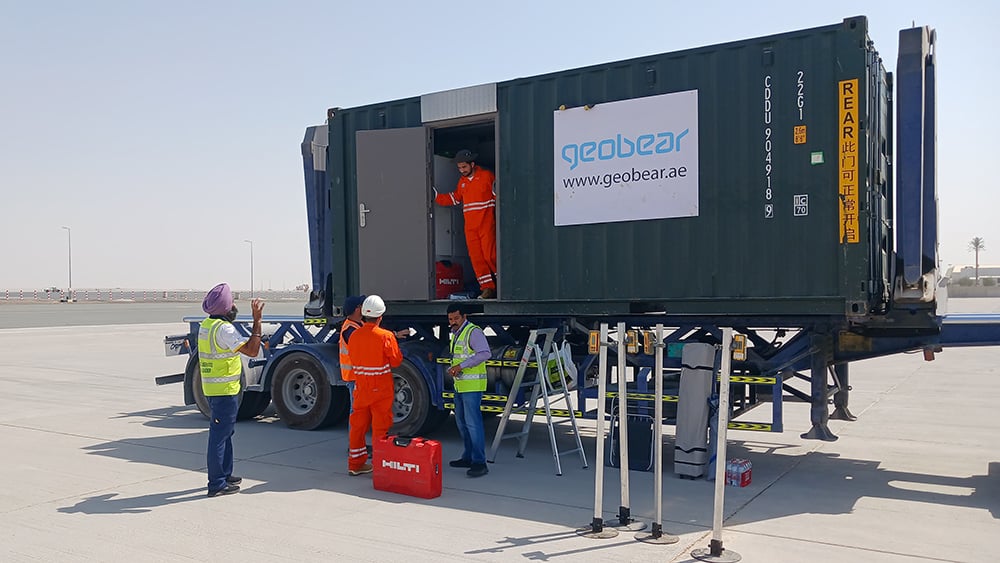
The injection plant can come in different sizes and shapes. The plants that we have in the UAE are housed in a 20-foot container that we can move from one site to another, which houses all the equipment, the tools, and the electric generator. They also come in other shapes like a van or a lorry.
Applications
Re-levelling: The first obvious and most commonly used application is the use of it to re-level structures or slabs. Due to the ability of the material to expand, we can actually use it to re-level slabs and structures by injecting underneath them and re-leveling them to the correct position.
Buried pipes: We can also use this technology to re-level buried pipes. For example, you can have a defective pipe that has suffered from differential settlement. We can actually inject below these pipes to re-level them and get them back to position, helping avoid any sort of excavation requirement.
Cavity filling: Sometimes you can have sinkholes developing under assets, which can jeopardize safe operation. These sinkholes can occur due to many reasons, like the presence of dissolution features, gaps in culverts, water leakage, or seawater erosion.
We inject our material into the sinkhole cavity to fill that cavity and also densify all the surrounding soil. The advantage of this approach is that you get instantaneous curing, so you don't need to wait for seven days to get the full strength. You would use far less material than conventional grouting because the material expands, so it will occupy a bigger volume with the same quantity.
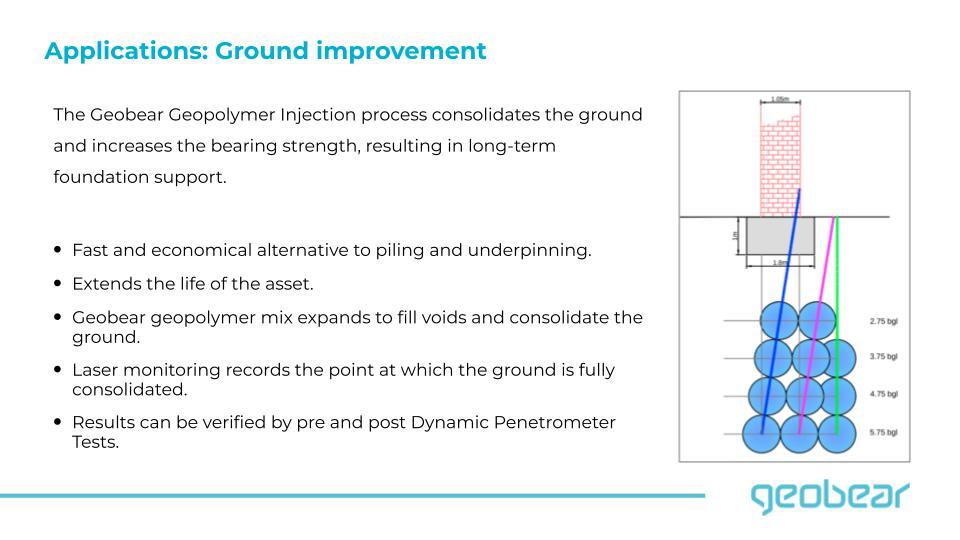
Foundation stabilization: We can also use our technology to stabilize foundations. It's a very fast, effective alternative to underpinning or micro-piles, where we drill through the foundations and inject below them at different levels to restore the bearing capacity of the soil. If a foundation has experienced settlement or you need to increase the bearing capacity due to extra stories or loading, we can improve the bearing capacity without any excavation or the need to make the foundation bigger.
Mechanism of improvement
When you inject the geopolymer into the soil, it will permeate the soil and create bulbs. These bulbs will have a diameter somewhere between 0.4 and 0.6 of a meter. As these bulbs expand, they start densifying all the soil around them. When you have two adjacent injections, you start getting compression in between the injections, densifying the soil in between. We've extracted some of these bulbs and measured the compressive strength, noting they can have a compressive strength of about two to three MPa easily.
We've done a lot of testing and R&D. For example, in one particular case, the SPT blow count improved from an average value of six to an average value of 12—almost double the SPT blow count as a result of the injection. We can increase that improvement depending on the amount of dosage we specify. In another trial on sandy silty soil, we managed to improve the tip cone resistance by a factor of 1.5, which translates into increasing the angle of friction of the material by almost two degrees.
Water mitigation
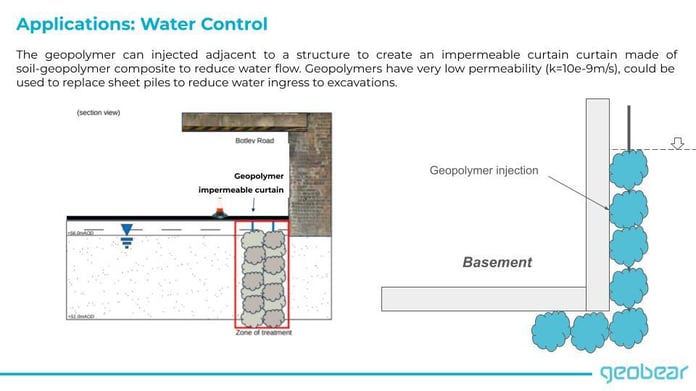
We also use our materials to mitigate the effect of water leakage. We can create water curtains because the material has a very low permeability—starting at 10^-9 m/s and going all the way to 10^-14 or 15 m/s. It's highly impermeable. We can inject behind basements to stop water leakage or create water curtains to almost act like sheet piles.
Liquefaction mitigation
In America, we also use our technology a lot to mitigate the effects of liquefaction. Liquefaction occurs when you have granular soil, a high water table, and seismic activity or vibrations. We can carry out our injections to increase the SPT blow counts to reduce the risk of liquefaction.
Case Studies
Wafi Mall (Boundary Wall): A boundary wall started to settle and tilt, posing risks on Sheikh Zayed Road. The wall is about six meters high and built on a strip foundation. Water leakage and erosion undermined the soil, resulting in settlement between 20 to 30mm, causing deviation toward the road.
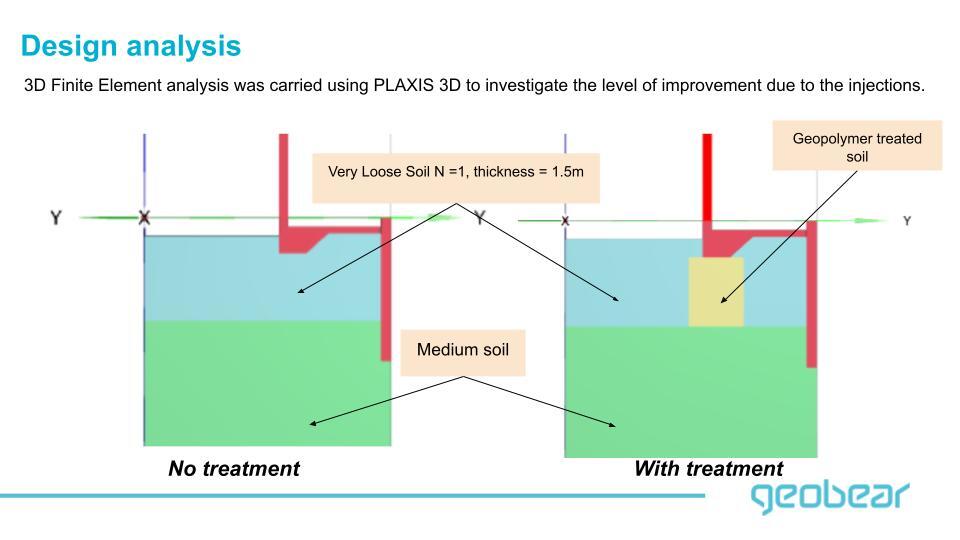
A GPR survey identified voids to a depth of 1.5 meters. We developed a solution targeting this depth with intense injections along the foundation wall without excavation, drilling holes every 0.75-meter centers. Finite element modeling predicted the settlement would go from a maximum of 50mm to about 21mm.
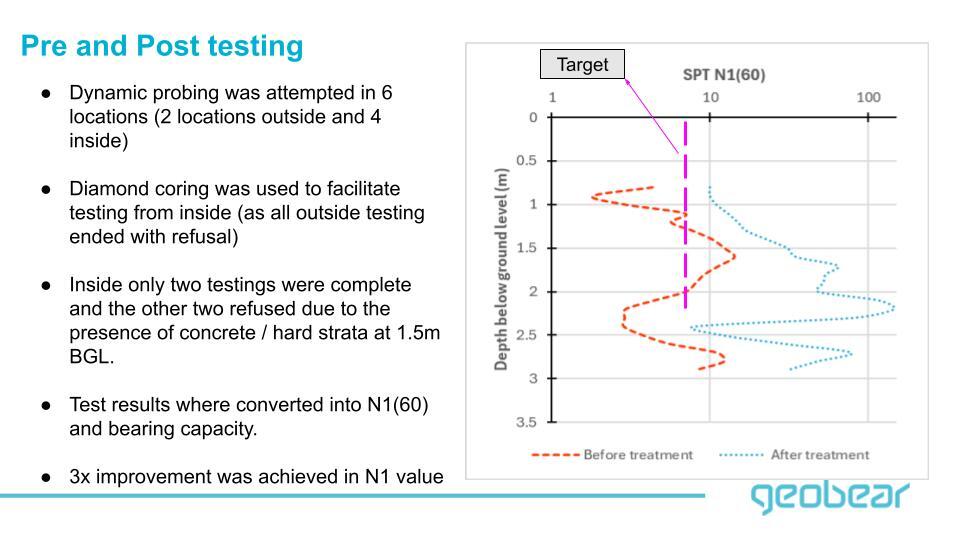
Post-injection testing showed SPT blow counts improved from an average of 6 to almost three times that, and the bearing capacity improved from 250 kPa to almost 1000 kPa.
Jebel Ali (labor accommodation): A labor accommodation with 16 pad foundations experienced significant settlement (up to 30cm), causing cracking and structural damage. A geophysical survey identified a wet layer caused by a significant water leakage in a nearby tank. The SPT blow counts were very low (between 2 and 5). We injected up to a depth of 1.5 meters below the foundations. Post-injection testing showed a substantial improvement in SPT blow count, moving from an average of 5 all the way to an average of 20.
Sharjah Shopping Mall: Two pad foundations experienced substantial settlement, about 20 centimeters, causing structural damage. The problem was a nearby damaged manhole causing water leakage and erosion. We drilled through the slab on grade and found a cavity with water dripping. We developed an injection plan treating up to two meters below the foundations with no excavation. Before treatment, SPT values were close to zero; we improved that substantially post-injections.
Fugro facility (Jebel Ali): An LV room housing servers experienced significant settlement due to soil washout. They could not shut it down. We carried out an intensive injection plan in the building foundations and created a water curtain to stop erosion.
Semi-Salt Factory: Significant settlement occurred due to sabkha soil and a high water table, up to 100mm. We carried out injections to re-level the floor to the correct position with an accuracy of plus-minus two millimeters.
The Palm Hotel: They wanted to build foundations for future water tanks in an area with buried services where they couldn't do normal compaction. They backfilled the soil and asked us to do injections around the utilities. We achieved a substantial improvement, going from an SPT of zero to over 10.
Poland (tunnel boring machine): A TBM going underneath the ground encountered a massive water leak jeopardizing the receiving pit. They asked us to come on an emergency basis. We injected around the TBM and stopped the water leakage entirely.
London Heathrow (Terminal 3): They wanted to build an additional two stories on top of the arrival terminal. The bearing capacity was around 160 kPa, and they needed 250 to 300 kPa. Making foundations bigger would involve major excavation and disruption.
We injected from outside and below the foundations. Modeling showed we pushed the factor of safety back to 2.4. Post-injection SPT testing showed increases in soil modulus up to 370%.
UAE (Sheet pile excavation): An excavation where sheet pile locking was not done properly resulted in significant water leakage. We treated that and stopped the water, allowing the dewatering system to cope.
Secant Pile Shoring: Similar to sheet piles, we stopped water coming through gaps in a secant pile shoring using our material.
Conclusion
That concludes my presentation. I hope you found it interesting. If you've got any questions, please don't hesitate to contact me or send any questions to my email. Thank you all, and take care.
Questions & answers