The smarter alternative to "Rip and Replace"
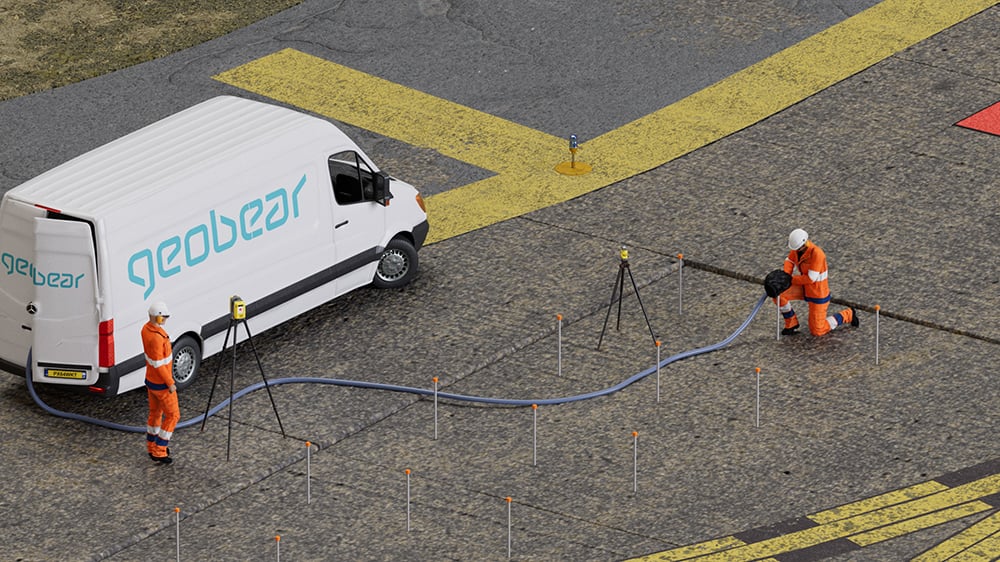
In the harsh climate of the UAE, infrastructure degrades quickly. Thermal expansion, saline groundwater (Sabkha), and heavy loading take their toll on concrete and asphalt assets.
Traditionally, when a road dips or a slab cracks, the response has been to demolish and rebuild. This is expensive, disruptive, and carbon-intensive.
There is a better way. By treating the root cause of the failure—usually the weak ground beneath—Geobear can restore the asset's structural integrity. This allows you to keep the existing concrete and asphalt in place, significantly extending its operational life.
The infrastructure network is ageing faster than it is being renewed
Yet premature replacement is not inevitable: in many cases, ground deterioration—not structural failure—is the real cause of early decline. Weak or variable soils, groundwater movement, and cyclic loading lead to settlement, cracking, and deformation that shorten design life.
Why asset life extension matters in the UAE
1. Sustainability & Net Zero 2050
Demolition and reconstruction generate massive CO₂ emissions (embedded carbon in new concrete/asphalt, transport, machinery).
Geobear Solution: Our injection process has a low carbon footprint, saving up to 60-70% CO₂e compared to full replacement. This directly supports your organization's ESG and sustainability targets.
2. Budget efficiency (OPEX vs. CAPEX)
Rebuilding an asset is a massive Capital Expenditure (CAPEX). Stabilizing it is a fraction of the cost and can often be funded from Operational Expenditure (OPEX) maintenance budgets.
Result: You free up capital for new projects while keeping existing networks functional.
3. Operational continuity
Replacing a runway, port apron, or highway lane takes months of closure.
Geobear Solution: We extend the asset's life during night shifts. The asset remains open during the day, preventing revenue loss and traffic chaos.
Design and verification
Each project follows Eurocode 7 design methodology, supported by finite-element modelling and validated field testing (DCP, PLT, FWD).
Typical post-treatment performance
|
Parameter |
Pre-Treatment |
Post-Treatment |
Improvement |
|
Subgrade stiffness (E) |
40–60 MPa |
100–150 MPa |
2–3× |
|
Bearing capacity |
200 kN/m² |
450 kN/m² |
2.2× |
|
In-situ CBR |
40 % |
85 % |
2.1× |
|
Design life |
50 yrs |
≥ 120 yrs |
+70 yrs potential |
Monitoring and assurance
Laser-level monitoring controls lift to ±1 mm. All data—pressures, injection volumes, lift profiles—are logged for traceability and QA certification.
Cross-sector benefits
The Volterra Transport Study found that the speed and efficiency of Geobear methods produce major economic and social value compared with traditional reconstruction.
|
Sector |
Key operational gain |
Typical time saving |
Indicative annual economic benefit* |
|
Road |
Reduced closures and congestion |
5–10× faster |
£70–90 million (UK equivalent) |
|
Rail |
Lower possession penalties and user delays |
2–10× faster |
£60–400 million (UK equivalent) |
|
Airports |
Faster runway return to service |
5–15× faster |
£3–19 million per event |
|
Ports & Marine |
Mitigation of voiding and washout |
4–6× faster |
— site specific |
|
Buildings & Utilities |
Prevented subsidence and tilt |
3–5× faster |
— project based |
*Derived from Volterra (2018) modelling of maintenance speed advantage and user-cost savings.
Lifecycle and socio-economic impact
Lifecycle extension
In treated foundations, expected service life increase of 5–15 years confirmed through CBR and stiffness gains
Societal cost savings
Faster maintenance reduces delays, congestion, and emissions—cutting user-borne costs by 60–80 % relative to conventional methods.
Carbon reduction
Up to 75 % lower CO₂ emissions due to zero excavation and minimal material usage.
Financial value
Road and rail sectors alone could save £1–2 billion annually across the G7 if such rapid, non-disruptive maintenance methods were standard.
Applications
Transport corridors
Highways, railways, runways, and bridge approaches.
Industrial and logistics hubs
Yards, warehouses, tank bases, and loading areas.
Energy & utility infrastructure
Substations, buried pipelines, wind turbine foundations.
Marine & waterfront
Quay walls, reclamation fills, and coastal defences.
Buildings and urban assets
Commercial, heritage, and residential structures suffering settlement or voiding.
Sustainability advantage
Zero spoil
All improvement done in situ.
Industrial and logistics hubs
Yards, warehouses, tank bases, and loading areas.
Immediate reuse
Treated areas return to service the same day.
Circular economy
Extends the functional life of existing assets, delaying carbon-intensive reconstruction.
Why asset owners choose geobear
Asset life extension
Extends infrastructure life by 5–15 years depending on load and soil conditions.
Downtime reduction
Cuts maintenance downtime by 50–90 %.
Carbon savings
Delivers measurable CO₂ and cost savings verified by independent economic studies.
Compliance
Fully compliant with Eurocode 7/8 design and ISO 9001 QA methodologies.
Track record
Solutions applied to more than 200,000 projects worldwide.
Don't demolish. Extend it with Geobear.
Find out how much carbon and budget you can save by extending the life of your infrastructure.