Ports & Harbours
Challenge
A historic stone sea wall protecting a busy tourist promenade was suffering from severe internal erosion. Tidal action and wave overtopping were washing fine soil particles out from behind the masonry face, creating large voids and causing the promenade surface to subside.
Solution
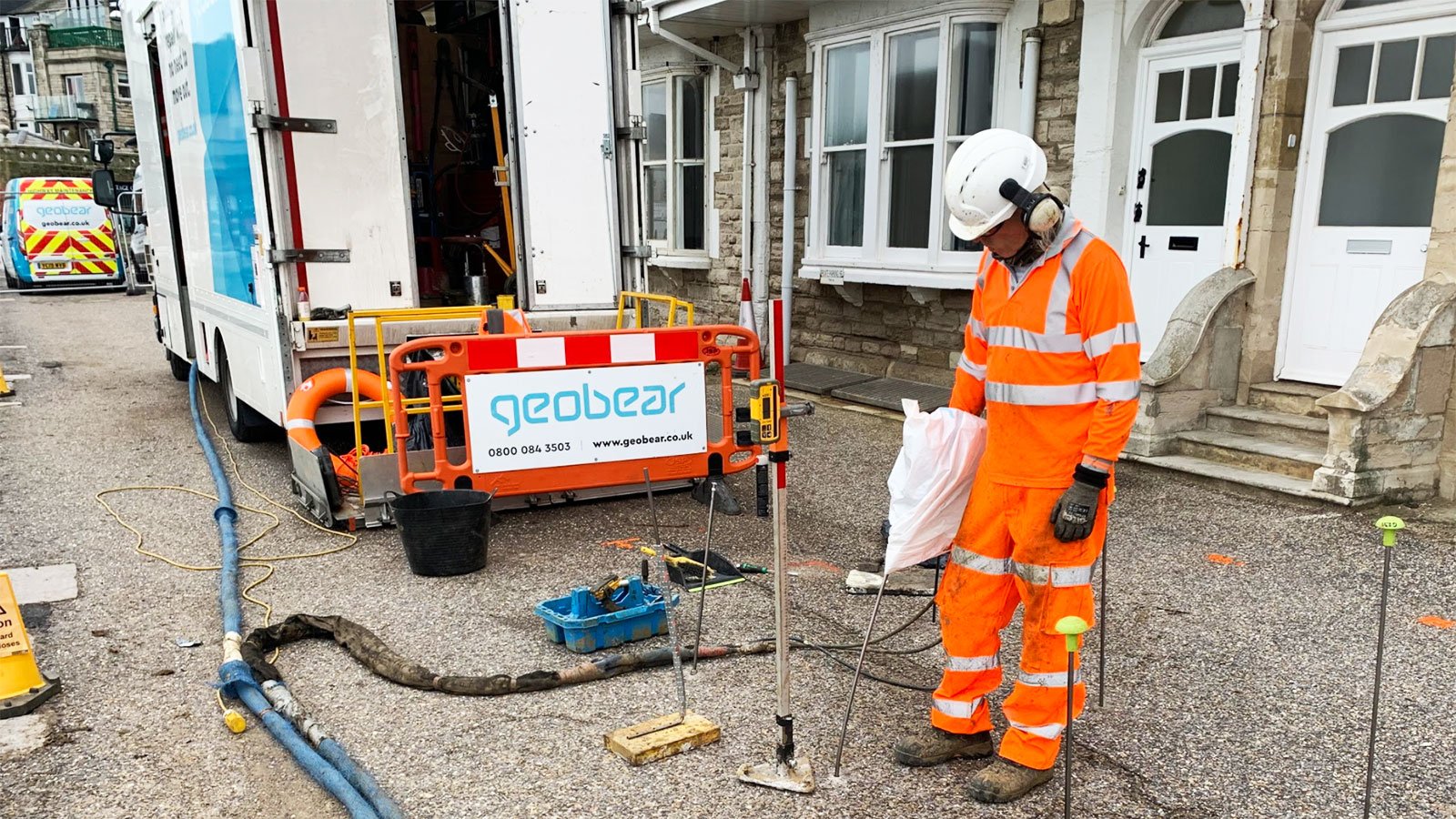
Geobear injected a specialized hydro-insensitive geopolymer through the promenade slab. The material displaced the seawater, filled the voids, and bound the loose fill material together, stabilizing the wall and preventing further erosion without the need for excavation.
Lower CO₂ emissions — 9 t CO₂e saved vs. cement grout
Injection points using over 2 tonnes of geopolymer
Completed in just three daytime shifts
Note: This project was executed in Swanage, UK, serving as a global reference for Geobear’s marine capabilities.
The Victorian-era sea wall is a critical defense structure protecting the town's promenade. Over decades, the constant ebb and flow of the tide, combined with storm surges, had exploited small gaps in the masonry. This hydraulic action sucked out the fine fill material behind the wall—a process known as fines washout or piping.
This resulted in significant voiding, leaving the heavy stone blocks unsupported and causing the pavement above to crack and settle. The asset owner faced the prospect of a catastrophic wall failure if the voids weren't filled.
The primary engineering challenge was water management.
1. Saturated zone: The voids were located in the tidal zone, meaning they were filled with seawater twice a day. Traditional cement grout often washes away before it sets in such dynamic environments.
2. Access: The promenade was a high-traffic area. Excavating to backfill the wall would have closed a major tourist attraction and required heavy machinery on a potentially unstable structure.
Geobear employed a void-filling and ground densification strategy using a marine-grade geopolymer.
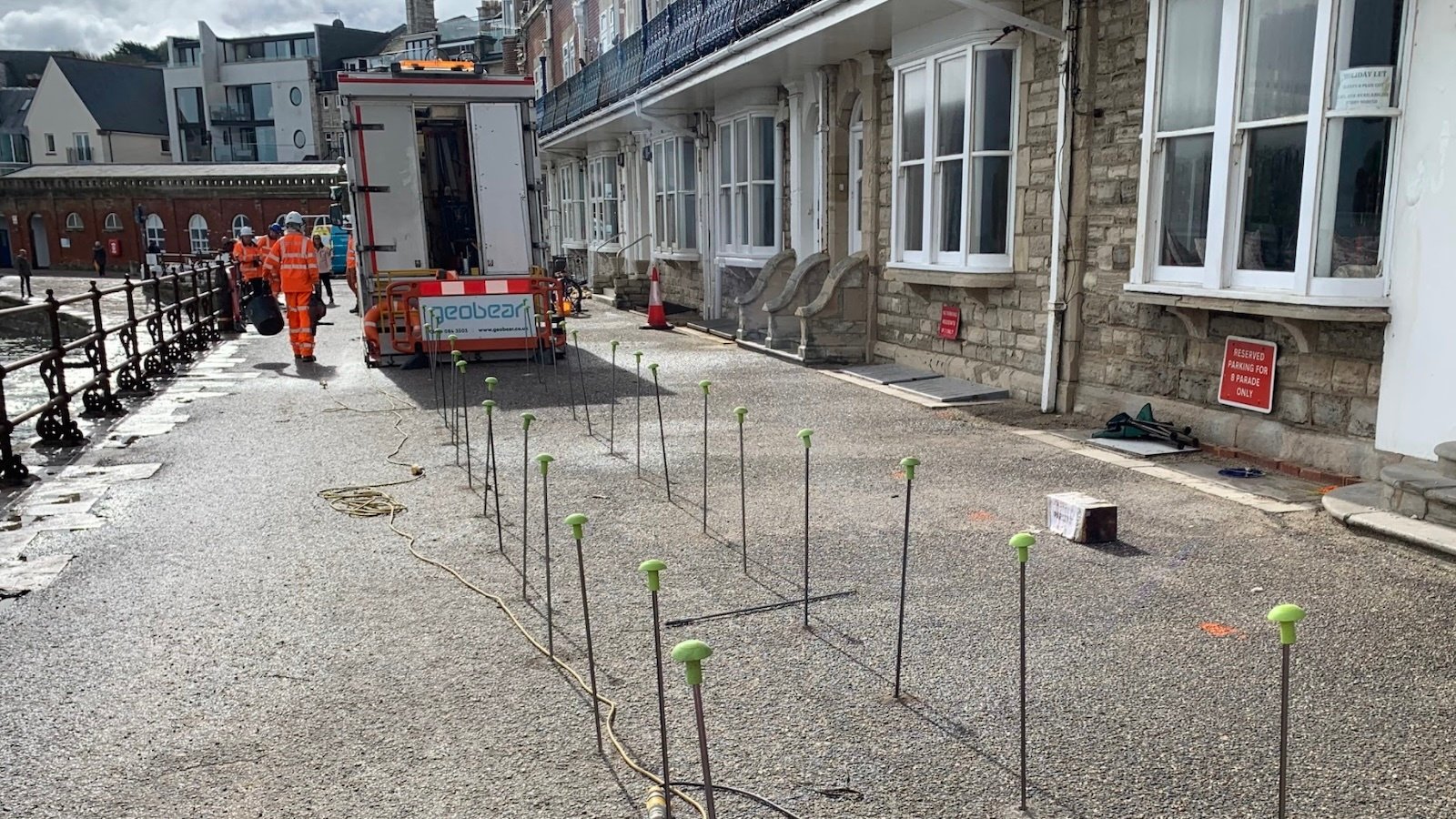
1. Drilling: small diameter holes were drilled through the concrete promenade slab to access the voided zone behind the wall.
2. Displacement: We injected a highly expansive, hydrophobic resin. Unlike cement, this material does not mix with water. Instead, it expands rapidly to displace the seawater out of the void.
3. Conglomeration: The resin permeated the remaining loose fill and gravel, binding it into a solid, stable mass that locked the stone face in place.
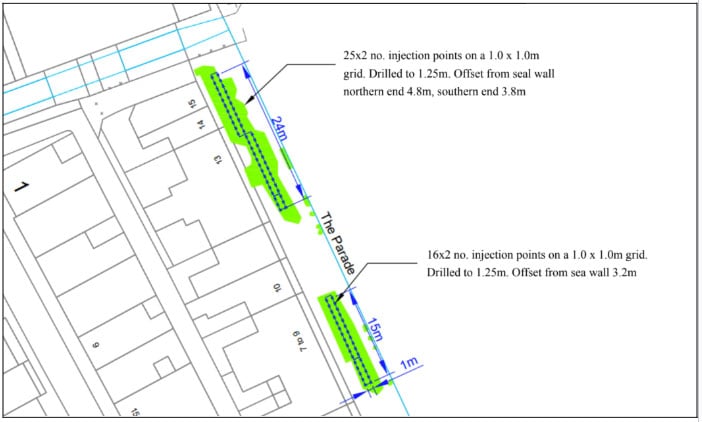
The treatment plan developed for two of the four areas treated is shown below. The total work involved the injection of 2,160kg of geopolymer across 94 injection locations. Injections were spaced at 1m vertical centers and at depths of 0.7m and 1.25m.
The intervention successfully restored the structural integrity of the sea wall.
Washout stopped: The geopolymer created a permanent barrier against future tidal erosion.
Public safety: The voids beneath the promenade were eliminated, removing the risk of sudden collapse.
Cost efficiency: The project was completed at a fraction of the cost of rebuilding the wall, with zero negative impact on the local tourism economy.
Carbon savings: it is estimated that the Geopolymer solution saved approximately 9 tonnes or 45% of CO2e emissions in direct comparison to a similar scheme executed using a microfine cement grouting solution.
The cement based solution is a lot less environmentally friendly compared to Geopolymer due the high risk of alkaline solutions such as calcium hydroxide (Ca(OH)₂) leaching from the uncured cement into the sea and harming wildlife and water quality,
We fill washout voids behind sea walls and revetments using hydro-insensitive materials. No excavation required.