Ports & Harbours
Challenge
A luxury yacht manufacturer needed to increase the load-bearing capacity of their shipyard apron to support a new 320-tonne boat hoist. The existing ground, consisting of reclaimed coastal fill, was too weak to handle the concentrated wheel loads. Traditional piling would have disrupted critical launch schedules.
Solution
Geobear densified the ground to a depth of 3 meters using high-strength geopolymer injection. The solution increased the bearing capacity to the required 250 kN/m², allowing the heavy hoist to operate safely without the need for concrete piles or excavation.
Increase in allowable bearing capacity (DCP verified)
Targeted injections to 4.5 m depth
Yacht production continued throughout phased delivery
Note: This project was executed at a Sunseeker Yachts facility in the UK, demonstrating Geobear’s expertise in heavy marine industrial flooring.
Shipyards and dry docks operate some of the heaviest mobile equipment in the world. As yacht sizes increase, so do the hoists required to move them. At this facility, the client was upgrading to a massive 320-tonne travel hoist.
However, the shipyard apron was built on reclaimed land—a mix of dredged sand and gravel common in coastal facilities. The existing concrete slab and subgrade were insufficient to support the extreme point loads of the new hoist's wheels. Without strengthening, the ground would fail, risking the toppling of a multi-million dollar vessel.
Two shipyards were assessed:
Load capacities for yacht cradles ranged from 100–250 tonnes, but boreholes revealed soft to very soft soils beneath both sites, incapable of supporting these loads without risk of slab failure.
The project demanded a solution that could achieve deep ground improvement under live operational conditions. Yacht production schedules could not be interrupted, so works had to be carried out in phases that allowed continuous use of the dockyard.
The load requirements were extreme: up to 250 tonnes transferred through yacht cradles and cranes. Boreholes confirmed that the underlying soils were inadequate, presenting a high risk of further slab failure if left untreated.
Two slab types, each with different defects, required tailored design approaches. Dockyard A’s thicker slabs had extensive cracking at slab edges and corners, while Dockyard B’s block paving system had deformed under crane loads. Both scenarios pointed to the need for deep, multi-level ground strengthening.
Environmental factors also shaped the solution. Situated in a marine environment, the repair method needed to be completely inert, fast-curing, and environmentally approved to prevent any risk of leachate or contamination. Traditional piling was ruled out because:
Geobear designed and implemented a multi-phase ground improvement program tailored to the site’s specific challenges.
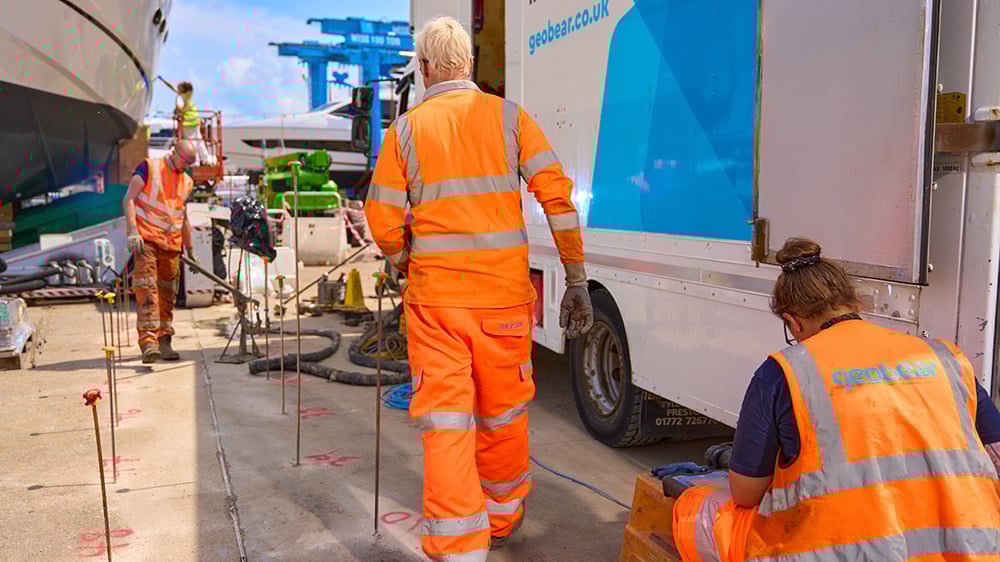
The process began with a trial area, where geopolymer injections were tested and validated by pre- and post-treatment DCP testing. Once verified, the full scheme was delivered in multiple phases across both dockyards, ensuring operational continuity.
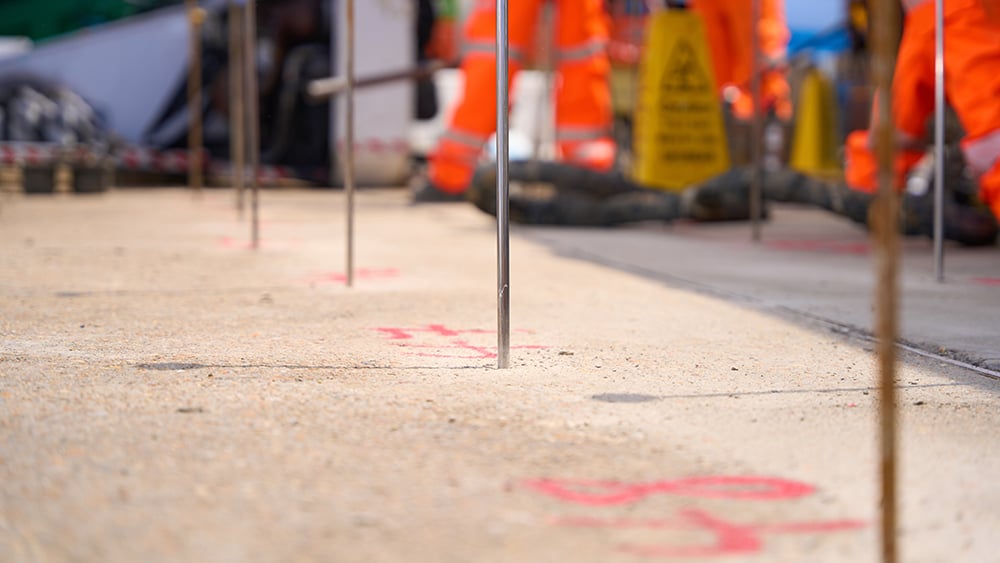
The project achieved significant technical, operational, and environmental outcomes:
We strengthen reclaimed coastal ground to support heavier cranes, hoists, and reach stackers.