Public Assets
Challenge
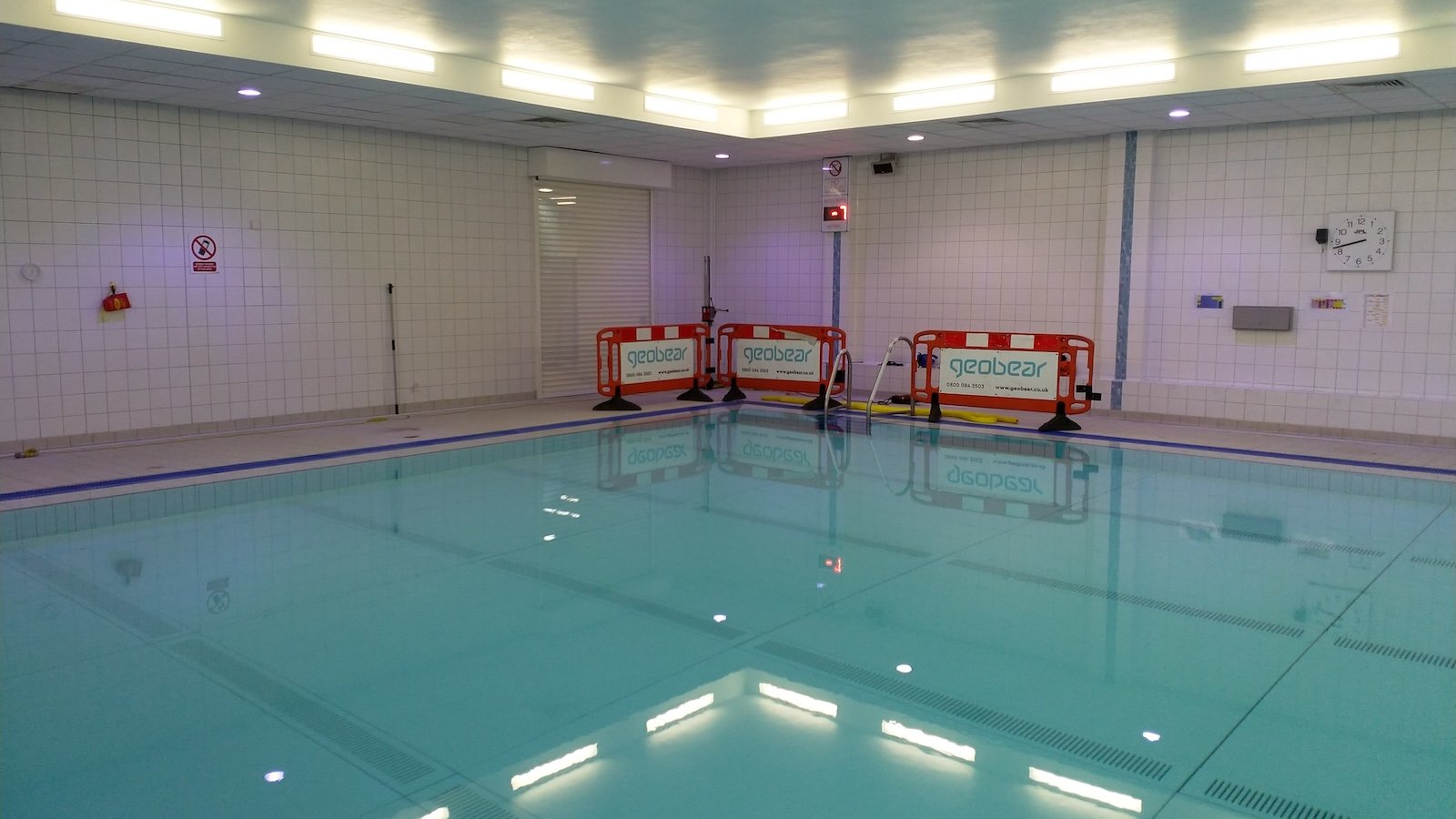
A public leisure center discovered significant settlement affecting its main swimming pool. The heavy weight of the water had caused the underlying "made ground" (loose fill) to consolidate, creating large voids beneath the pool shell. This threatened the structural integrity of the tank and the safety of the facility.
Solution
Geobear implemented a deep ground improvement program using geopolymer injection. We treated the soil at multiple depths (up to 4 meters) to fill voids and densify the loose fill. The work was completed through the pool floor without demolishing the concrete shell, saving the client the massive cost of reconstruction.
Approximate weight of water the stabilized ground now supports
No need to drain or demolish pool structures
Pool reopened to the public within one week
Note: This project was executed at Huncote Leisure Centre in the UK, serving as a global reference for Geobear’s leisure and hospitality capabilities.
Swimming pools are incredibly heavy structures. In the UAE, they are often built on reclaimed land or sandy fill. If this sub-base is poorly compacted, or if a minor pipe leak washes out the fines, the ground can settle.
This leaves the rigid concrete pool shell bridging a void. Eventually, the shell cracks, causing massive water loss and structural failure. For a hotel or community club, digging up a pool to fix the foundation is a nightmare scenario involving months of closure and destroyed landscaping.
A public swimming pool owned by a Midlands local authority suffered a major water loss when fractured circulation pipes allowed water to escape beneath the slab. The main pool had to be closed while pipe repairs were undertaken.
Investigations revealed that the backfill beneath the pipework was loose and prone to further settlement. This created a risk that pipes could bow, causing joint displacement and future water leaks.
The local authority required an urgent, non-invasive solution that would stabilize the backfill quickly and avoid lengthy closures, as the pool was a key community asset.
The project presented a combination of geotechnical, structural, and operational challenges:
Loose backfill at depth: Investigations confirmed poorly compacted soils around the pipework, increasing the risk of pipe bowing and further fractures. The site investigation revealed that the pool was built over 12 meters of "waste fill" material. Over time, this material had decomposed and settled, creating voids immediately beneath the pool slab.
Live public facility: The pool was closed temporarily, but the council demanded the fastest possible solution to avoid extended disruption to community services.
Construction detail: The pool hall slab was reinforced concrete, meaning drilling was more time-intensive than expected and required additional equipment to maintain program.
Alternative methods: Excavation and re-compaction or cementitious grouting would have required months of closure and extensive demolition, which was unacceptable for the council.
Geobear designed a "top-down" stabilization grid.
Design: Injection points were established 500 mm from pool walls and drilled to 2 m below slab level.
Injection method: Steel tubes were installed through the slab, and two-component geopolymer resin was injected. On mixing, the resin expanded to form a closed-cell structure that filled voids, displaced water, and compacted loose soils.
Adaptation to reinforced slab: When drilling progress was slowed by reinforcement, the client arranged mechanical boring, allowing Geobear to resume injections and maintain the revised 7-day program.
Execution: A total of 120 injections were carried out adjacent to both pools. Continuous monitoring ensured resin expansion was controlled and confined within the target zones.
This approach provided immediate ground strengthening, prevented further pipe movement, and avoided the need to drain the pools.
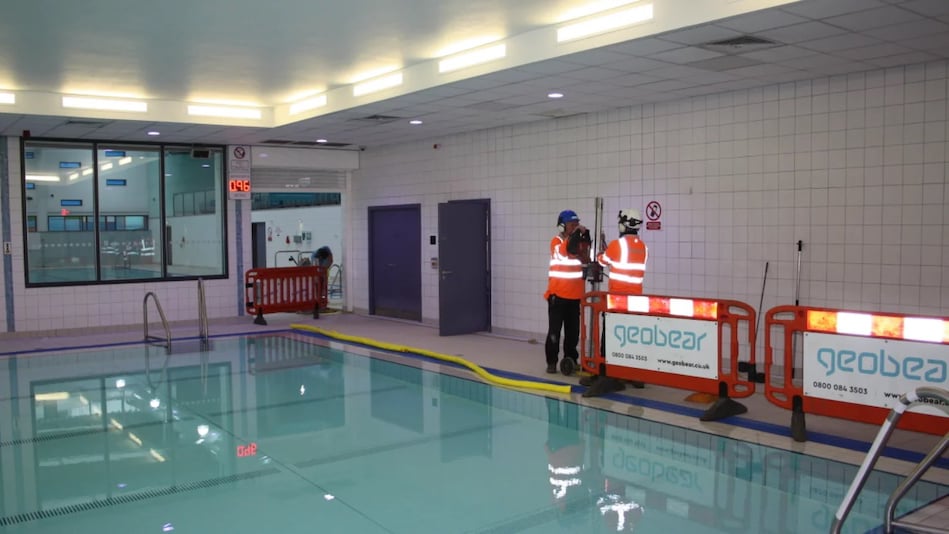
The stabilization was completed successfully, allowing the pool to be refurbished rather than rebuilt.
Structural support: The voids were eliminated, and the sub-base was densified.
Cost savings: The project cost was a fraction of a full reconstruction.
Sustainability: By saving the existing concrete shell, the project avoided significant carbon emissions associated with demolition and new concrete pouring.
Pipe stability restored: Risk of further bowing and joint displacement removed.
Rapid program: Works completed in 7 days, compared with months for excavation.
Minimal disruption: No need to drain pools or close surrounding facilities.
Carbon savings: Geopolymer injection avoided the high emissions of excavation, concrete backfill, and heavy plant.
Community benefit: Pool handed back to the council and reopened to the public on schedule.
We stabilize swimming pools and water park assets without excavation. Save your pool shell and reopen faster.