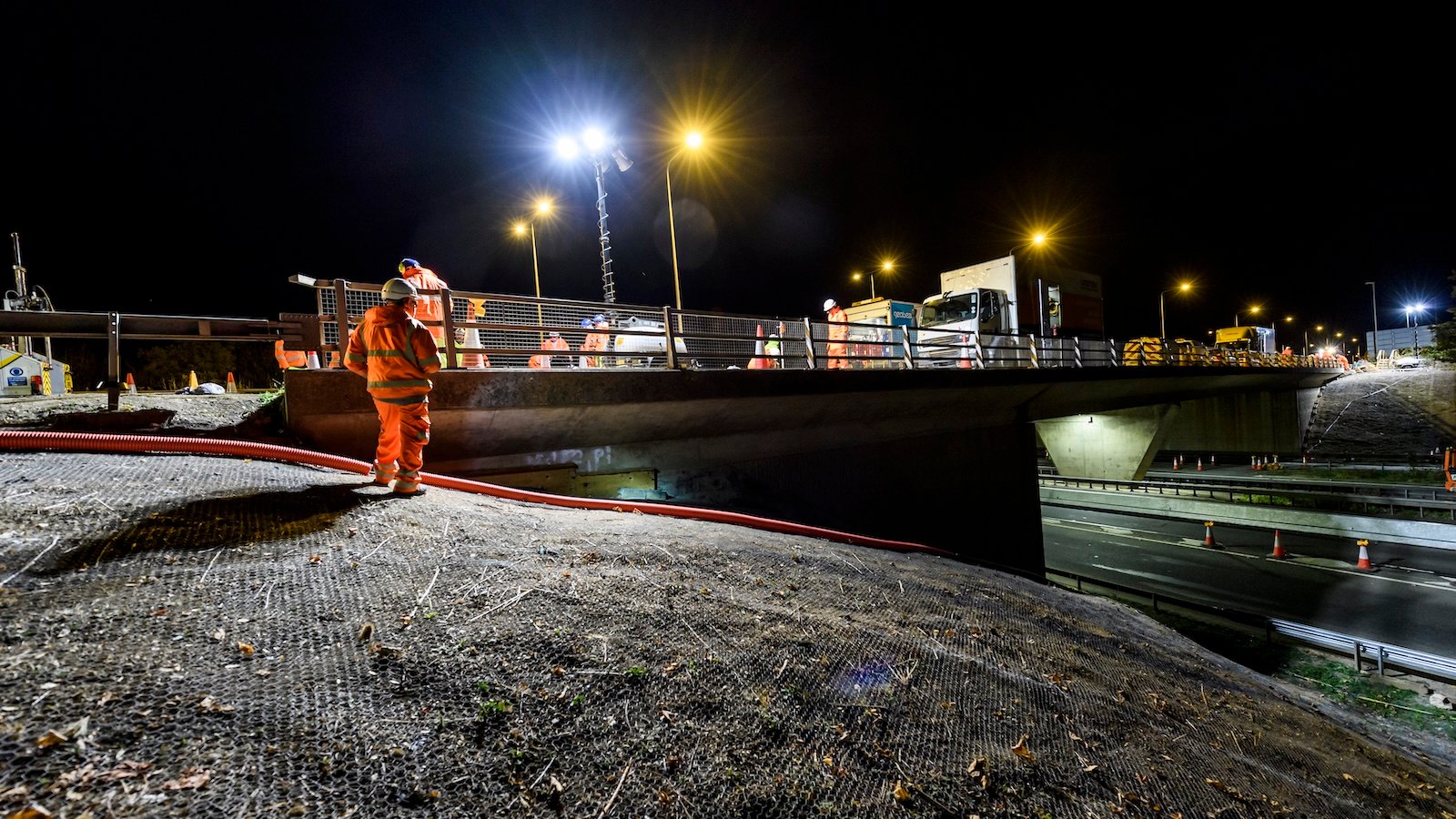
Highways
Challenge
Severe voiding beneath a critical slip road on the M11 motorway (UK) threatened the stability of a bridge abutment. Traditional excavation would have required weeks of closure on a strategic route carrying 40,000 vehicles/day, causing unacceptable congestion.
Solution
Geobear designed and delivered an emergency geopolymer injection scheme. The solution stabilized the embankment and filled the voids in just 3 weeks of night shifts—5 weeks faster than traditional methods—with zero daytime traffic disruption.
Carbon saving - 45% lower CO₂ emissions vs. cementitious grouting
High strength: ≥4 MPa compressive strength achieved with ±5 mm surface tolerance
Time saved compared to traditional excavation
Note: This project took place on the M11 motorway in the UK, demonstrating Geobear’s capability to deliver major infrastructure repairs under strict regulatory conditions.
Routine inspections revealed significant voiding beneath the carriageway on an approach embankment to a bridge. Left untreated, the voids posed a risk of sudden collapse. The client (Highways England) needed an urgent solution that could restore structural integrity without closing this vital artery to Stansted Airport and major logistics hubs.
The project faced strict technical and operational constraints:
High strength requirement: The solution needed to achieve a compressive strength of ≥4 MPa to support heavy highway loads.
Precision control: The injection had to be controlled to within ±5mm of surface movement to prevent damage to the adjacent bridge wingwalls.
Speed: An emergency intervention was required to remove the collapse risk immediately with minimal impact on the ongoing A14 improvement scheme..
Traffic impact: Closure of this section would have caused severe congestion on the M11, A14, and A428, affecting commuters and freight movements to Stansted and strategic ports.
Investigative limits: Restricted traffic management precluded extensive ground investigation, requiring real-time adaptability during delivery.Client insight
Karl Brooks - Highways England
Geobear, working with Highways England, WSP, Interserve, and Kier Highways, designed and delivered an emergency geopolymer injection scheme:
Injection process: Resin was injected beneath the carriageway to depths of up to 2.5 m, rapidly filling voids and reinstating soil contact.
Controlled expansion: “Trigger time” methodology ensured resin expansion remained predictable and pavement heave stayed within ±5 mm.
Real-time adjustments: Engineers adapted injection spacings and volumes to respond to unforeseen voiding conditions.
QA and monitoring: CCTV verified void fill, laser levels monitored surface movement, and Falling Weight Deflectometer tests confirmed post-treatment performance.
Accelerated delivery: Four crews worked in parallel across north and south abutments, enabling early completion.
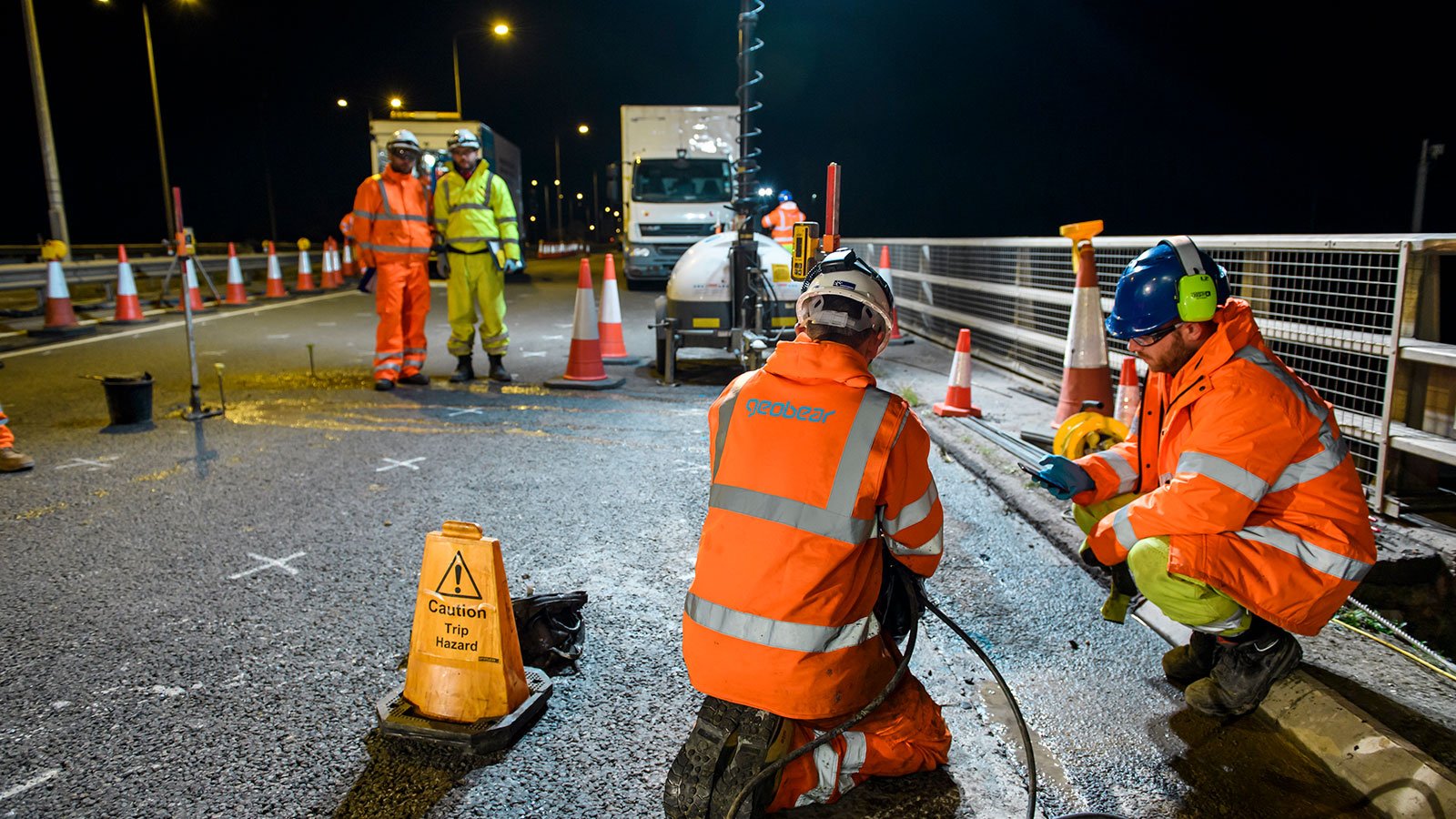
The works were completed two days ahead of programme, within budget, and with no safety incidents. The carriageway was stabilized, risk of collapse eliminated, and the motorway reopened every morning, ensuring disruption was limited to overnight closures only.
Compared with excavation, the project avoided at least five weeks of disruption. This aligns with the Volterra Transport Study, which found that faster road maintenance on high-demand routes like the M11 can deliver £640–£7,400 of user savings per kilometer of works, with national annual savings of £70m–£87m if adopted more widely.
Carbon benefits were also clear: geopolymer injection generated ~45% lower CO₂ emissions than cementitious alternatives, as verified by independent analysis.
The project was recognized across the sector, covered by the BBC, and commended by the Chartered Institution of Highways & Transportation.
“Geobear’s solution to the essential embankment repair at M11 Girton interchange has been a highlight of this year’s program. The geopolymer injection provided an innovative response to voiding, allowing us to effectively manage this complex stretch of motorway. Monitoring of pavement heave was impressive, and the programme of delivery outperformed comparative methods. Collaboration with WSP and Interserve meant we met — and in some cases exceeded — the requirements of the network and our stakeholders.”
- Karl Brooks, Project Sponsor, Highways England
We stabilize embankments and abutments without closing the road. Proven on major international highways.