Utilities
Challenge
A major Victorian-era brick sewer running beneath a busy central London street was showing signs of structural distress. Groundwater infiltration and aging mortar had caused significant voids to form in the soil surrounding the tunnel lining, creating a risk of surface subsidence and pipe collapse.
Solution
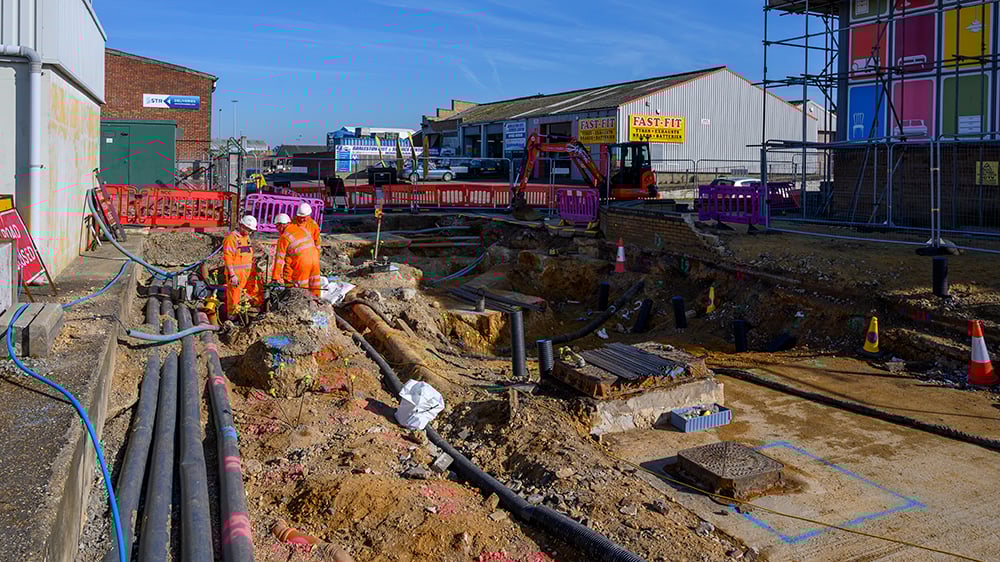
Geobear designed a solution to fill the voids and re-encapsulate the sewer tunnel using hydro-insensitive geopolymer. The injection was carried out from within the sewer (man-entry) and from surface probes, stabilizing the asset without digging up the busy road above.
SPT values improved from 0–1 to 5–15
Targeted injections to 7.5 m beneath sewer alignment
Completed five days ahead of schedule
Note: This project was executed at Baker Street, London, serving as a global reference for Geobear’s pipeline stabilization capabilities.
Underground utility networks, whether ancient brick or modern concrete, face a common enemy: washout. When pipes crack or joints fail, water leaks out (exfiltration) or groundwater leaks in (infiltration). In the UAE's loose sandy soils, this water movement quickly washes away the fine particles around the pipe.
This creates "halo voids" around the sewer. Without the support of the surrounding soil, the pipe loses its structural integrity, leading to deformation and eventual collapse—often taking the road above with it.
In the UK, A road and sewer system managed by the Anglian Water One Alliance experienced severe settlement of 100–200 mm following flash flooding. The washout beneath a critical sewer pipe caused it to bow, with failed joints accelerating erosion and ground loss. This created the risk of a localized sinkhole and threatened service continuity.
Standard Penetration Testing (SPT) classified the ground beneath the sewer as very loose, with values between 0–1 at depths of 4.5–7.5 m. The client required the soils to be improved to at least medium density before relining works could proceed.
Traditional excavation to a depth of 6.5 m was ruled out. The site was in a constrained town-centre location — a busy road junction beside a supermarket. Full excavation would have required:
The client faced both engineering and logistical challenges.
From an engineering perspective, the soils were dangerously weak and required densification without excavation. Full pipe collapse was a risk if ground support was not reinstated.
The treatment had to reach depths of 7.5 m in very loose, water-affected soils, while ensuring accuracy to avoid clashes with utilities.
From a logistical perspective, the works were located in a busy town centre. Excavation would have meant major disruption, extended road closures, and high community impact. Anglian Water needed a solution that was fast, precise, and minimally disruptive.
Client testimonial:
Anglian Water Alliance
Geobear worked closely with the Anglian Water Alliance to develop an innovative geopolymer injection program.
Plaxis modelling was used to demonstrate achievable ground improvement, giving the client confidence in the proposed solution.
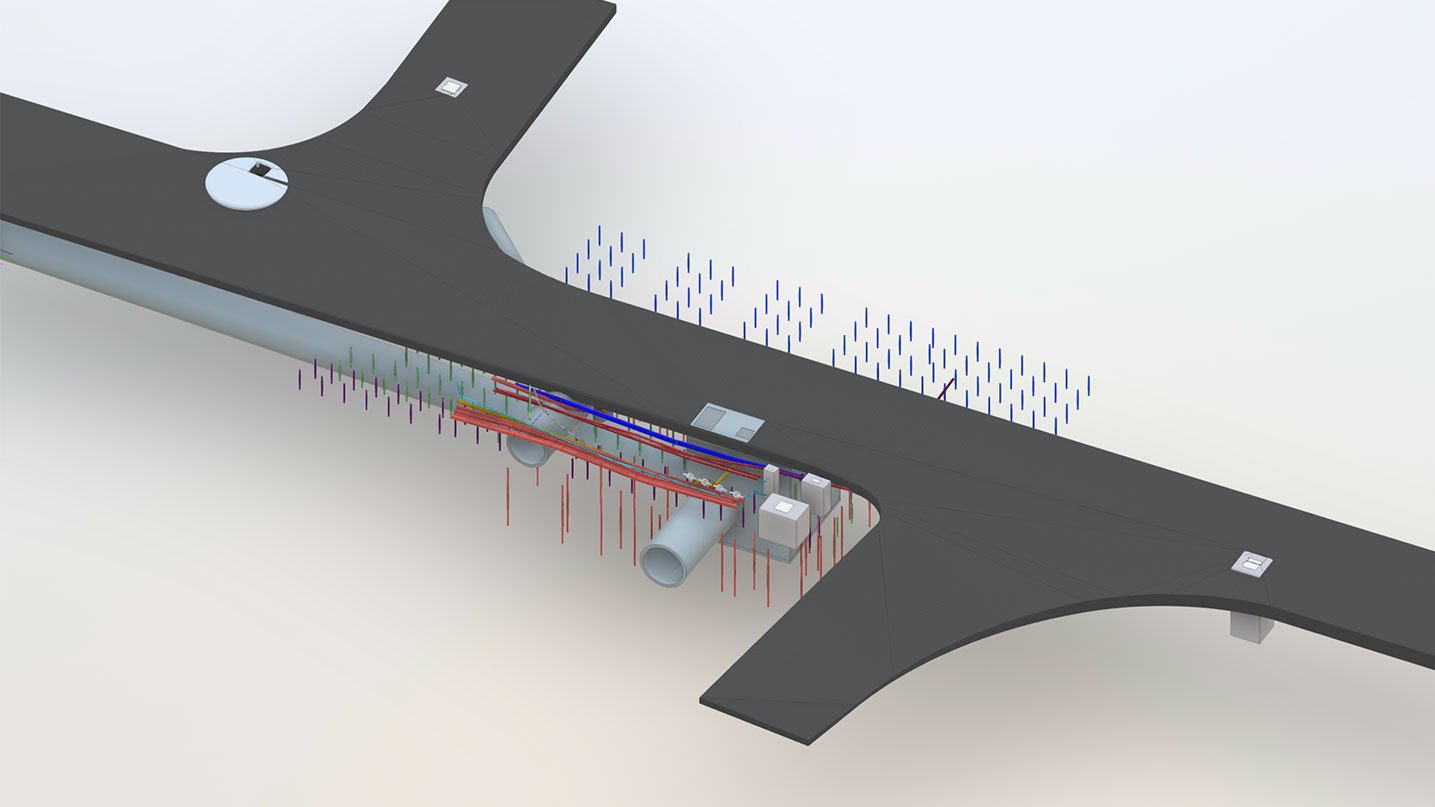
BIM integration: For the first time in the industry, Geobear’s injection design was incorporated into a Building Information Model (BIM). This enabled accurate mapping of injection points, avoiding buried services and ensuring safe, targeted delivery. (See image below)
Injection methodology: Resin tubes were installed to depths of 7.5 m on a grid pattern beneath the sewer. Expansive geopolymer resin was injected to densify the loose soils, compacting voids and reinstating support to the pipe.
Program optimization: The original design anticipated a working platform for rod-driving. On site, Geobear’s engineers developed a direct rod-driving method, eliminating the need for the platform and saving five days from the program.
Monitoring & verification: Pre- and post-treatment SPT testing demonstrated that soil density increased from 0–1 to between 5–15, exceeding the client’s requirement for medium-density ground.
The project was successfully completed ahead of program and enabled full sewer relining to proceed safely.
Ground strength tripled: Post-treatment SPT values confirmed soils were improved to medium density.
Sinkhole risk eliminated, restoring stability beneath the road and sewer.
No disruption to the community, as excavation and extended road closure were avoided.
Carbon savings realized: Compared with 6.5 m excavation and reconstruction, the geopolymer approach cut embodied carbon significantly.
Innovation milestone: First-ever use of BIM modeling to design and deliver a geopolymer injection scheme in the utilities sector.
“The unforeseen circumstances presented us with a particularly challenging situation. Geobear’s engineering team worked collaboratively with us to develop an innovative solution. The site team exceeded expectations and clearly met all of our objectives. The result was delivered ahead of program, with ground conditions improved well beyond the requirement."
Client Representative, Anglian Water Alliance:
We fill voids and stabilize pipes from the inside or surface. Prevent road collapse caused by utility washouts.