Ground improvement has changed. Have your methods?
In the past, ground improvement in the UAE was simple: you had open desert, no neighbors, and no constraints. You could use high-energy, high-vibration methods like Dynamic Compaction without a second thought.
Those days are over.
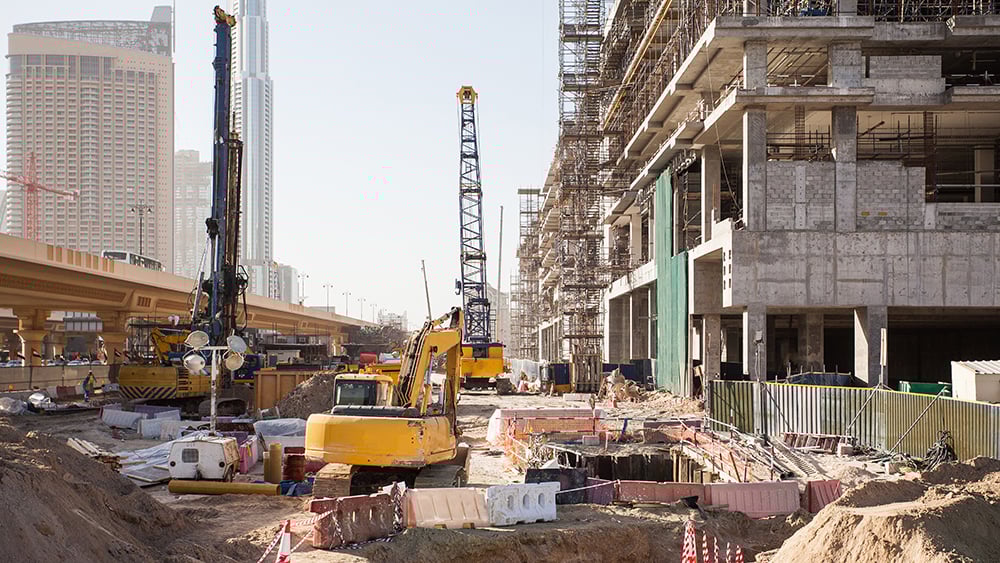
Today, the majority of UAE projects happen in dense urban environments, on brownfield sites, or within operational facilities. You are working next to glass-facade skyscrapers, over sensitive utility corridors, and inside live factories.
In these environments, the "old ways"—Vibrocompaction and Dynamic Compaction—are often not just technically unsuitable; they are a commercial risk you cannot afford to take.
Why "brute force" no longer works
Traditional methods rely on brute force to rearrange soil particles. While effective in the middle of the desert, they are disastrous in downtown Dubai or Abu Dhabi.
1. Vibrocompaction (The "Shaker")
This method relies on powerful depth vibrators to densify the soil.
The Problem: It generates significant vibration that travels through the ground. It requires large exclusion zones and simply cannot be used beneath existing foundations or near sensitive electronics.
2. Dynamic Compaction (The "Hammer")
This involves dropping weights of up to 25 tons from a crane.
The Problem: The impact energy creates extreme shockwaves and noise. In an urban setting, this risks cracking adjacent structures and damaging buried utilities.
The intelligent alternative: geopolymer grouting
Modern infrastructure demands a smarter approach. You need to increase bearing capacity and control settlement without shaking the neighborhood apart.
Geobear provides a surgical alternative to the "sledgehammer" approach. We use Geopolymer injection—a controlled process that improves the ground through chemistry and physics, not impact energy.
How it works:
Precision drilling: We drill small-diameter holes (often just 16mm) to the required depth.
Controlled expansion: We inject a proprietary geopolymer that expands underground with significant force.
Densification: This expansion compresses the soil skeleton, increasing stress within the ground and densifying loose zones without generating harmful vibrations.
This method aligns with the Observational Method defined in Eurocode 7, giving you real-time verification of the results.
Comparison: the old way vs. the Geobear way
|
Aspect |
Geobear Grouting | Vibrocompaction | Dynamic Compaction |
|---|---|---|---|
| EN Classification | Grouting – EN 12715 | Vibration densification | Impact densification |
| Vibration Generated | Negligible | High | Very High |
| Near Existing Structures | Suitable | Poor | Not suitable |
| Buried Utilities | Compatible | High risk | Very high risk |
| Beneath Structures | Yes | No | No |
| Observational Method | Highly suitable | Limited | Limited |
Designed for compliance (Eurocode)
We know that as a consultant or engineer, you need more than just a promise; you need a verified standard.
Geobear solutions are not "quick fixes"; they are engineered solutions designed and executed in strict accordance with:
- EN 1997-1 (Eurocode 7): Geotechnical Design
- EN 12715: Execution of Special Geotechnical Works (Grouting)
We verify performance through appropriate pre- and post-treatment monitoring (such as SPT or CPT testing), providing you with the data you need to sign off on the solution.
The bottom line
When you are constrained by vibration limits, congested utilities, or live operations, you don't have to abandon ground improvement. You just need to switch tactics.
Geobear offers a proven, low-vibration alternative that allows you to improve the ground right under your feet without disrupting the world around you.