Airports
Challenge
An international airport was preparing to open expanded taxiways to heavy traffic. The asset management team needed to ensure the pavement slabs were structurally sound before handover. Potential voiding beneath the slabs posed a risk of immediate cracking, unscheduled closures, and disruption penalties once the taxiways went live.
Solution
Geobear acted as the specialist consultant to manage a comprehensive Ground Penetrating Radar (GPR) survey and validation program. We identified specific zones of instability, verified them through coring, and designed a targeted stabilization program. This data-driven approach refined the treatment area significantly, saving budget while guaranteeing operational readiness.
Ground surveyed with penetrating radar across entire expansion zone
Voids detected beneath new slabs
Geobear validation refined true treatment area to just 1.2% of total
Note: This project was executed at London Luton Airport (UK), demonstrating Geobear’s consultancy and preventative maintenance capabilities for aviation.
Airport expansions often involve integrating new pavements with existing infrastructure or subjecting older taxiways to increased traffic loads. If voids exist beneath these slabs, the sudden increase in dynamic aircraft loading will cause rapid failure (cracking or rocking slabs).
The airport operator wanted a preventative maintenance strategy. Instead of waiting for the slabs to fail (reactive), they wanted to identify and fix weak spots before the taxiways became fully operational.
Geobear previously stabilised 100 slabs at Luton Airport in 2018. When new taxiways were planned as part of operational expansion, Luton sought guidance on future maintenance risk.
Working on a consultancy basis with the client and their engineering partner, Geobear recommended a preventative maintenance strategy. This would allow the airport to stabilize slabs before they were brought into heavy aircraft use, reducing the likelihood of slab cracking, movement, or costly unscheduled closures.
The approach would also protect Luton Airport from disruption penalties associated with unplanned maintenance affecting airline operations.
The problem: Newly expanded taxiway slabs risked cracking or failure once exposed to heavy aircraft loading.
The barrier: Without preemptive validation and strengthening, the airport risked unscheduled maintenance closures, operational disruption, and penalty charges from airlines.
The need: A precise, data-driven method to detect voiding and stabilize only the areas requiring treatment — without unnecessary cost or disruption.
Project management of GPR surveys: Geobear shortlisted three GPR specialists and facilitated the final selection with Luton Airport and their engineer.
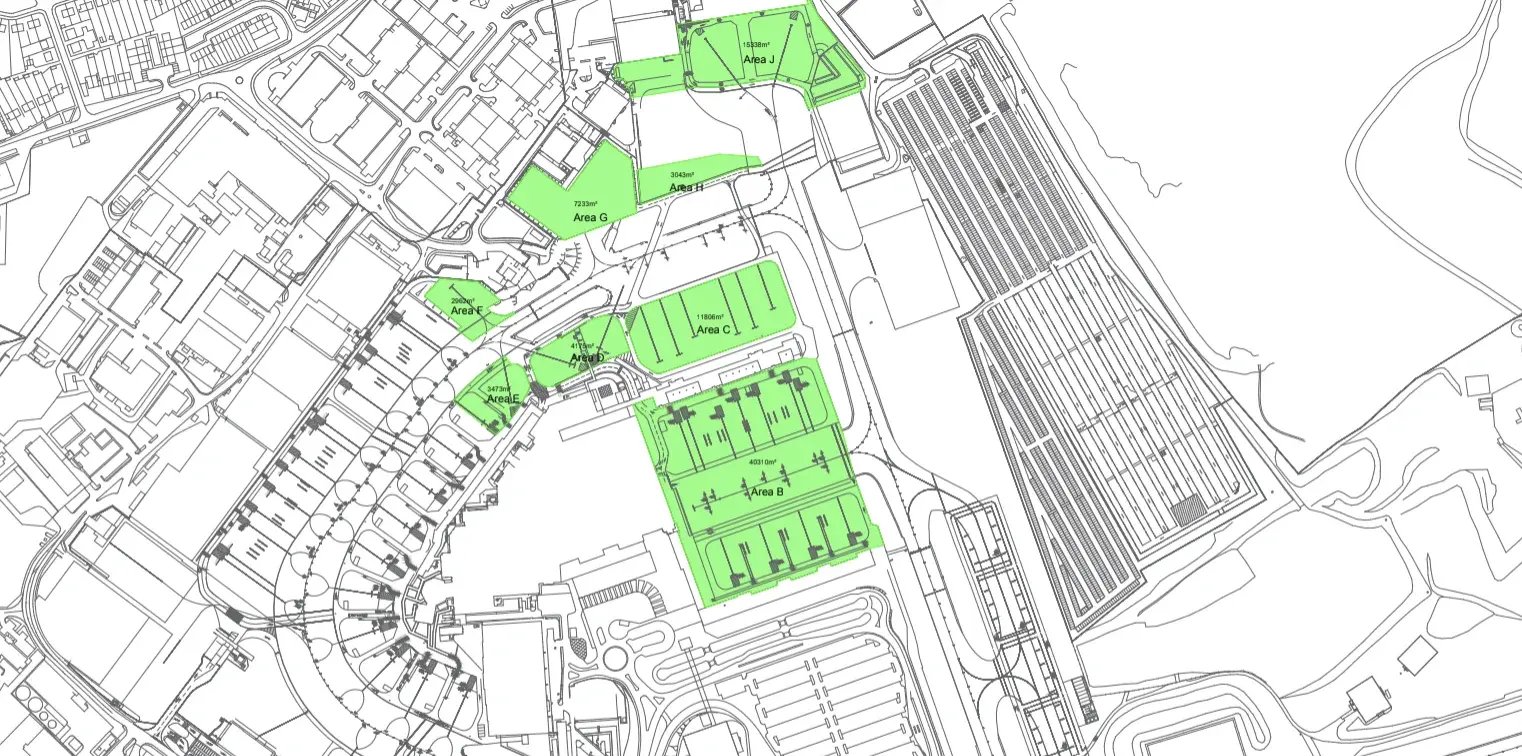
Comprehensive scanning: GPR surveys of 100,000 m² identified 3,500 m² of potential voiding beneath new slabs.
Geobear validation: Our teams cored five points per flagged slab and used inspection cameras to confirm real voids.
Refined treatment area: This process accurately reduced the stabilization zone to 1,200 m², avoiding unnecessary works.
Stabilization design: Geobear produced a full geopolymer injection proposal to strengthen the validated areas ahead of future aircraft traffic.
The stabilization works were scheduled for completion following full expansion approval.
The preventative program was a major success for the airport's asset strategy.
Cost efficiency: By validating the data, we saved the client the cost of treating 2,300 m² of healthy pavement.
Operational readiness: The taxiways entered service with a verified, stable subgrade capable of handling heavy aircraft loads.
Risk mitigation: The risk of early-life pavement failure and associated airline disruption penalties was eliminated.
Avoided unnecessary works — validation reduced treatment area by 66%, saving time and budget.
Improved reliability — taxiways were prepared to handle future aircraft loading safely.
Minimised disruption — early intervention avoided unplanned closures once taxiways entered service.
Better design data — Luton Airport gained precise ground condition insights for long-term pavement planning.
This program demonstrated the value of preventative ground engineering in major aviation infrastructure upgrades.
Get in touch with our expert team today and discover how Geobear can extend the life of your critical infrastructure assets.