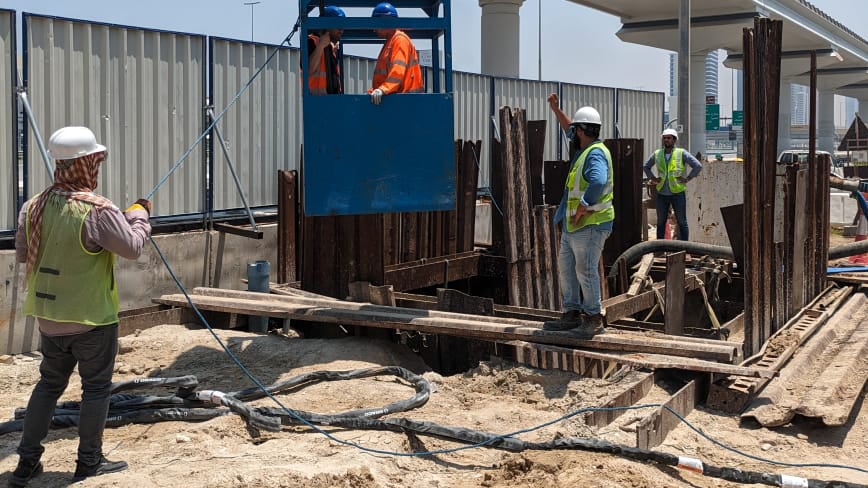
Geobear crew at open construction site with sabhka soil

Understanding Sabkha soil in the UAE

"Sabkha" (an Arabic term for salt flat) refers to the salt-encrusted, supratidal flat areas common along the coastal regions of the UAE and the Arabian Gulf.

From a geotechnical perspective, Sabkha is one of the most problematic soil types for construction. It is typically characterized by a heterogeneous mixture of sand, silt, and clay, loosely cemented together by soluble salts (evaporites) like gypsum, anhydrite, and halite.

While Sabkha often appears hard and stable when dry (due to the salt crust), it is structurally metastable. Its strength relies heavily on these salt bonds, making it highly susceptible to "hydro-collapse"—a sudden loss of structural integrity when water enters the soil profile.

The engineering challenge: Why Sabkha soils fail

Construction on Sabkha presents three primary risks to foundations and floor slabs:

1

Hydro-collapse (Salt Dissolution)

The most critical risk is the dissolution of the cementing salts. When fresh water (from rain, leaking utilities, or irrigation) infiltrates the ground, it dissolves the salt bonds holding the soil particles together. This causes the soil structure to collapse immediately, leading to sudden and severe settlement.

2

Soil variability & differential settlement

Sabkha deposits are highly variable, often containing pockets of loose sand, soft clay, and voided areas within the same site. This heterogeneity leads to differential settlement, where one part of a building sinks faster than another, causing major structural cracking.

3

Corrosive environment

The high salinity of Sabkha soil creates an aggressive environment that attacks reinforced concrete foundations (sulfate attack) and corrodes steel piling, reducing the lifespan of traditional substructures.

The Geobear Solution: In-situ geopolymer stabilization

Traditional methods for treating Sabkha often involve "cut and fill" (excavating and replacing the soil) or deep piling—both of which are disruptive, expensive, and often impossible for existing structures.

Geobear provides a modern, engineered alternative: deep geopolymer injection.
We stabilize the ground in-situ, without excavation. By injecting a high-density, expansive geopolymer resin into the Sabkha layer, we modify the soil's engineering properties to prevent collapse and restore bearing capacity. 
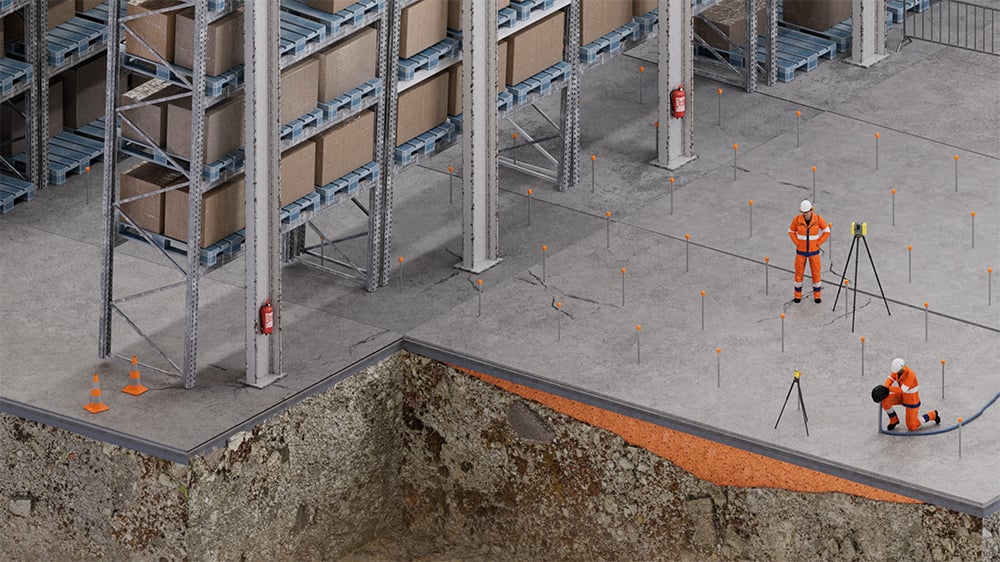
3D view of exposed soil under concrete slab in warehouse with Geobear techs injecting geopolymer

1
Densification & compaction

Our geopolymer is injected under high pressure. As it expands (up to 40 times its liquid volume), it exerts significant lateral and vertical force, compacting the loose sand and silt particles. This effectively increases the relative density (Dr) of the soil, reducing its compressibility.

2
Void filling

The material permeates the soil matrix, filling the voids left by dissolved salts or washouts. This eliminates the potential for future collapse.

3
Hydro-insensitive composite

Unlike the natural salts in Sabkha, our geopolymer is hydro-insensitive and chemically inert. It does not dissolve in water and is unaffected by the highly saline, corrosive environment. Once cured, it forms a permanent, stable composite with the soil that is resistant to future water ingress.

Technical advantages for UAE projects

Mitigates hydro-collapse risk

By replacing soluble salt bonds with a permanent, insoluble polymer matrix, we remove the risk of collapse due to wetting.

High bearing capacity

Post-treatment Dynamic Cone Penetrometer (DCP) tests typically show a significant increase in soil stiffness and load-bearing capacity, allowing the ground to support heavy commercial loads.

Chemical resistance

Our materials are certified to resist the aggressive sulfates and chlorides found in Sabkha environments, ensuring long-term durability where concrete might fail.

Precision control

Laser monitoring allows us to treat specific problem depths (e.g., a loose layer at 3m depth) without disturbing the strata above or below.

Comparison: Geobear vs. Traditional Methods

Feature Geobear Geopolymer Injection Soil Replacement (Cut & Fill) Piling / Underpinning
Disruption None. Injection through small diameter holes. High. Requires major excavation. High. Heavy machinery required.
Speed Fast. 500m² can be treated in days. Slow. Weeks of digging/compacting. Slow. Curing time required.
Water Risk Resistant. Material does not dissolve. Vulnerable. New fill can settle. Vulnerable. Concrete corrosion risk.
Site Access Flexible. Hose reaches 80m. Restricted. Heavy plant needed. Restricted. Piling rigs needed.

Solve your Sabkha soil problems for good

Don't let ground collapse threaten your asset. Contact Geobear UAE for a technical consultation and site assessment.


Bear pointing Bear pointing

Frequently Asked Questions: Sabkha Soil

Yes. This is our specialty. We drill small holes through your existing floor slab to reach the Sabkha layer beneath. We can stabilize the ground and re-level your floor without you moving out or removing racking.

No. Our geopolymer resins are rigorously tested for chemical resistance. They are inert and do not degrade when exposed to the high sulfate and chloride levels typical of UAE Sabkha groundwater.

Our material is hydro-insensitive, meaning it cures and maintains its strength even when submerged in water. By densifying the soil, we also reduce its permeability, which can help mitigate the effects of groundwater fluctuation.

We can inject at depths of up to 10 meters or more, depending on the soil profile. We use a multi-level injection technique to target the specific depths where the weak Sabkha layers are located.