Soil injections - a fast, non-excavation solution for weak ground, settlement and foundation support
What are soil injections?
Soil injections are a ground improvement technique used to strengthen weak soils, fill voids, reduce settlement risk and improve the performance of foundations, slabs, roads and other structures.
Instead of excavating and replacing poor ground, a specialist material is injected directly into the soil through small-diameter holes. Once injected, the material interacts with the surrounding ground to improve its engineering behaviour.
For property owners, consultants, contractors and asset managers, soil injections can offer a major advantage: ground improvement can often be carried out with minimal disruption, limited excavation and fast return to service.
At Geobear, our soil injection solution uses high-performance expanding geopolymers to improve ground conditions beneath existing structures, pavements, industrial floors and infrastructure assets.
Why soil injections are used
Weak or unstable ground can cause serious problems if left untreated. Common signs include cracks in walls, floor movement, slab settlement, recurring pavement depressions, loss of support below foundations and voids beneath concrete floors.
Traditional repair methods often involve excavation, demolition, underpinning or replacement of the affected soil. These methods can be slow, disruptive and expensive, especially when the affected structure is already in use.
Soil injections provide an alternative approach. The ground can be treated in place, with the injected material delivered directly to the problem zone.
| Site symptom | Likely ground-related issue |
| Cracked walls or floors | Possible differential settlement or weak ground below foundations |
| Rocking or hollow-sounding slabs | Voids or loss of contact beneath concrete |
| Uneven warehouse floors | Weak fill, poor compaction or repeated operational loading |
| Road depressions or pavement dips | Weak subgrade, water ingress or erosion |
| Recurring settlement after leakage | Soil washout or softening caused by water movement |
How Geobear soil injections work
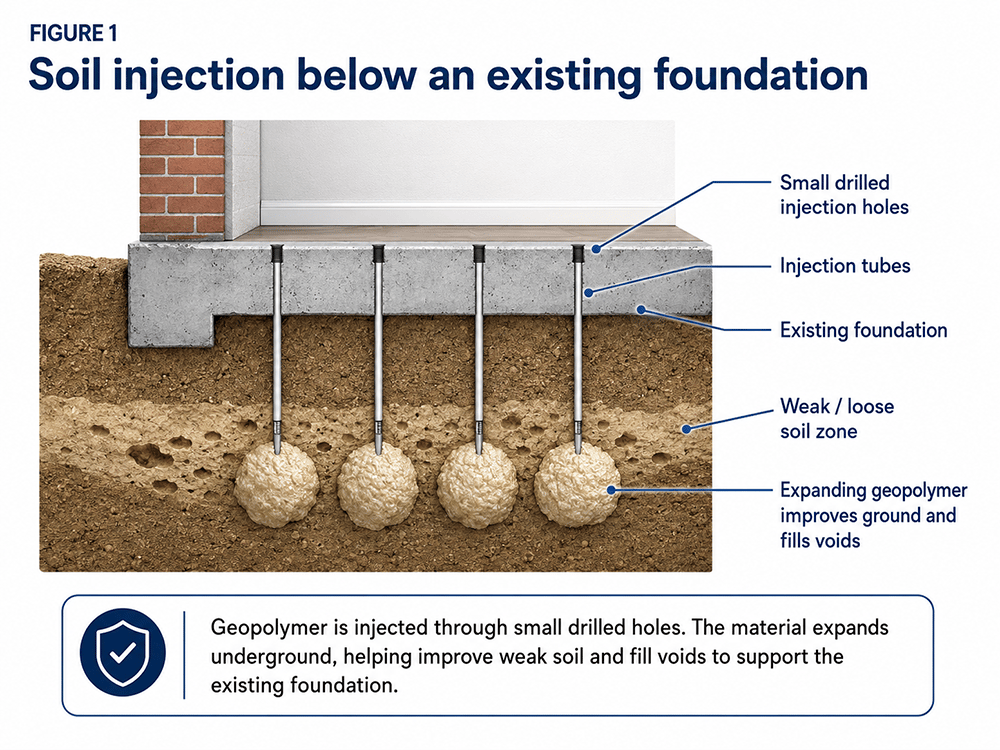
Geobear’s solution involves injecting an expanding geopolymer into the ground through small injection tubes. The material is delivered in liquid form and then reacts rapidly underground.
As the geopolymer expands, it can fill voids, compact loose granular soils, increase soil stiffness, improve load-bearing performance, reduce future settlement risk and re-support settled slabs or foundations.
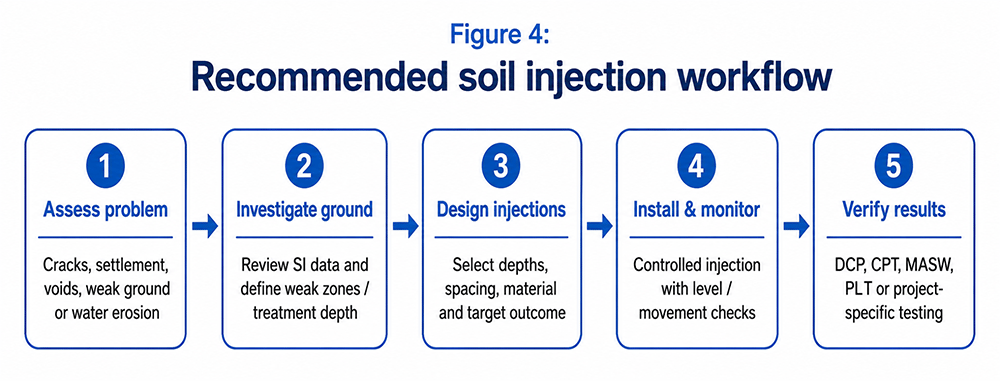
The process is controlled by experienced engineers and technicians. Injection locations, depths, spacing and material quantities are selected based on the ground conditions, structural loading and required improvement target.
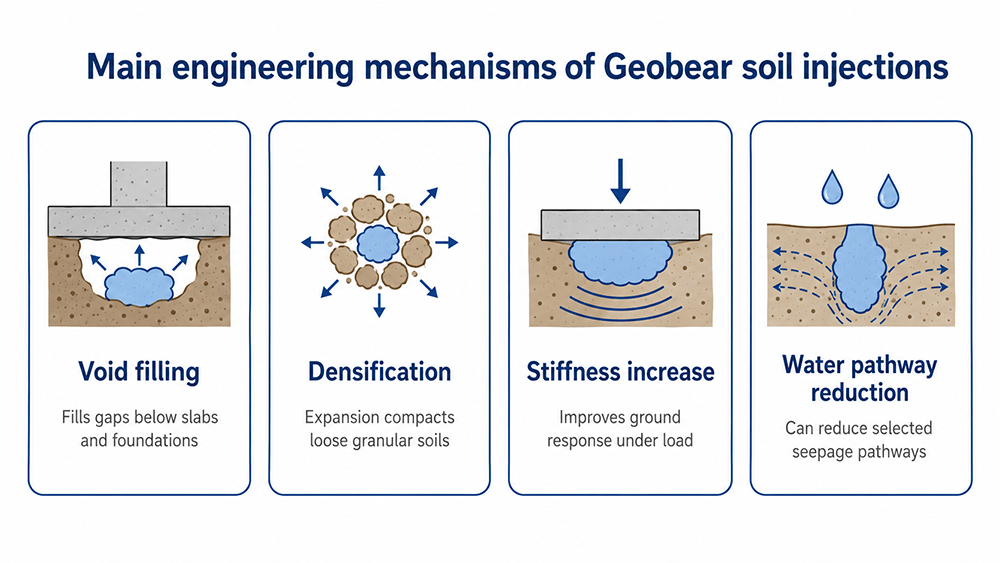
Figure 2. Main engineering mechanisms of Geobear soil injections.
Soil injections for foundation settlement
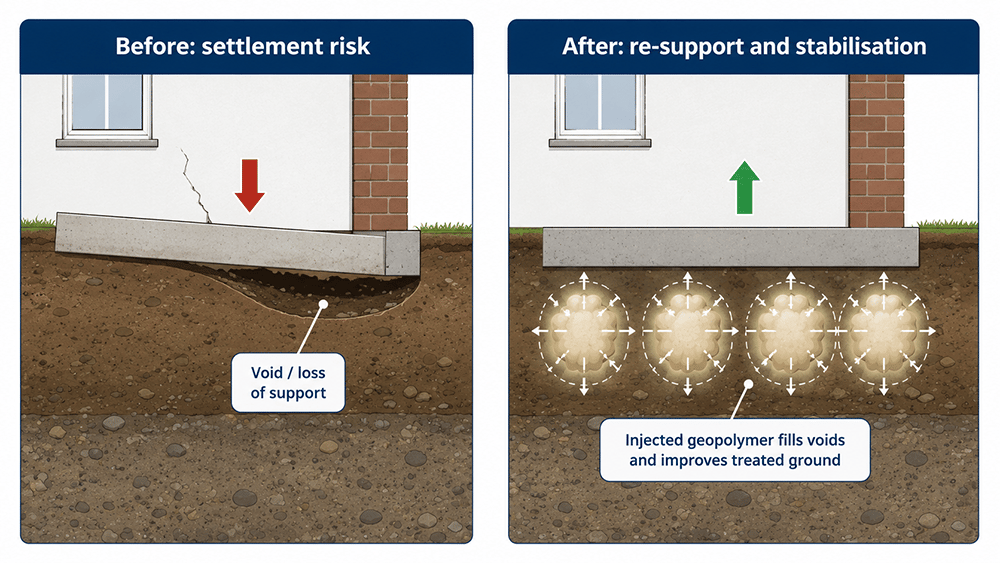
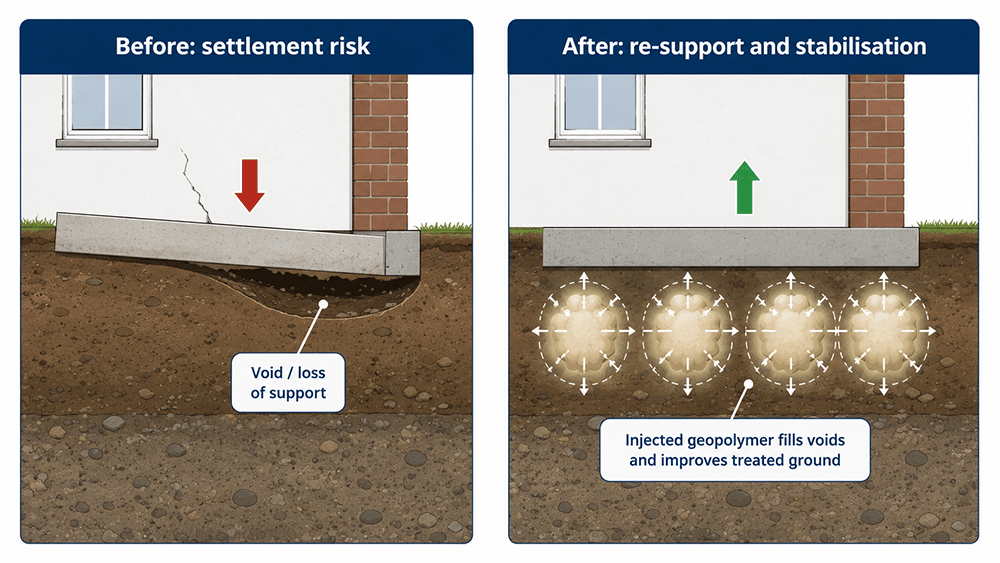
Foundation settlement can happen when the soil beneath a foundation loses strength, becomes loose, is washed away by leaking water, or was poorly compacted during construction. As the ground compresses or erodes, the foundation loses support and the structure above may crack or move.
Geobear’s soil injection method can be used to improve the soil beneath existing foundations without the need for major excavation. The geopolymer is injected below or around the foundation, where it expands and improves the treated ground.
In suitable conditions, this can help stabilize the foundation, reduce ongoing movement and improve the load transfer between the structure and the ground.
Soil injections for slabs and industrial floors
Concrete slabs often settle because of voids, weak fill, poor compaction, water erosion or repeated loading from forklifts, trucks and storage systems.
Common symptoms include hollow-sounding slabs, cracked floor panels, uneven joints, trip hazards, rocking slabs, ponding water and operational issues in warehouses or factories.
Soil injections can be used to fill voids beneath slabs and improve the support conditions below the concrete. In many cases, the work can be completed through small drilled holes, avoiding full slab replacement.
Soil injections for roads, pavements and infrastructure
Roads and pavements can suffer from settlement, depressions, voids and weak subgrade conditions. These problems are often caused by poor compaction, water ingress, erosion, leaking services or repeated traffic loading.
Geobear’s soil injection solution can be used to improve weak ground beneath pavements and infrastructure assets with limited excavation. The rapid reaction of the geopolymer means that treated areas can often be returned to service quickly compared with traditional reconstruction methods.
Soil injections compared with traditional ground improvement
Traditional ground improvement methods such as excavation and replacement, piling, underpinning, jet grouting or cement grouting can be effective, but they are not always practical for existing buildings or live sites.
Soil injections can offer minimal excavation, fast installation, low disruption, lightweight material, targeted treatment and verification through suitable pre- and post-treatment testing.
| Method | Typical strength | Practical limitation / note |
| Excavation and replacement | Direct removal of weak soil | Very disruptive; often impractical below live structures |
| Piling / underpinning | Transfers load to deeper competent strata | Higher disruption, cost and access constraints |
| Cementitious grouting | Can fill voids and improve ground | Heavier material; longer curing; access and spoil issues |
| Geobear soil injections | Fast, targeted, low-excavation treatment | Requires site-specific engineering assessment and verification |
Is soil injection suitable for every soil?
No. Soil injections are powerful, but they are not magic. The design must consider the soil type, groundwater conditions, foundation load, treatment depth, access restrictions and required performance improvement.
In granular soils, expanding geopolymer injections can improve performance mainly through densification, void filling, stress increase and stiffness improvement. In cohesive soils, the mechanism can be different and may involve controlled fracturing, local displacement, composite behavior and improvement in strength or stiffness depending on the soil condition and injection design.
This is why proper engineering assessment is essential. The correct injection strategy must be selected for the actual ground conditions, not guessed.
Why choose Geobear for soil injections?
Geobear specialises in geopolymer soil injection solutions for ground improvement, settlement control, slab lifting, void filling and foundation support.
Our approach combines engineering-led design, specialist geopolymer materials, controlled injection methods, fast installation, minimal disruption and pre- and post-treatment verification where required.
The result is a modern ground improvement solution that can often avoid the cost, disruption and delay associated with traditional excavation-based repairs.
Common applications of Geobear soil injections
- Settled foundations
- Weak ground beneath existing buildings
- Slab settlement
- Void filling below concrete floors
- Warehouse floor repairs
- Road and pavement settlement
- Water erosion-related ground loss
- Poorly compacted fill
- Infrastructure ground improvement
- Re-supporting assets where excavation is difficult
- Improving bearing capacity below shallow foundations
Soil injections: a practical solution for existing assets
When ground problems occur below an existing structure, the challenge is not only technical. It is also operational.
Excavation may not be possible. Piling may be too disruptive. Full replacement may be too expensive. Access may be limited. The building, road or facility may need to remain operational.
This is where soil injections can provide real value. Geobear’s geopolymer injection method allows weak or unstable ground to be treated directly, quickly and with minimal disruption. For many settlement, voiding and weak ground problems, it provides a practical alternative to traditional repair methods.
Learn more
Soil injections for villas and residential properties
Soil injection solutions for property and community managers