Challenge
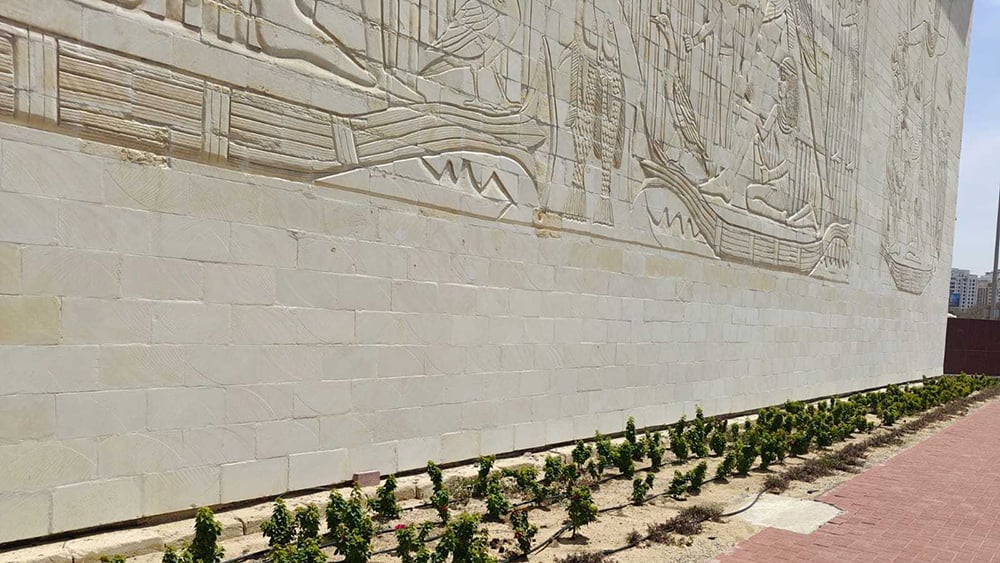
A 6-meter high, 42-meter long boundary wall at Wafi Mall was suffering from settlement (up to 30mm) and tilting. Historical rain events had caused soil erosion and voids, threatening the structure's stability.
Solution
Geobear utilized advanced geopolymer injection to fill voids and densify the loose soil to a depth of 1.5 meters. The solution restored bearing capacity and stabilized the wall without excavation or disrupting the busy Sheikh Rashid Road area.
Increase in allowable bearing capacity (from 253 kPa to 1056 kPa)
Time on-site to complete the injections
Length of the boundary wall treated
Excavation required near the busy roadway
The boundary wall of Wafi Mall in Dubai is a significant structure (6m high) located between the mall and the busy Sheikh Rashid Road. The asset management team identified structural damage, including cracks and deviations in vertical alignment. An investigation attributed the issue to soil instability and erosion caused by historical rain events, which had compromised the shallow beam foundation.
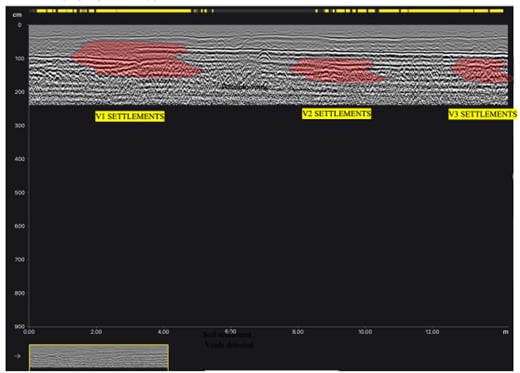
A Ground Penetrating Radar (GPR) survey revealed the extent of the subsurface problem: significant voids and loose soil layers were detected beneath the foundation beam extending to a depth of 1.5 meters.
The loose soil had a low bearing capacity, leading to differential settlement of 20mm to 30mm. Without intervention, the tilting would worsen, potentially leading to structural failure. Traditional underpinning was not a viable option due to the disruption it would cause to the mall's operations and the adjacent highway.

Pre injection GPR scanning (showing hyperbolic reflector features)
The execution involved:
1. Drilling: installing 12mm diameter tubes at 39 targeted injection points along the wall.
2. Injection: injecting a high-density geopolymer resin into the loose sand and voided areas.
3. Densification: the resin expanded, filling the erosion voids and compacting the surrounding soil to increase its stiffness and friction angle.
Geobear’s engineering team used PLAXIS 3D Finite Element analysis to model the ground conditions and design the solution. The analysis determined that treating the top 1.5m of soil was necessary to limit settlement.
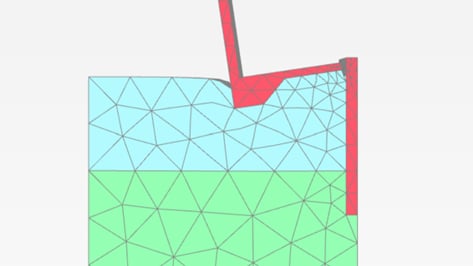
Modelled wall tilt for current condition (loose soil)
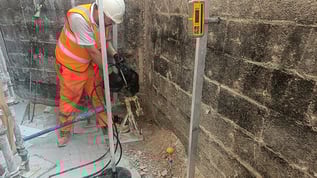
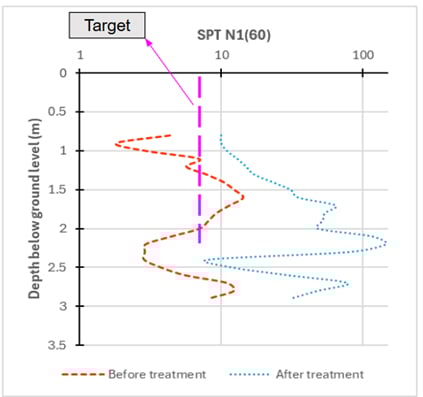
Pre and post injection dynamic probing results
The project was completed in just one week. Post-treatment validation was rigorous:
Dynamic probing: Results showed a significant increase in the N1(60) value, exceeding the design target.
Bearing capacity: Calculations confirmed an increase in allowable bearing capacity from 253 kPa to 1056 kPa, providing a robust factor of safety for the wall.
Stability: The soil was successfully consolidated, mitigating further settlement and restoring the structural integrity of the wall with zero operational disruption.
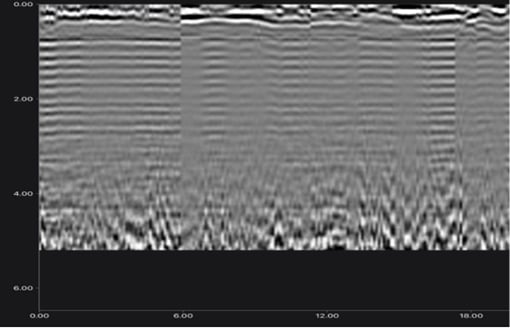
Post injection GPR scanning (showing no hyperbolic reflector features)
| Before Treatment | After Treatment |
|---|---|
| Formula: qult = c Nc sc + q Nq + 0.5 γe B Nγ sγ | |
| qult = (0.00)(53.61)(1.00) + (15.20)(37.44) + (0.5)(19.00)(0.60)(33.12)(1.00) | qult = (0.00)(134.58)(1.00) + (15.20)(126.50) + (0.5)(19.00)(0.60)(218.66)(1.00) |
| qult = 758 kPa | qult = 3169 kPa |
| qall – st = qult / FSst qall – st = 758 / 3 |
qall – st = qult / FSst qall – st = 3169 / 3 |
| qall – st = 253 kPa | qall – st = 1056 kPa |
Learn more about how our solutions strengthen foundations for walls, gates, and perimeter security assets without excavation.