The construction of an extension to a school in Ajman city, United Arab Emirates, included a shallow excavation supported by a king post shoring wall. The excavation ran alongside an existing building founded on a raft foundation.
During installation of the king post wall, a localised soil collapse occurred next to the existing building. Soil was lost from beneath the edge of the raft foundation, leaving a void between the underside of the raft and the ground behind the shoring line.
Geobear's client, Splash Building Contracting LLC, commissioned Geobear to fill the void beneath the raft foundation and compact the disturbed soil around it, so that support to the existing building was re-established.
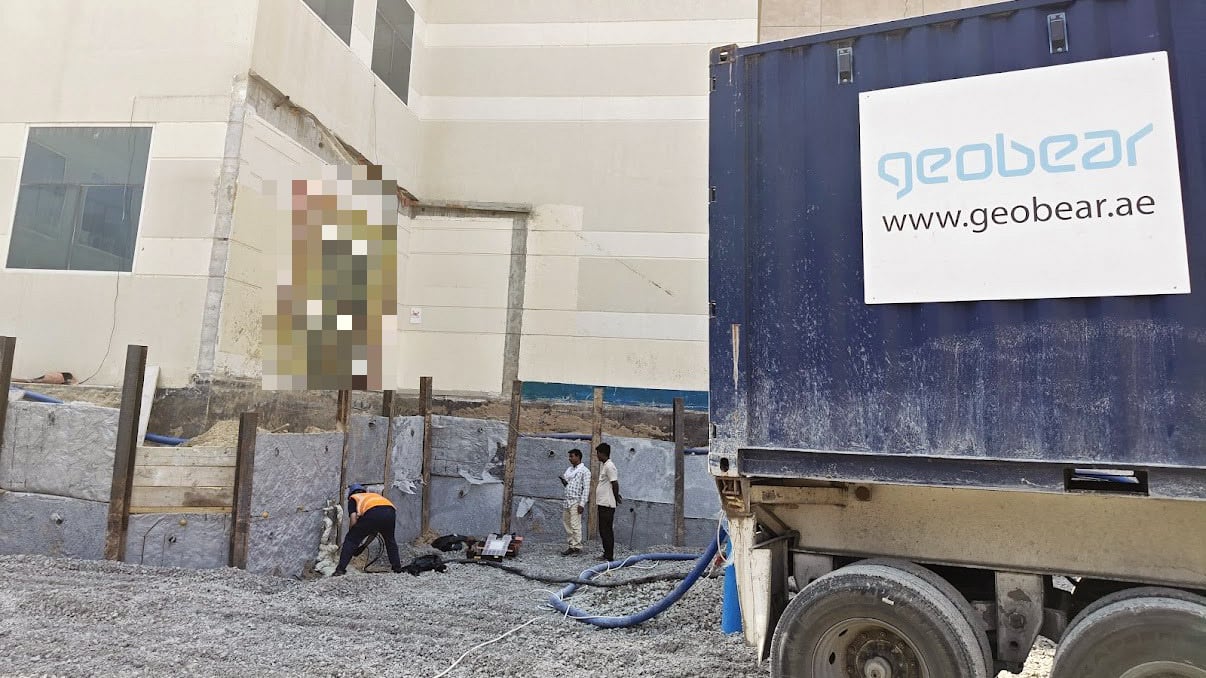
Geobear's injection rig on site beside the shoring line, with the existing building behind.
The engineering problem at the Ajman school extension was loss of support beneath a raft foundation that was carrying an existing building. The project completion report confirms the cause: a localised soil collapse during installation of the shallow king post shoring wall. The voided area extended for up to 4 m along the foundation, and Geobear's treatment drawing indicates a gap of 100–150 mm between the underside of the raft and the remaining soil.
Two conditions needed treating. The first was the open void, which left that length of the raft edge without ground support. The second was the soil beneath and around the void, which the collapse had loosened. Filling the void alone would have left disturbed ground directly below the foundation.
Site conditions shaped the method. The void sat behind the shoring line, beside an open excavation, and Geobear's site-specific risk assessment recorded poor and uneven ground in the work area. The treatment also had to avoid moving the existing structure. Material injected beneath a raft can lift it, so the building needed monitoring throughout the works.
The extent of the voiding behind the shoring could only be estimated before treatment. Geobear's design was based on an estimated material quantity, and the method had to allow both the quantity and the number of injection points to change on site. No ground investigation data, settlement measurements or crack surveys form part of the project record, and the completion report does not record any damage to the existing building.
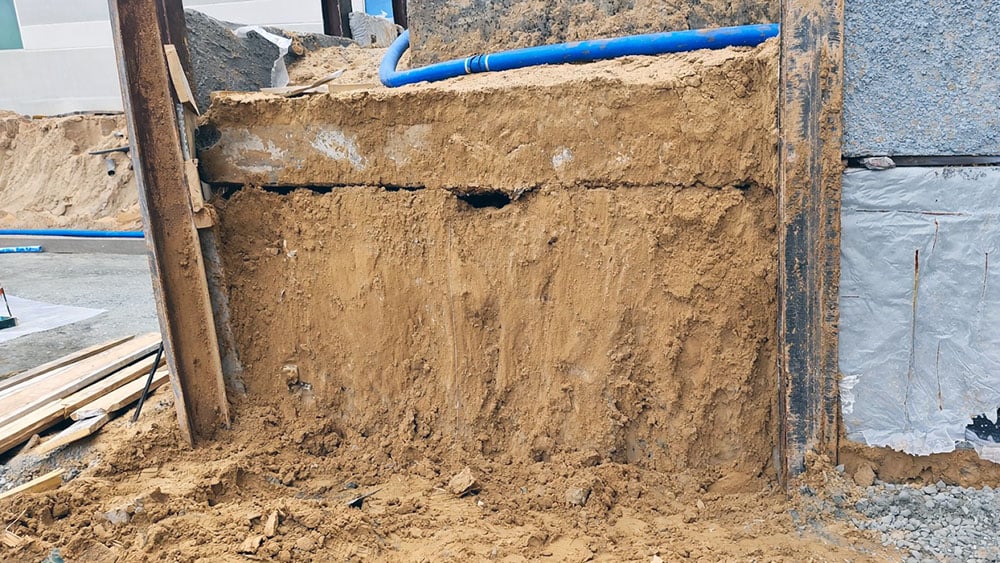
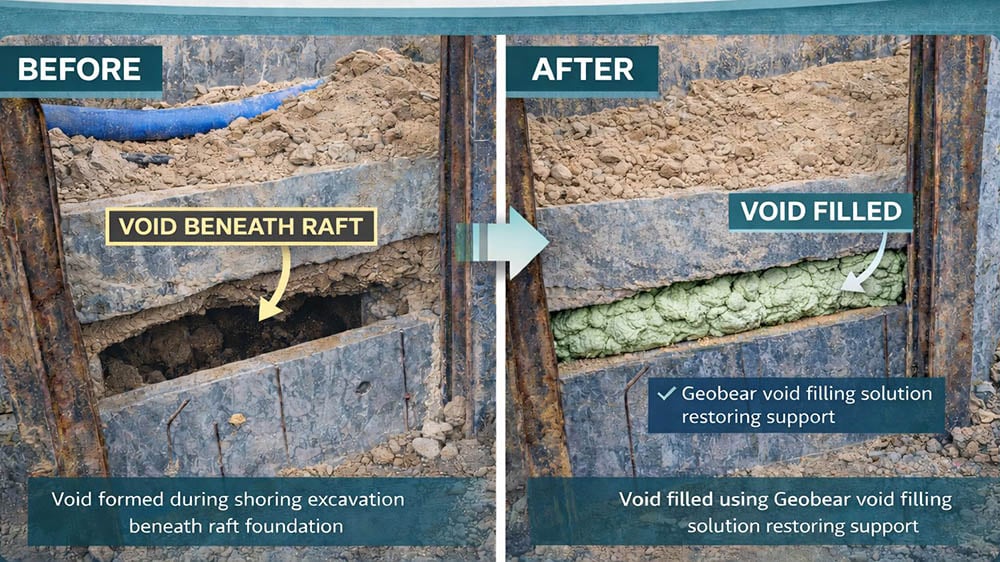
Before treatment: the gap beneath the raft foundation, seen from the excavation face between two king posts.
Geobear designed a void filling solution for the raft foundation at the Ajman school extension using targeted geopolymer injection at two levels: directly beneath the underside of the raft to fill the void, and at a lower level to compact the loosened soil below it.
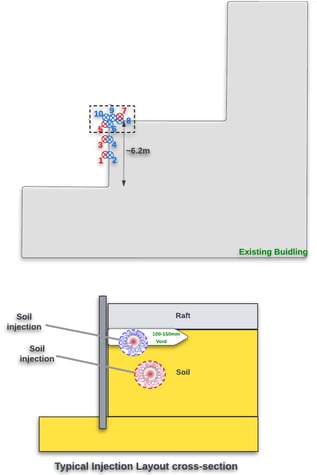
Injection layout: injection points along the voided section of the raft foundation (plan, top) and the two injection levels beneath the raft (typical cross-section, bottom).
Geobear carried out the work on 15 and 16 March 2026. After mobilisation and a safety briefing, the crew confirmed the treatment zone against the collapse area and set out the injection points to the approved layout. The crew drilled access holes through the exposed foundation and wall face, installed injection tubes to the target levels, and injected the geopolymer point by point in sequence. The quantity at each point was adjusted in real time to the ground response.
Injection at each point continued until refusal indicators appeared: geopolymer returning from adjacent holes, or controlled breakout at the ground surface.
Both show that interconnected voids were full.
Geobear monitored the structure continuously during injection, and the injection logs record no adverse laser or structural reaction.
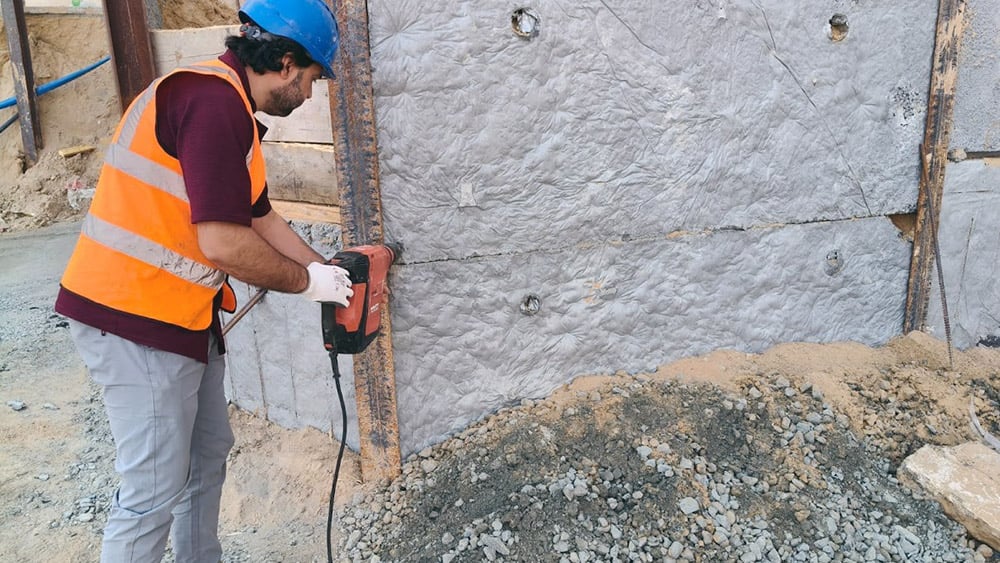
Drilling access holes through the exposed foundation face.
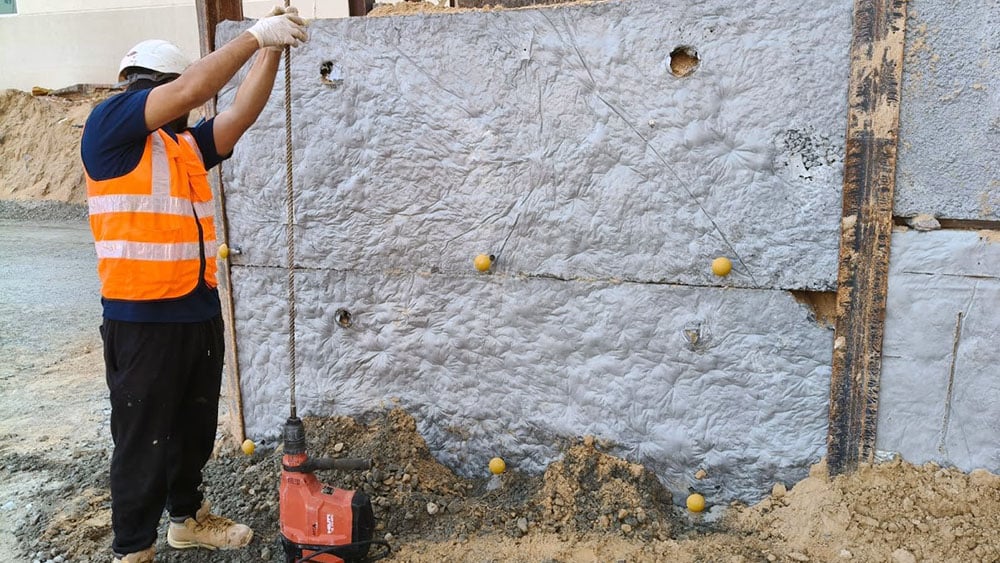
Installing injection tubes at the target levels.
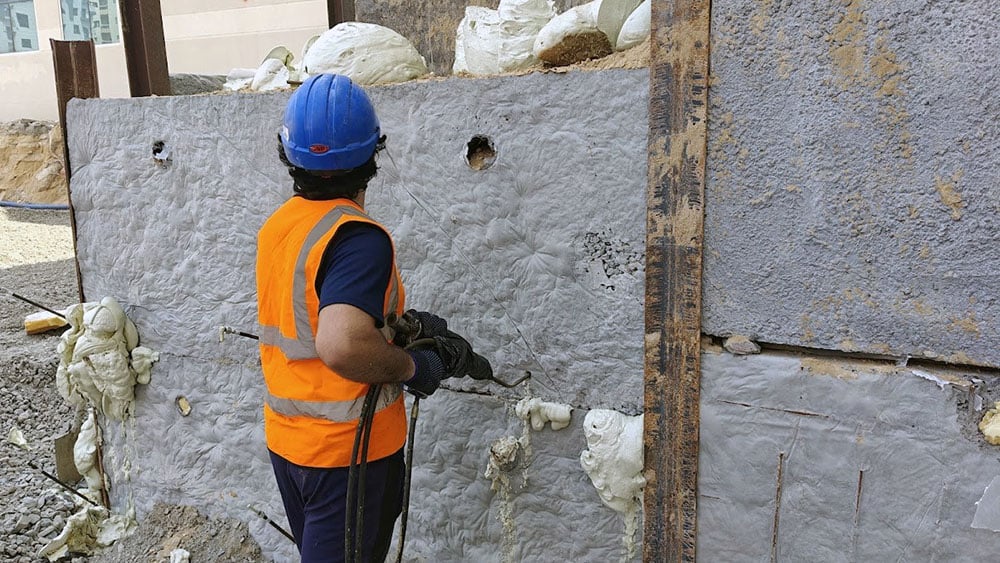
Injection in progress, with geopolymer returning from adjacent holes.
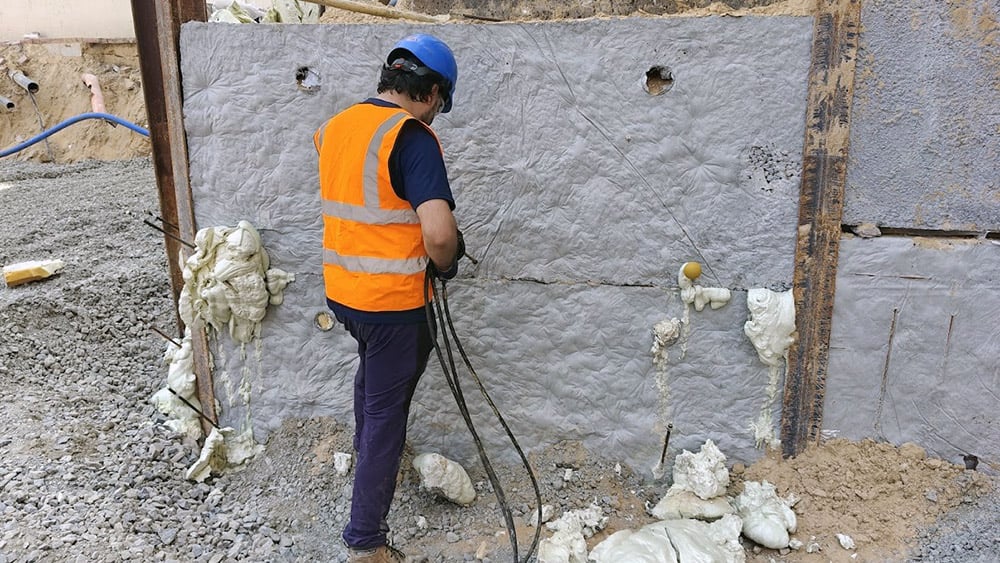
Geopolymer breakout at the face, a refusal indicator that the void is full.
Verification on this project was by observation, not by ground testing. After treatment, a section of plywood was temporarily removed from the shoring so that the underside of the raft foundation could be inspected.
The inspection confirmed that the void had been adequately filled. No penetrometer, plate load or level survey data was collected, so the result is reported as a confirmed void fill and not as a measured increase in bearing capacity.
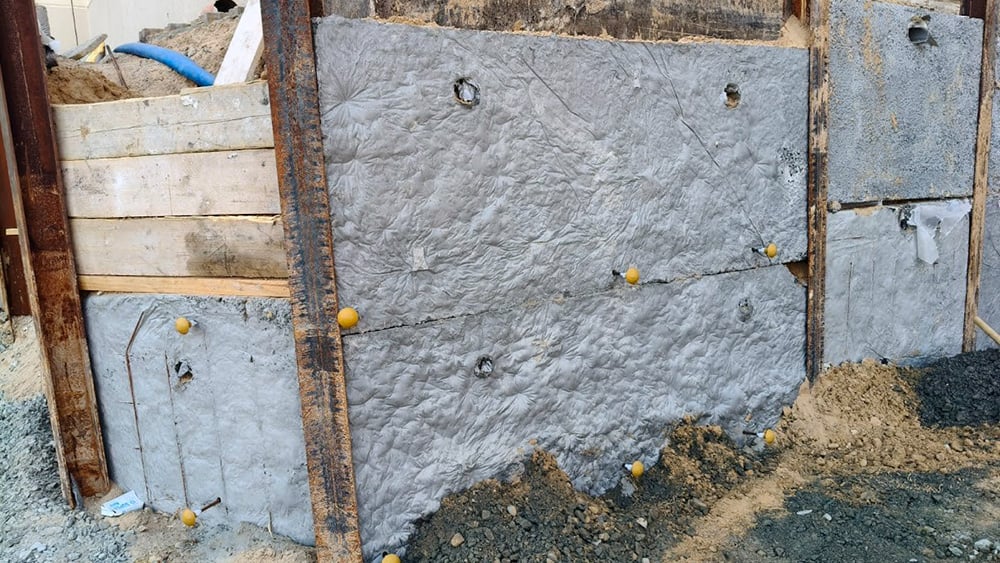
Completed injection points sealed across the treated face.
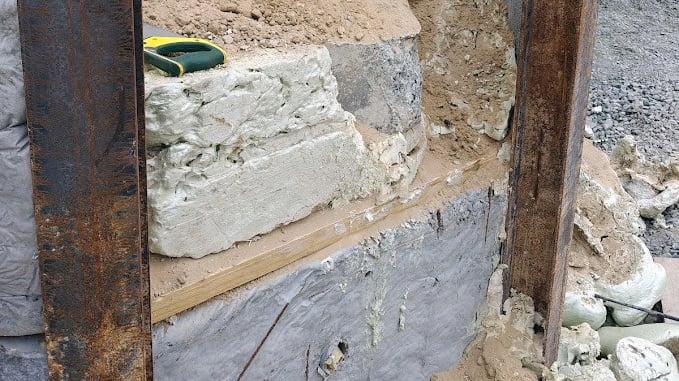
After treatment: cured geopolymer beneath the raft, exposed for inspection.
Don't let unstable ground put your business at risk. Our commercial team can provide a clear assessment and a fast, effective solution tailored to your operational needs.