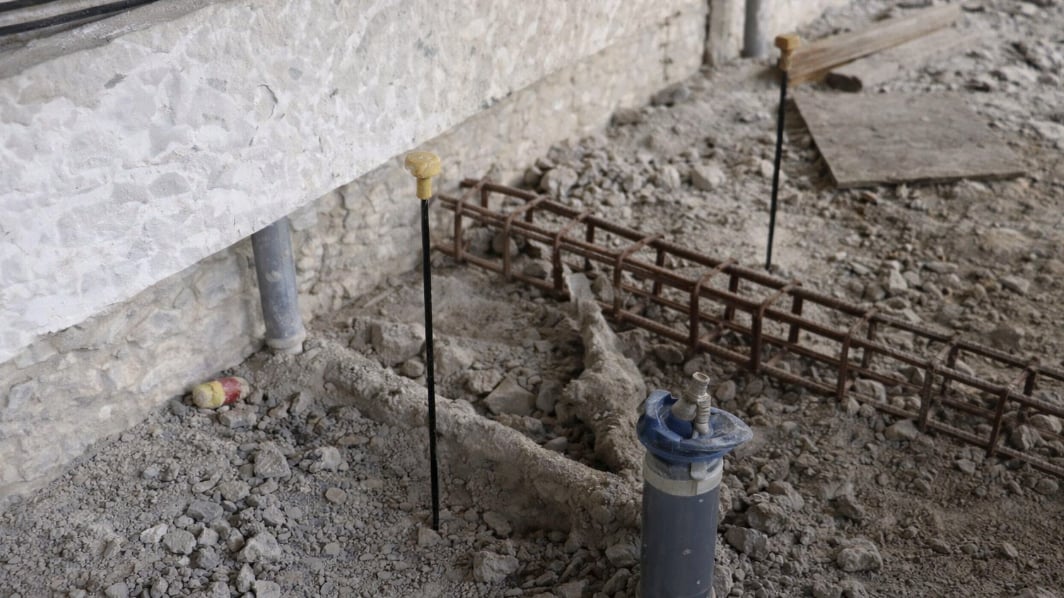
A labour accommodation facility in Jebel Ali, Dubai experienced severe differential settlement affecting multiple pad foundations, leading to visible structural damage and serviceability concerns.
The issue was traced to subsurface weakening caused by water leakage from a nearby tank, which altered soil conditions beneath the structure.
Geobear was appointed to stabilize the foundations using its geopolymer injection solution, providing a fast, non-disruptive alternative to conventional underpinning.
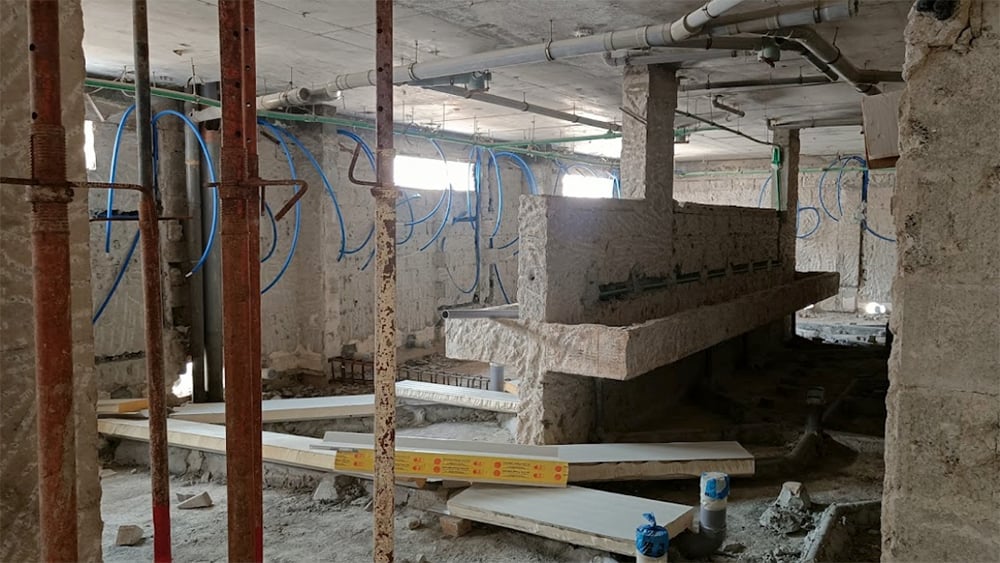
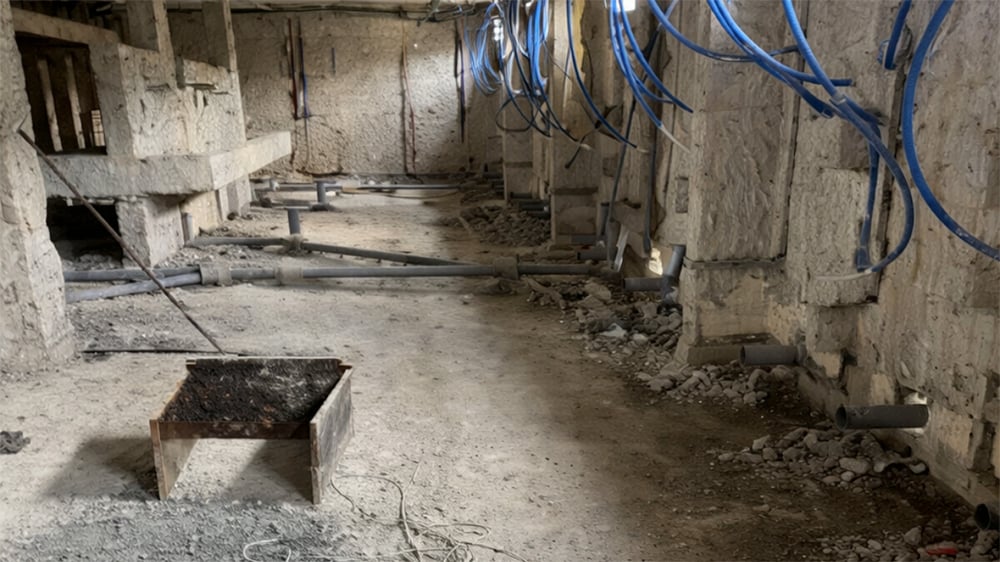
Severe differential settlement
Root cause
Water leakage led to:
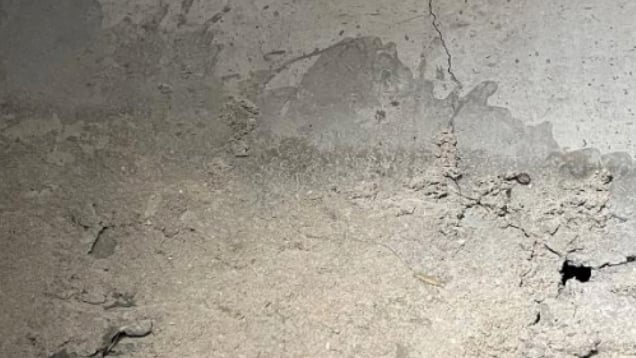
Observed damage
Signs of ground instability around footings
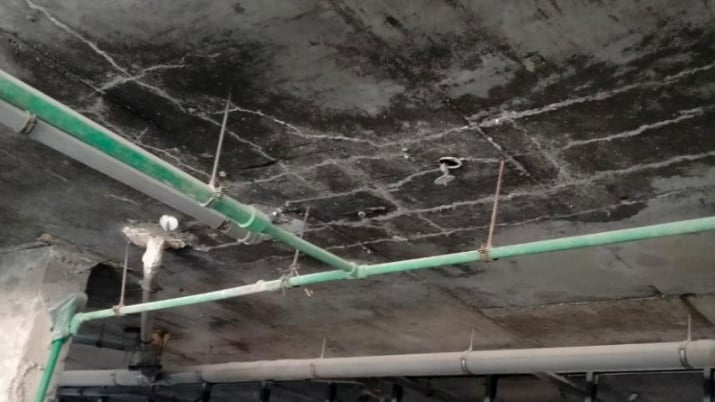
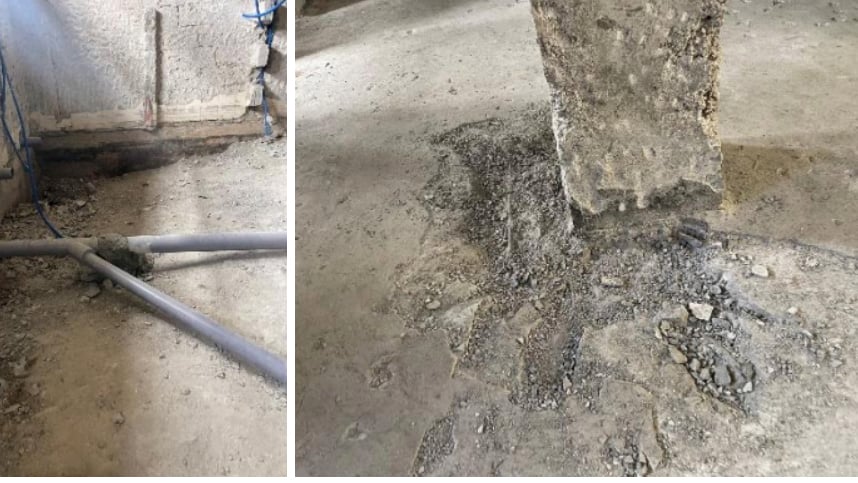
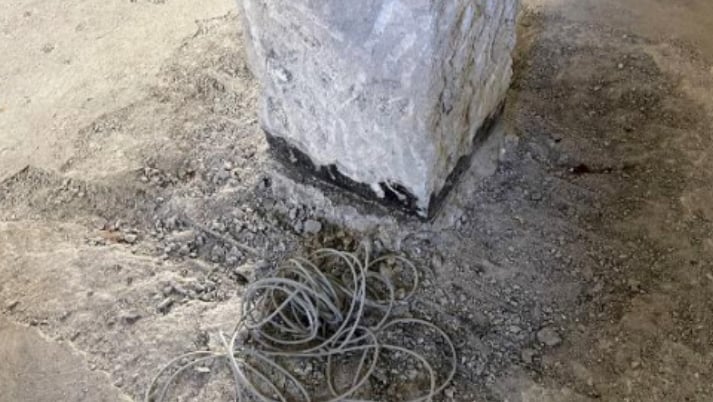
Geotechnical testing (DCPT)
Very low resistance at foundation depth:
Equivalent SPT N60 ≈ 2 – 11 (loose soil condition)
%20findings.png?width=893&height=659&name=UAE%20Jebel%20Ali%20Geotechnical%20Testing%20(DCPT)%20findings.png)
Geophysical survey (MASW)
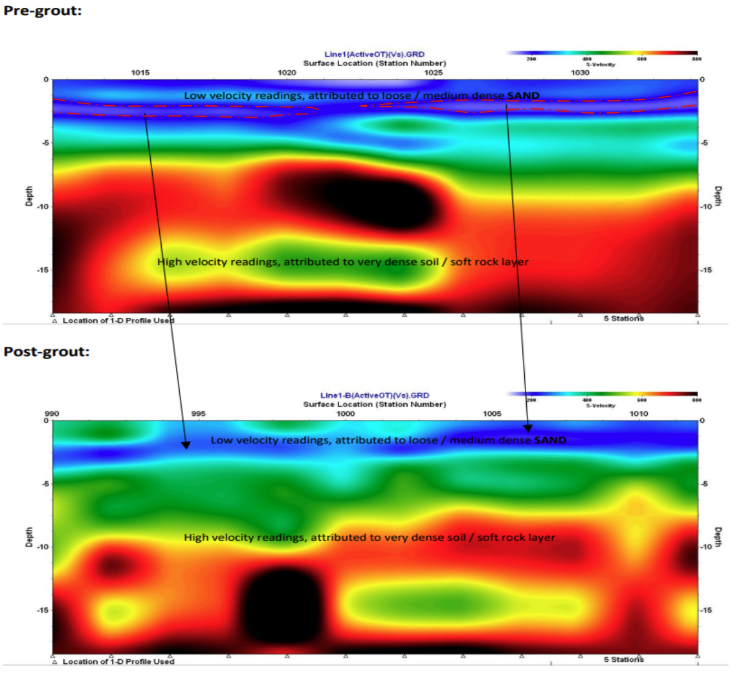
Identified a weak layer between 1.5 m and 2.5 m depth
Shear wave velocity:
129–300 m/s (low stiffness zone)
The structure was founded on loose to medium sand weakened by water ingress.
Competent strata existed below ~4 m depth, confirming a localized problem.
Geobear implemented a targeted ground improvement program using expanding geopolymer material.
Execution approach
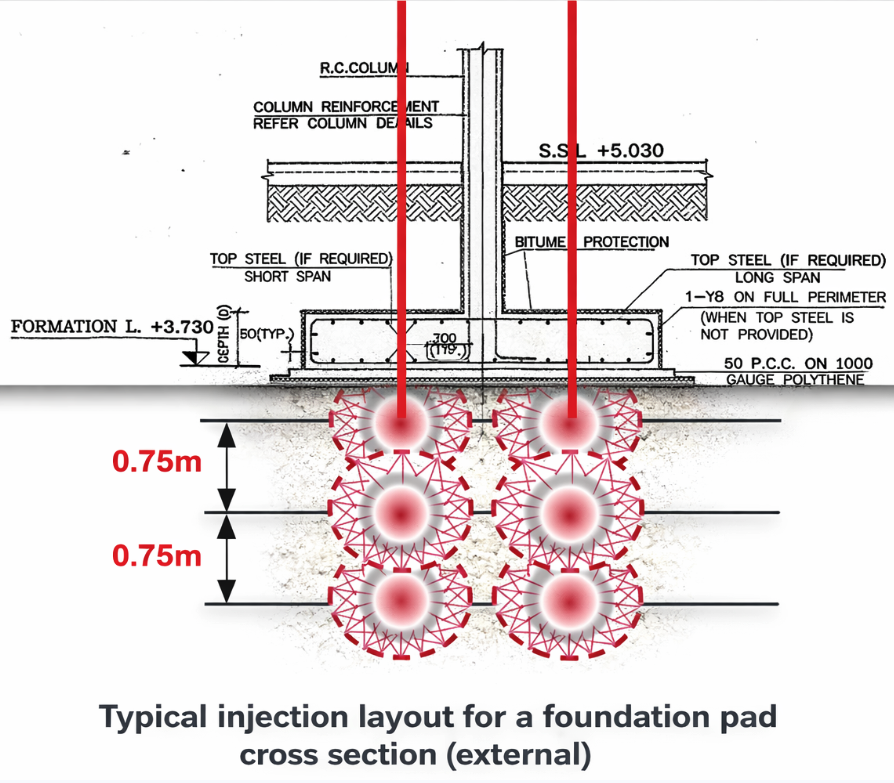
Method advantages
Mechanism
The geopolymer:
Increases:
Pre and Post injections DCPT testing and MASW survey were carried out to verify the effectiveness of the treatment
Test 1 results
82 kPa → 309 kPa (~3.8× increase)
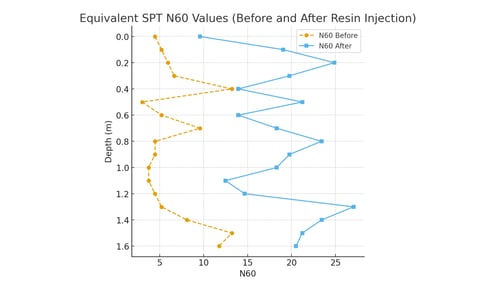
Results
| Condition | Average N60 | ϕ (deg) | q_ult (kPa) | q_allow (kPa) |
|---|---|---|---|---|
| Before Injection | ≈4.77 | ≈21.3 | ≈246 | ≈82 |
| After Injection | ≈18.38 | ≈30.9 | ≈927 | ≈309 |
A MASW survey was carried out to assess ground stiffness before and after treatment. Results identified a low-velocity zone at 1.5–2.5 m depth (Vs ≈ 129–300 m/s), corresponding to weak, moisture-affected soils responsible for the observed settlement.
Following Geobear’s Geopolymer Injection, a clear increase in shear wave velocity was recorded within the same depth range, confirming improved soil stiffness, density, and continuity.
Deeper layers (>4 m) remained consistently dense and unaffected, confirming that the issue was localized and successfully targeted.
Overall, the MASW results independently verify that the treatment eliminated the weak zone and restored ground stiffness beneath the foundations.
The treatment achieved:
This directly translated into:
Treatment zone: 1.5 m - 3.5 m depth | Method: S-wave velocity (Vs) comparison, MASW
Summary metrics — treatment zone (1.5-3.5 m)
| Pre-grout avg Vs | Post-grout avg Vs | Avg Vs gain | Shear modulus gain |
|---|---|---|---|
| ~133 m/s | ~233 m/s | +100 m/s | ~3.1x |
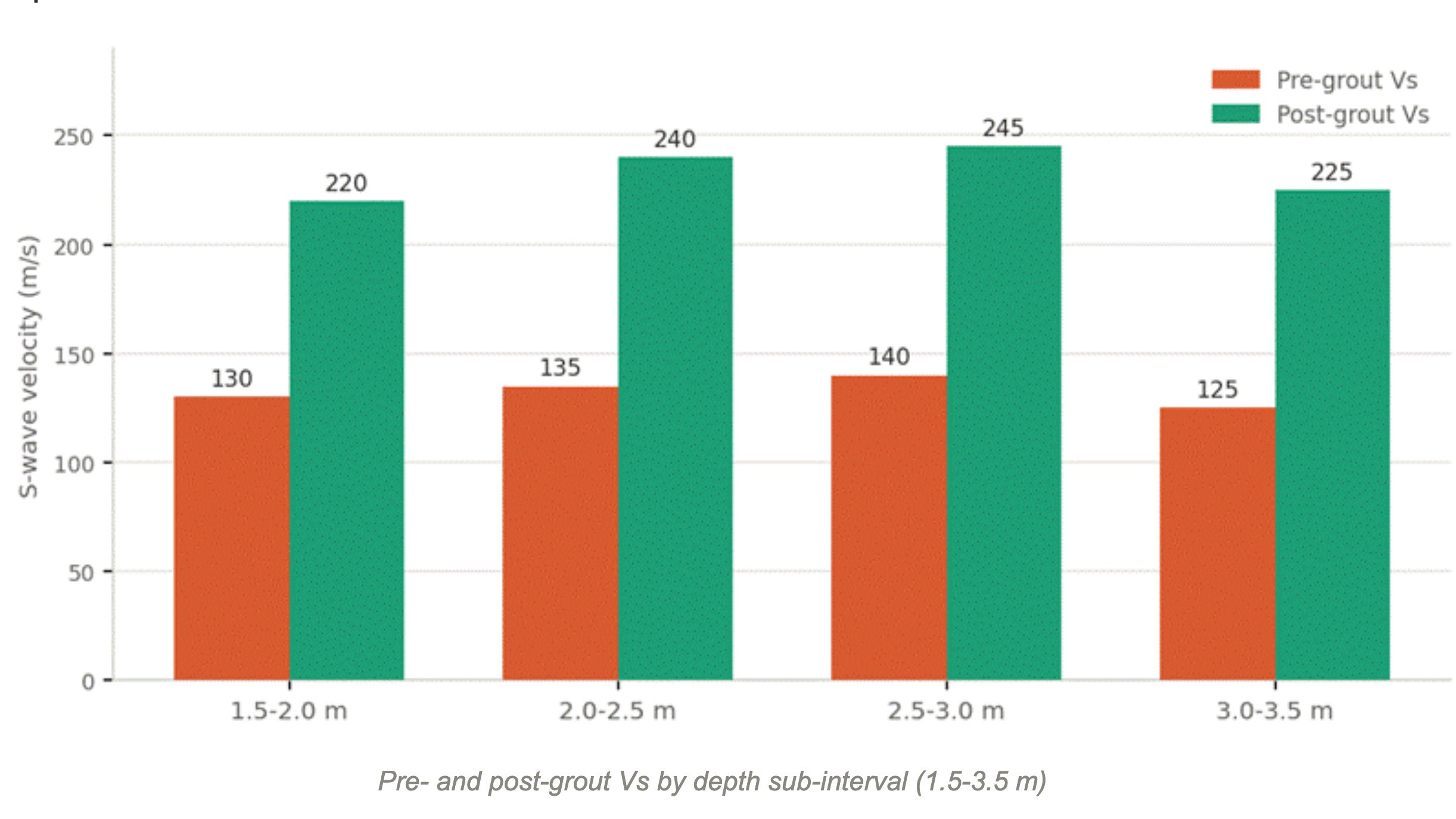
Pre- and post-grout shear wave velocity at 0.5 m sub-intervals across the treatment window. Post-grout values consistently exceed 200 m/s throughout, confirming effective ground improvement.
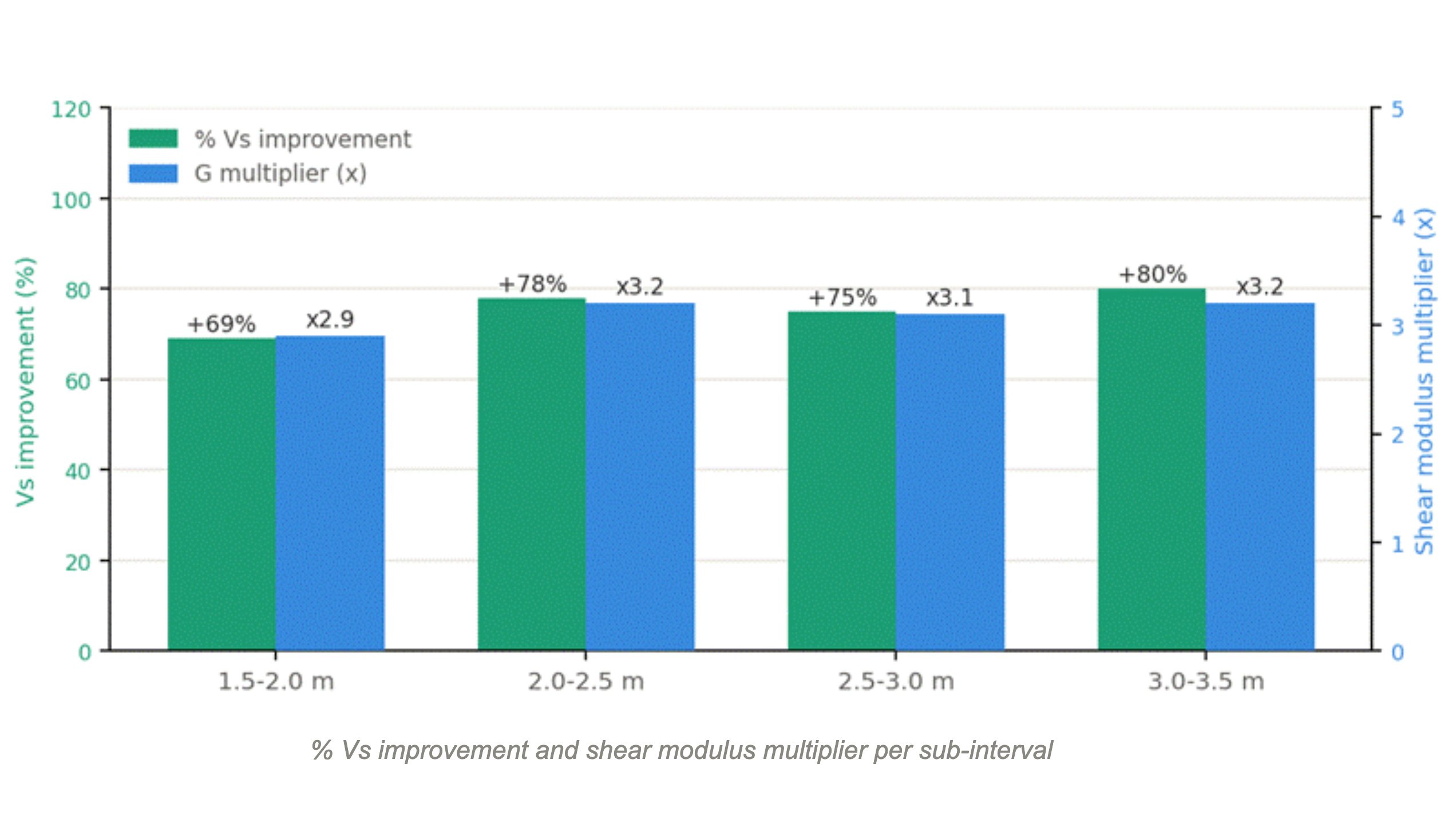
Vs improvement ranges from +69% to +80% across the zone. Since shear modulus G is proportional to Vs², the corresponding stiffness gain (G multiplier) ranges from 2.9x to 3.2x, indicating substantial densification.
| Sub-interval | Pre-grout Vs | Post-grout Vs | Vs gain (%) | G multiplier |
|---|---|---|---|---|
| 1.5 - 2.0 m | ~130 m/s | ~220 m/s | +69% | x2.9 |
| 2.0 - 2.5 m | ~135 m/s | ~240 m/s | +78% | x3.2 |
| 2.5 - 3.0 m | ~140 m/s | ~245 m/s | +75% | x3.1 |
| 3.0 - 3.5 m | ~125 m/s | ~225 m/s | +80% | x3.2 |
| Zone average | ~133 m/s | ~233 m/s | +75% | x3.1 |
The core of the treatment zone (1.5.0-3.5 m) exhibits the strongest response (69-80% Vs), consistent with grouting and lateral confinement being most effective at depth.
Post-grout Vs values of 220-245 m/s place the treated material firmly in the medium-dense to dense sand range. The shear modulus improvement of approximately 3.1x across the treatment zone is consistent with successful permeation or compaction grouting.
Don't let unstable ground put your business at risk. Our commercial team can provide a clear assessment and a fast, effective solution tailored to your operational needs.