Mini piling - at a glance:
|
Typical applications |
Extensions, commercial buildings, rail, industrial |
|
Suitable for |
Weak ground and restricted access sites |
|
Typical installation |
Steel piles with grout or concrete |
|
Alternative solution |
Geopolymer ground improvement (where appropriate) |
What is mini piling?
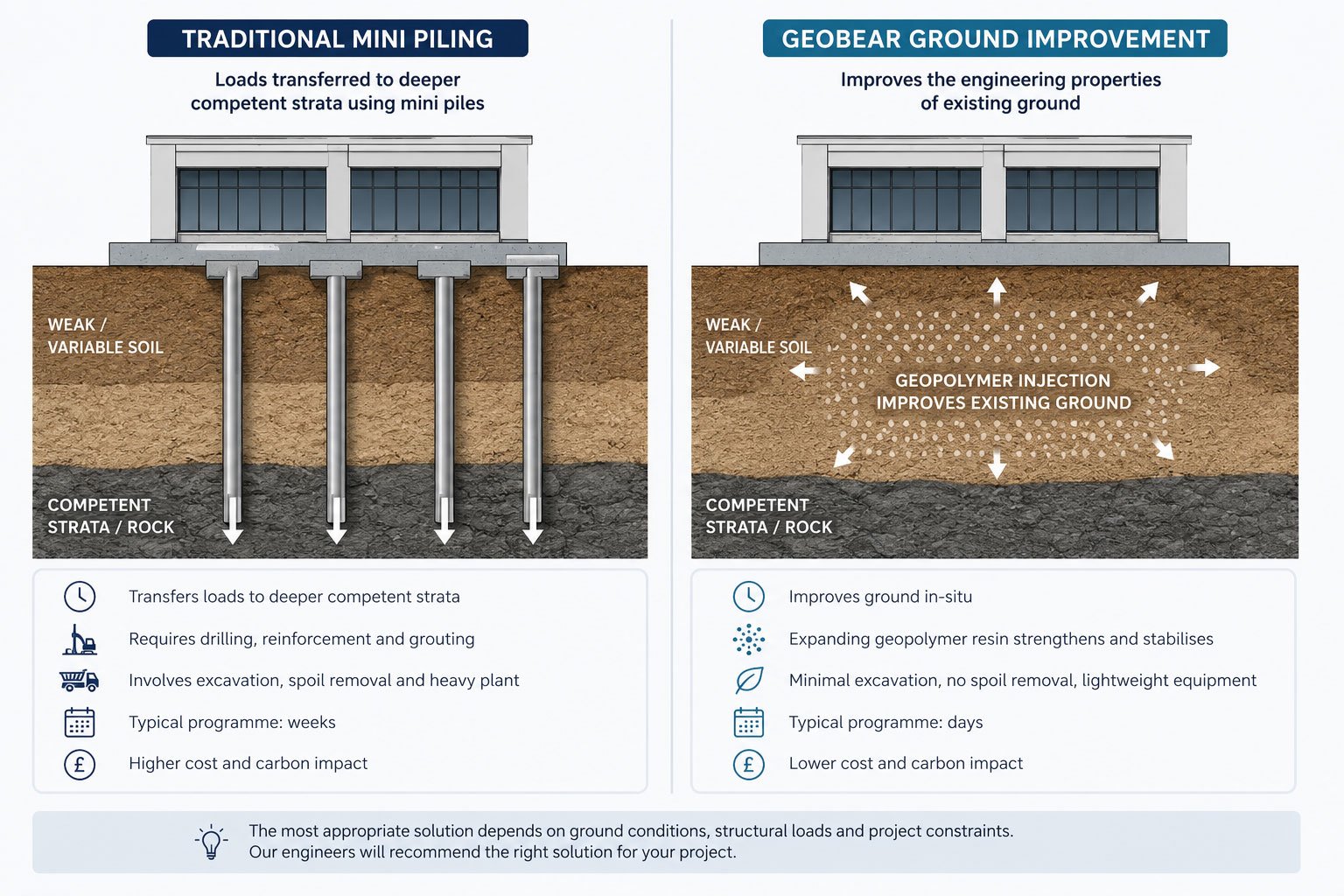
Mini piling, also known as micro piling, is a specialist foundation technique that uses small-diameter steel piles, typically installed with grout or concrete, to transfer structural loads through weak ground into stronger bearing strata.
Unlike conventional piling, mini piling rigs are designed for restricted access sites where larger equipment cannot operate.
Mini piling is commonly used for:
- Foundation underpinning
- Building extensions
- Existing buildings experiencing settlement
- Rail infrastructure
- Commercial developments
- Industrial buildings
- Bridges
- Confined access locations
Although highly effective, mini piling is not always the most appropriate solution. Where the objective is to improve the engineering properties of existing ground rather than transfer loads to deeper strata, ground improvement techniques such as geopolymer injection may provide a faster and less disruptive alternative.
How does mini piling work?
Mini piling transfers structural loads from existing or proposed foundations into stronger soil or rock at depth.
The typical process involves:
- Drilling or driving small-diameter piles.
- Installing reinforcement or steel casing where required.
- Grouting or concreting the pile.
- Connecting piles to the existing foundation using pile caps or beams.
- Transferring structural loads onto the new piles.
The method is particularly suited where shallow foundations cannot safely support structural loads.
Where is mini piling used?
Mini piling is widely specified across the construction and infrastructure sectors.
Typical applications include:
- Commercial buildings
- Warehouses
- Rail infrastructure
- Airports
- Bridges
- Residential extensions
- Historic buildings
- Restricted access projects
- Structures affected by settlement
How much does mini piling cost?
The cost of mini piling varies considerably depending on:
- Number of piles required
- Diameter of piles
- Installation depth
- Ground conditions
- Site access
- Structural loading
- Temporary works
- Reinforcement requirements
While individual piles can cost from approximately £2000–£4000 per pile, the overall project cost also includes mobilisation, excavation, spoil removal, concrete, reinforcement, testing and reinstatement. Costs vary significantly depending on project complexity.
Advantages of mini piling
Mini piling offers several engineering benefits:
- Suitable for restricted access sites.
- High load-bearing capacity.
- Proven engineering solution.
- Suitable beneath existing structures.
- Can reach competent strata at significant depth.
- Well suited where additional structural loads are being introduced.
Limitations of mini piling
Mini piling is not always the most efficient solution.
Potential limitations include:
- Specialist drilling equipment required.
- Spoil removal.
- Concrete and grout curing.
- Longer construction programmes.
- Larger site compounds.
- Noise and vibration.
- Greater reinstatement works.
- Higher embodied carbon than some ground improvement techniques.
These limitations do not make mini piling unsuitable, but they should be considered alongside alternative engineering solutions.
When is geopolymer injection a better alternative?
Geobear's geopolymer injection does not replace mini piling in every situation.
However, where the objective is to strengthen existing ground rather than transfer loads to deep bearing strata, geopolymer injection can often achieve the required engineering performance with significantly less disruption.
The Geobear geopolymer approach is particularly beneficial in the following situations:
- where access is difficult
- where contamination of water courses may occur due to cement / spoil wash out
- working around critical underground assets
- working in very close proximity to assets
- working where large plant can't access site
Typical applications include:
- Improving bearing capacity.
- Treating loose granular soils.
- Filling underground voids.
- Correcting settlement.
- Re-levelling foundations.
- Slab stabilisation.
- Extending asset life.
Projects can often be completed in days rather than weeks, with no excavation and minimal disruption to ongoing operations.
Mini piling vs geopolymer injection
| Comparison | Mini piling | Geobear geopolymer injection |
|---|---|---|
| How it works | Small-diameter piles transfer structural loads through weaker soils to stronger bearing strata at depth | Expanding geopolymer is injected to improve the engineering properties of the existing ground |
| Load support | Transfers loads to deeper competent ground | Improves the ground supporting the existing foundation or structure |
| Equipment | Specialist piling rigs, drilling equipment and associated plant | Compact injection equipment |
| Excavation | Excavation and foundation connection works may be required | Minimal excavation |
| Site access | Mini rigs can work in restricted areas but require sufficient piling access | Compact equipment allows treatment in highly restricted locations |
| Spoil | Drilling and piling can generate spoil requiring removal | Very little spoil generated |
| Noise and disruption | Drilling, construction and foundation works can affect site operations | Low-disruption installation can often be completed while assets remain operational |
| Programme | Depending on scale and complexity, works can take weeks | Many projects can be completed in days |
| Typical applications | New structural loads, underpinning and situations requiring deep load transfer | Settlement correction, bearing capacity improvement, foundation support and ground improvement |
| Best suited to | Projects where structural loads must be transferred to competent strata at depth | Projects where improving the existing ground can achieve the required engineering performance |
case study
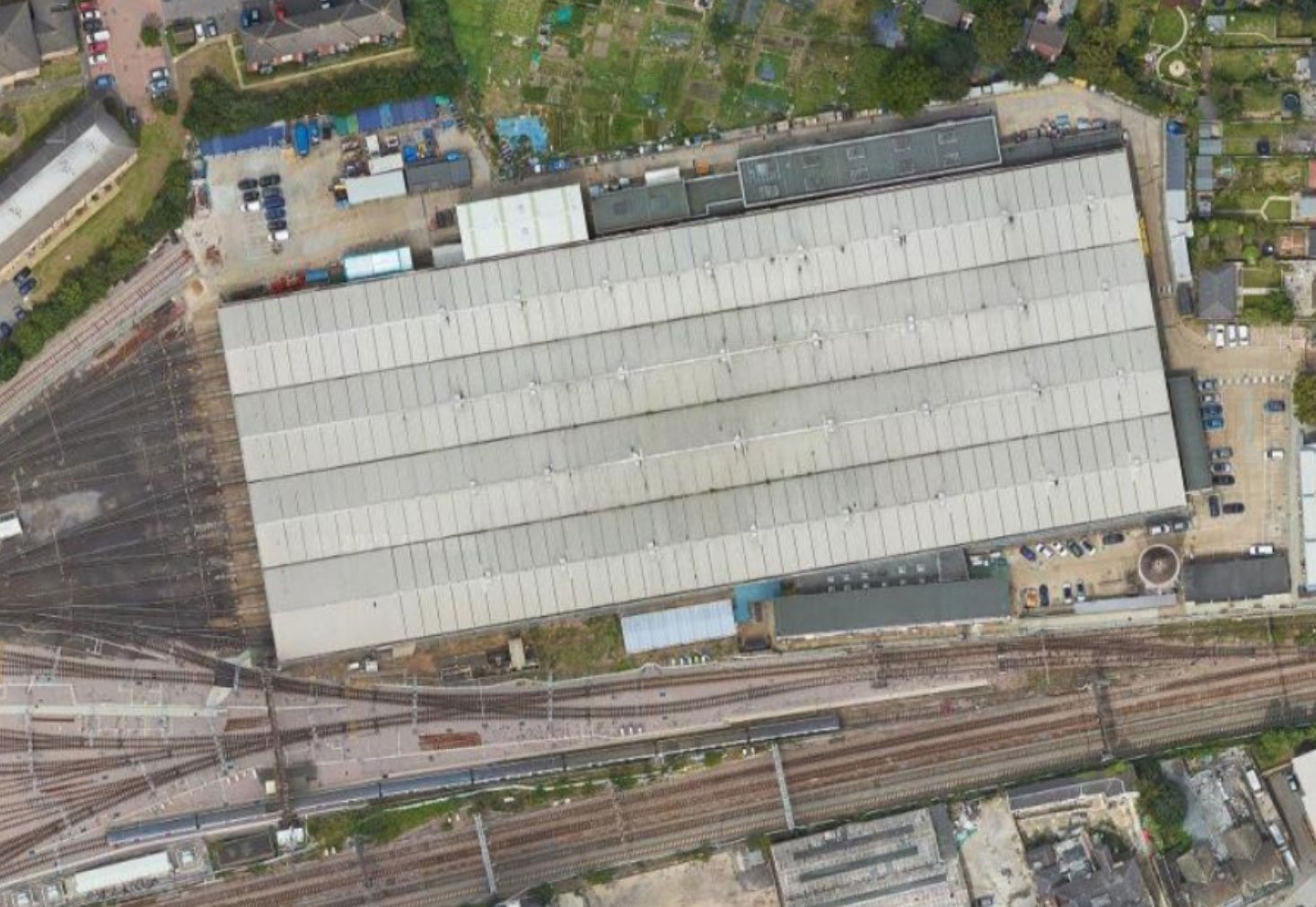
Mini piling avoided at Ilford Rail Depot
During the redevelopment of Ilford Rail Depot, conventional mini piling was initially considered to strengthen new foundations.Following engineering assessment, Geobear's geopolymer solution was selected to improve bearing capacity beneath 19 foundation pads and 168 metres of strip foundations.The required 350 kPa bearing capacity was achieved within a 10-day programme, compared with an estimated six-week mini piling programme. Performance was independently verified using pre- and post-treatment plate load testing.