What is jet grouting?
Jet grouting is an advanced ground improvement technique that uses high-pressure jets of grout, water or air to break up and mix the existing soil, creating engineered soil-cement columns or panels.
The resulting material has significantly improved strength, stiffness and reduced permeability compared with the original ground.
Jet grouting is commonly used where conventional excavation or foundation replacement is impractical, or where existing structures must remain supported during construction.
How does jet grouting work?
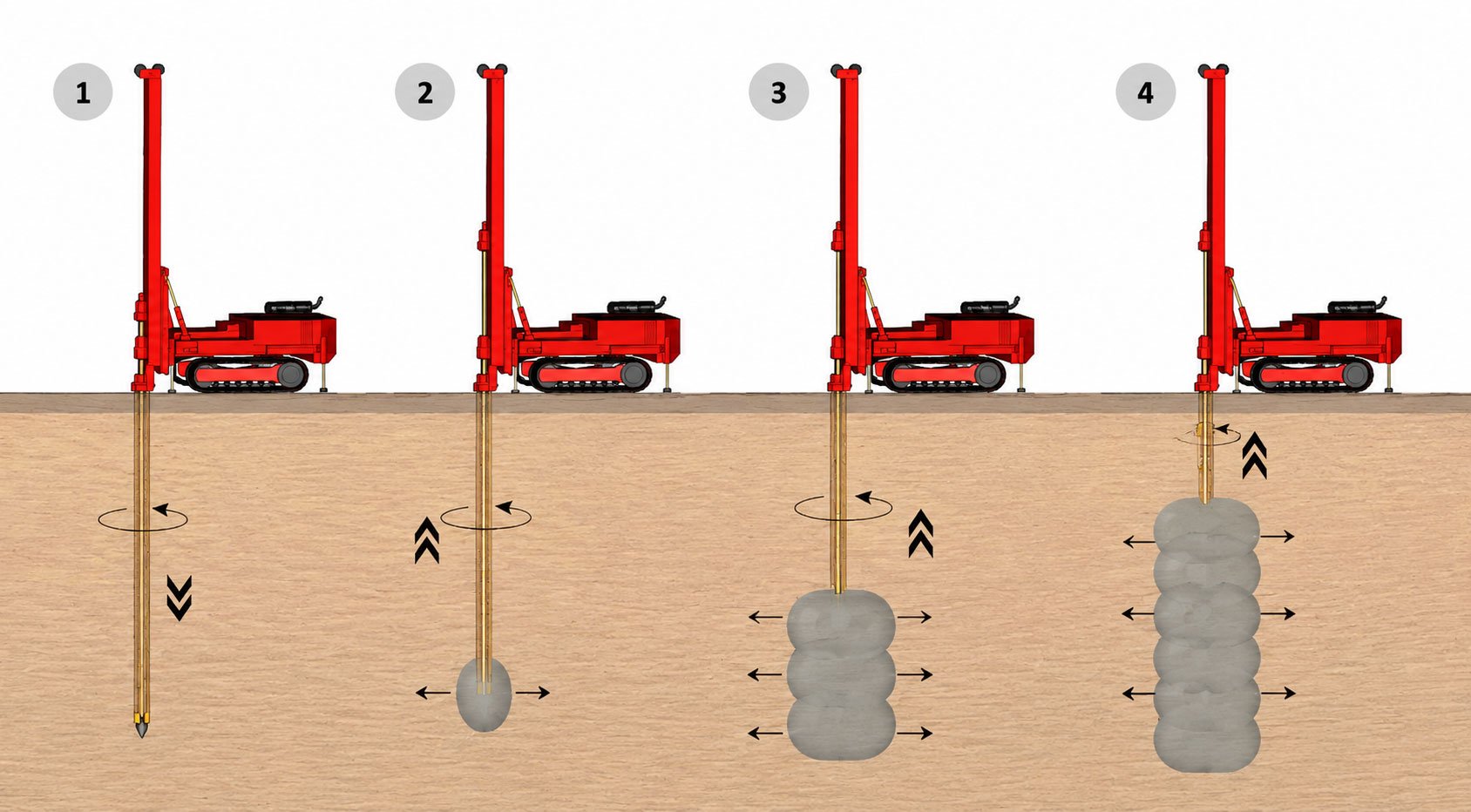
Jet grouting follows a controlled construction process:
- A small diameter borehole is drilled to the design depth.
- A specialised monitor is inserted into the ground.
- Cement grout is injected at extremely high pressure.
- The jet erodes and mixes the surrounding soil.
- The monitor is slowly withdrawn while rotating.
- A continuous soil-cement column is formed.
- The treated ground cures to achieve the required engineering properties.
The size of each column depends on the soil type, grout pressure and withdrawal rate.
When should jet grouting be specified?
Jet grouting remains one of the most versatile ground improvement techniques where deep treatment, groundwater control or structural soil-cement columns are required.
- Foundation strengthening
- Underpinning existing structures
- Tunnel construction
- Basement excavation support
- Bridge foundations
- Rail infrastructure
- Groundwater cut-off walls
- Deep excavations
- Brownfield redevelopment
- Soft ground improvement
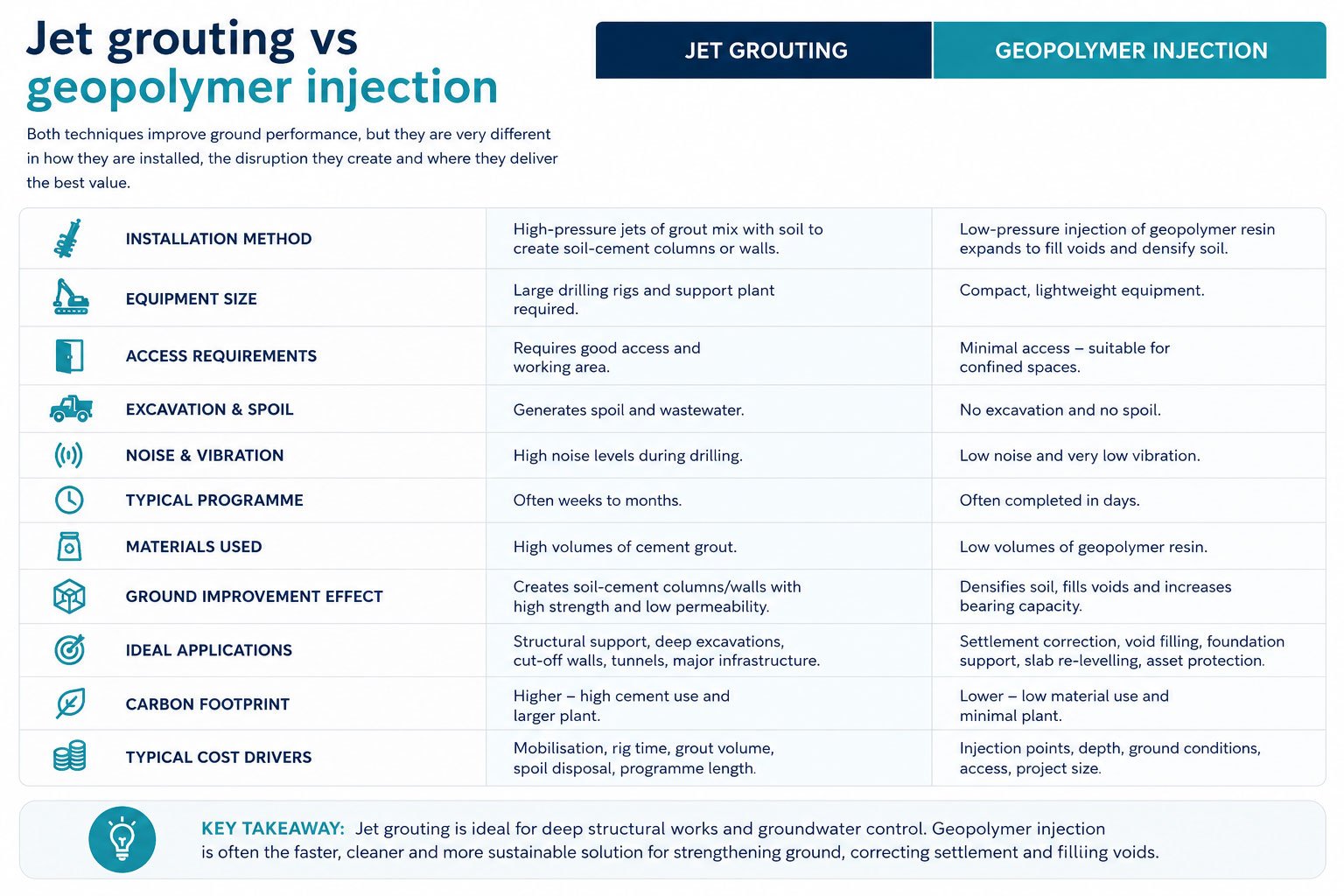
However, where the objective is settlement correction, bearing capacity improvement or slab re-levelling, geopolymer injection may provide a faster and less disruptive alternative.
How much does jet grouting cost?
The cost of jet grouting varies significantly depending on project requirements.
Typical factors include:
- Treatment depth
- Column diameter
- Number of columns
- Soil conditions
- Grout consumption
- Site access
- Specialist drilling rigs
- Mobilisation and demobilisation
- Testing and verification
Jet grouting projects typically involve specialist plant, highly trained operators and significant mobilisation costs, making them most suitable for larger or technically complex projects.
Advantages of jet grouting
Jet grouting provides several engineering advantages:
- Suitable beneath existing structures
- Can improve many soil types
- High strength soil-cement columns
- Can reduce groundwater permeability
- Suitable for restricted access projects
- Flexible treatment geometry
- Effective for difficult ground conditions
Limitations of jet grouting
Jet grouting is not appropriate for every project.
Potential limitations include:
- Specialist drilling rigs required
- High mobilisation costs
- Spoil generation
- Noise during drilling
- Grout handling and storage
- Longer construction programmes
- Significant temporary works
- High cement consumption
These factors should be considered alongside alternative ground improvement methods during the design process.
When is geopolymer injection a better alternative?
Jet grouting remains an excellent engineering solution where deep ground treatment, structural soil-cement columns or groundwater control are required.
However, where the objective is to strengthen existing ground, increase bearing capacity or correct settlement without major construction works, geopolymer injection can often provide a faster and less disruptive alternative.
Geobear's solution is commonly used for:
- Correcting differential settlement
- Increasing bearing capacity
- Filling underground voids
- Re-levelling slabs
- Strengthening weak soils
- Supporting existing foundations
- Extending the life of existing assets
Many projects can be completed within days using compact equipment and without excavation.
Related ground improvement methods
Frequently asked questions
No.
Jet grouting creates engineered soil-cement columns by mixing grout with the existing soil using high-pressure jets. Compaction grouting injects a stiff grout that displaces and densifies surrounding soils without mixing them.
Yes.
Jet grouting is commonly used beneath existing structures for underpinning, foundation strengthening and excavation support.
In some situations.
Where the objective is settlement correction or bearing capacity improvement rather than constructing structural soil-cement columns or groundwater barriers, geopolymer injection may provide a faster and less disruptive solution.
This helps with topical authority and creates a natural internal link to your future compaction grouting page.
Not sure whether jet grouting is the right solution?
Every project is unique. Our engineers assess your ground conditions, structural loading and operational constraints before recommending the most appropriate ground improvement solution.