What is compaction grouting?
Compaction grouting, also known as low mobility grouting, is a ground improvement technique that strengthens weak soils by injecting a stiff, low-slump grout under pressure.
Unlike permeation or jet grouting, the grout does not mix with the surrounding soil. Instead, it displaces and compacts the existing ground, increasing density and improving its load-bearing capacity.
Compaction grouting is commonly used beneath existing structures to reduce settlement, improve bearing capacity and prepare weak ground for construction.
How does compaction grouting work?
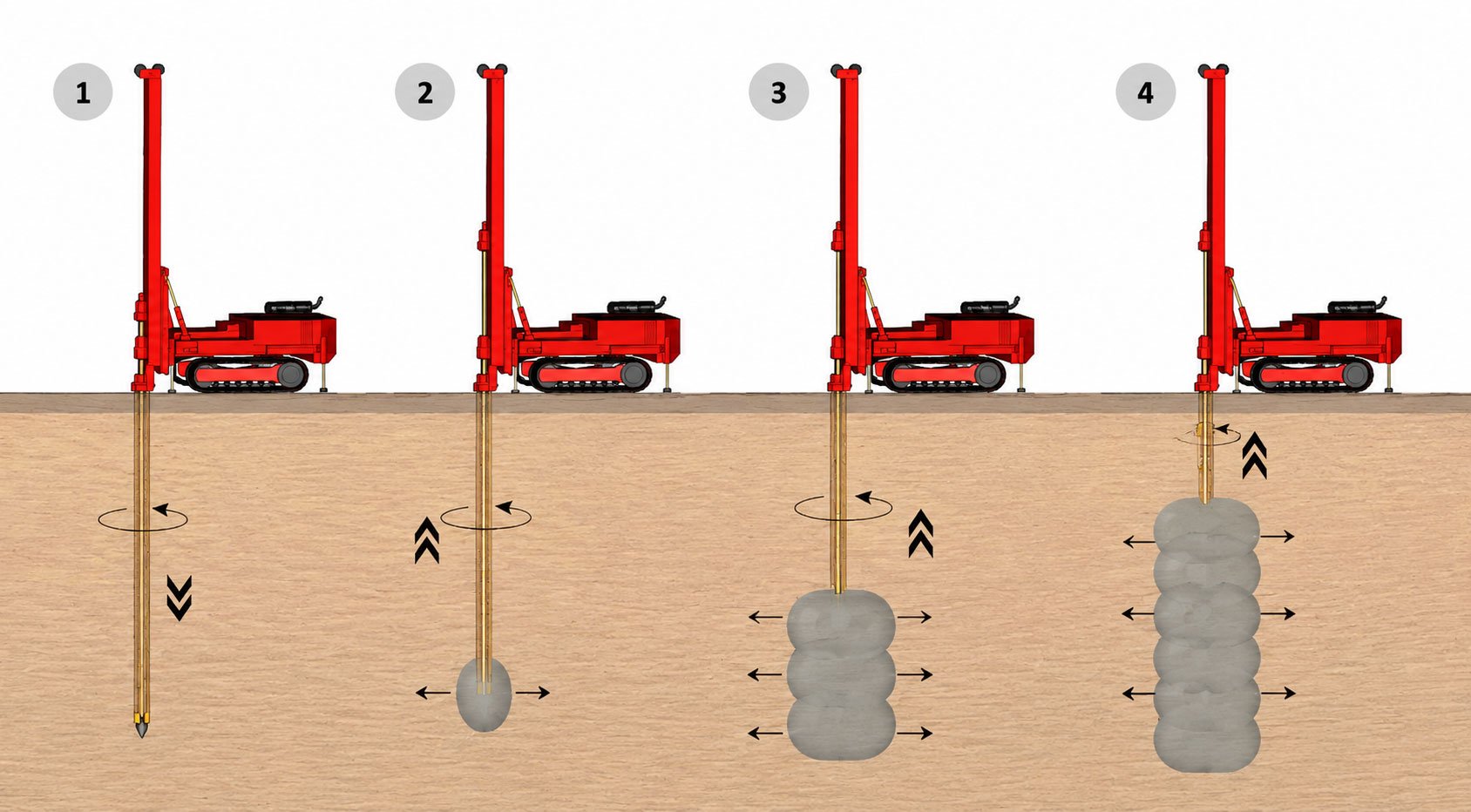
Compaction grouting follows a controlled construction process.
- Small-diameter holes are drilled to the required treatment depth.
- Steel injection pipes are installed.
- A stiff cementitious grout is injected under pressure.
- The grout forms discrete bulbs within the soil.
- Each injection displaces and densifies the surrounding ground.
- The process is repeated in stages until the required ground improvement is achieved.
- Verification testing confirms the engineering performance where required.
The process improves soil density without excavating or replacing the existing ground.
Typical applications for compaction grouting
Compaction grouting is commonly specified for:
- Correcting foundation settlement
- Increasing bearing capacity
- Sinkhole remediation
- Void filling
- Bridge foundations
- Road and highway stabilisation
- Warehouse floors
- Rail infrastructure
- Industrial buildings
- Liquefaction mitigation
Compaction grouting v Geobear geopolymer injection
Both compaction grouting and geopolymer injection can improve weak ground, increase bearing capacity and address settlement. However, the materials, installation process, site requirements and most suitable applications differ.
| Comparison | Compaction grouting | Geobear geopolymer injection |
|---|---|---|
| How it works | Stiff, low-mobility cementitious grout is injected under pressure, displacing and densifying the surrounding soil | Expanding geopolymer is injected into the ground to improve the engineering properties of the existing soil |
| Material | Low-slump cementitious grout | Expanding geopolymer resin |
| Ground improvement effect | Densifies surrounding soil through displacement | Improves ground strength and stiffness through controlled expansion and interaction with the surrounding soil |
| Equipment | Drilling and specialist grout mixing and pumping equipment | Compact drilling and injection equipment |
| Installation | Injection pipes are installed to depth and cementitious grout is injected in controlled stages | Small-diameter injection tubes are installed into the treatment zone and geopolymer is injected in controlled stages |
| Excavation | Generally limited, although grout handling and associated site works are required | Minimal excavation and very little spoil |
| Site access | Requires sufficient access for drilling, grout mixing, pumping and material handling | Compact equipment allows treatment in restricted-access locations |
| Noise and disruption | Drilling, pumping and grout operations can create site disruption | Low-disruption installation suitable for many operational sites |
| Typical programme | Programme depends on treatment depth, grout volumes and project scale | Many suitable projects can be completed in days |
| Settlement correction | Can be used to address settlement through controlled ground densification | Can be used for controlled settlement correction and re-levelling |
| Bearing capacity | Used to densify suitable soils and increase bearing capacity | Used to improve ground performance and bearing capacity beneath existing structures |
| Typical applications | Foundation settlement, ground densification, sinkholes, weak granular soils and liquefaction mitigation | Foundation settlement, slab re-levelling, bearing capacity improvement, void filling and ground improvement |
| Best suited to | Projects requiring significant soil densification using a low-mobility cementitious grout | Projects requiring rapid ground improvement or settlement correction with minimal disruption |
How much does compaction grouting cost?
The cost of compaction grouting depends on several factors.
These include:
- Treatment depth
- Grout volume
- Soil conditions
- Access restrictions
- Number of injection locations
- Verification testing
- Mobilisation
- Project size
Because specialist pumping equipment and cementitious grout are required, larger projects often achieve better economies of scale.
Advantages of compaction grouting
Compaction grouting offers several engineering benefits.
- Increases soil density
- Improves bearing capacity
- Effective beneath existing structures
- Suitable for many granular soils
- Minimal excavation
- Well-established engineering method
- Can treat significant depths
- Suitable for settlement correction
Limitations of compaction grouting
Compaction grouting is not appropriate for every project.
Potential limitations include:
- Cement grout deliveries required
- Longer installation programmes
- Larger plant than resin injection
- Spoil and washout management
- Noise from drilling
- Less effective in some cohesive soils
- Greater site logistics
- Potential heave if not carefully controlled
When is geopolymer injection a better alternative?
Compaction grouting remains an excellent engineering solution where large volumes of ground require densification or where traditional cementitious grouting is preferred.
However, where the objective is to correct settlement, increase bearing capacity or re-level structures with minimal disruption, geopolymer injection can often provide a faster and less invasive solution.
The Geobear geopolymer approach is particularly beneficial in the following situations:
- Where access is difficult
- Where contamination of water courses may occur due to cement / spoil wash out
- Working around critical underground assets
- Working in very close proximity to assets
- Working where large plant can't access site
Geobear's solution is commonly used for:
- Correcting differential settlement
- Increasing bearing capacity
- Filling underground voids
- Re-levelling slabs
- Strengthening weak soils
- Supporting existing foundations
- Extending the life of existing assets
Many projects can be completed within days using compact equipment and without excavation.
Related ground improvement methods
Frequently asked questions
Compaction grouting is different from jet grouting - compaction grouting densifies soil by displacement using a stiff grout. Jet grouting mixes grout with the surrounding soil using high-pressure jets to create structural soil-cement columns.
It can.
If carefully controlled, compaction grouting may produce limited re-levelling while improving bearing capacity. However, excessive injection can cause unwanted heave.
In many situations.
Where the objective is settlement correction, slab lifting or bearing capacity improvement without large-scale cement grouting operations, geopolymer injection may provide a faster and less disruptive alternative.
Not sure whether jet grouting is the right solution?
Every project is unique. Our engineers assess your ground conditions, structural loading and operational constraints before recommending the most appropriate ground improvement solution.