Challenge
Severe differential settlement caused radial cracking and level deviations across the warehouse slab and pad foundations, disrupting safe operational serviceability.
Solution
Geobear delivered targeted ground improvement and controlled re-levelling, restoring slab and pad foundation levels with minimal disruption to warehouse operations.
m2 treated
Settlement present
deviation
A commercial warehouse facility experienced prominent radial cracking and differential settlement of its floor slab and pad foundations along its southern perimeter. The project required a low-disruption solution to improve ground support conditions and re-level both the slab and the structural foundations over an area of 585m². The objective was to reinstate serviceability without major excavation or halting the facility's operations.
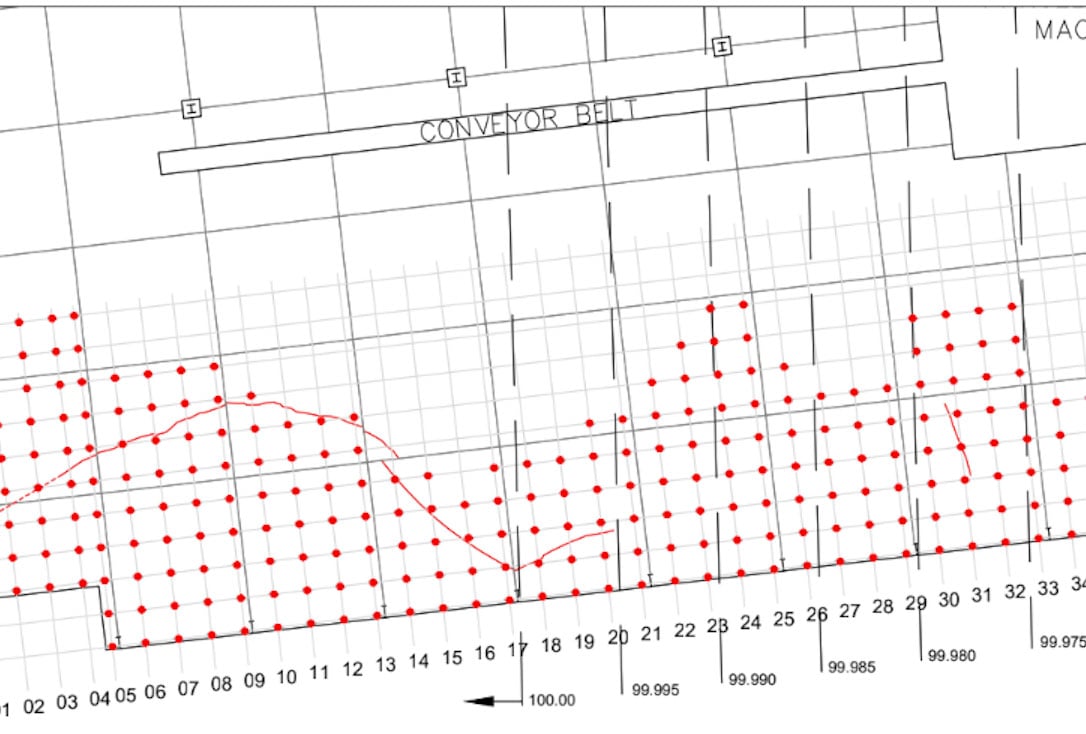
The floor slab had settled significantly, dropping progressively below the inferred original level and reaching severe deviations of approximately 131mm in the most affected areas. Alongside the slab, the pad foundations along the southern boundary had also settled to the same degree, evidenced by the supporting concrete plinths remaining level with the dropped floor slab. This structural movement created uneven surfaces, radial cracking, and serviceability issues that posed a risk to the normal operation of the warehouse facility.
Probable Failure Mechanism
Geotechnical investigations revealed a variable thickness of granular sub-base overlaying native clay deposits. Because the pad foundations and slab settled to the same degree, it was determined that the deeper clay layer, rather than shallow fill consolidation, was the primary driver of movement along the boundary. The likely mechanism for the movement was a combination of the consolidation and softening of the variable fill beneath the slab, exacerbated by seasonal shrink-swell movements of the underlying high-volume-change clay.
Why Traditional Methods Were Less Suitable
Conventional remediation, such as slab and foundation removal, underpinning or excavation and reconstruction, would have caused significant downtime and severe disruption. It would have required closing the affected operational areas, introducing heavy machinery, and generating considerable noise and dust. This traditional approach was commercially and technically unattractive due to the immense disruption it would cause to the live commercial environment.
Geobear provided a targeted ground improvement solution designed to re-establish contact between the slab and pad foundations with the underlying soils. The treatment systematically re-levelled both the affected floor area and the structural pads. The Geobear treatment was chosen to deliver the necessary lift and ground improvement while avoiding the disruption associated with traditional underpinning and reconstruction.
Design Approach
Based on the available level surveys and geotechnical investigations, Geobear engineers developed a systematic injection plan addressing both the general slab area and the specific pad foundation locations. The treatment was designed to be applied directly beneath the slab and the pad foundations through small-diameter access points to deliver controlled expansion, gradually lifting the structural elements back to target operational tolerances, which were dynamically revised as knowledge of the site developed.
Execution
The Geobear solution was installed through 14mm drilled holes using controlled delivery. Geopolymer was injected beneath the slab and pad foundations in carefully managed passes to balance the lifting of the foundations and the slab. The work was carried out with minimal interference to the surrounding site, utilising self-contained mobile units. Drain monitoring using CCTV was also conducted concurrently to ensure underground utilities were unaffected by the works.
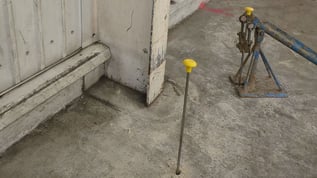
The lifting process was continuously monitored in real-time using precision laser levelling equipment. A third-party surveyor worked alongside the Geobear team to verify the response of the slab and pad foundations to the treatment. A comprehensive post-works level survey confirmed that the severe depressions had been effectively addressed. The treated zone successfully achieved the required re-levelling targets, with the maximum level difference from target levels reduced from a 131mm differential prior to the works down to a maximum deviation of just 20mm.
Outcome and Benefits
The Geobear treatment successfully improved the ground support condition and re-levelled both the settled floor slab and the pad foundations, fully reinstating serviceability to the facility. The low-disruption approach allowed the warehouse to avoid major excavation, ensuring a rapid return to normal operations and mitigating the risk of further settlement in the treated area.
Conclusion
The project demonstrates how targeted Geobear ground improvement can successfully address severe differential settlement affecting both floor slabs and pad foundations. By relying on thorough geotechnical investigation, dynamic target revisions, and precision monitoring, the Geobear solution restored the support condition and serviceability of the warehouse floor and structural supports with minimal operational disruption.
Don't let unstable ground put your business at risk. Our commercial team can provide a clear assessment and a fast, effective solution tailored to your operational needs.