Challenge
Soft to very soft clay beneath a proposed flood wall base was predicted to settle 40–50 mm, well beyond the allowable limit.
Solution
Geobear ground improvement solution strengthened the clay in a single shift, raising average undrained shear strength by 262% so construction could proceed.
Sheer strength increase
Treatment time on site
Foundation footprint treated
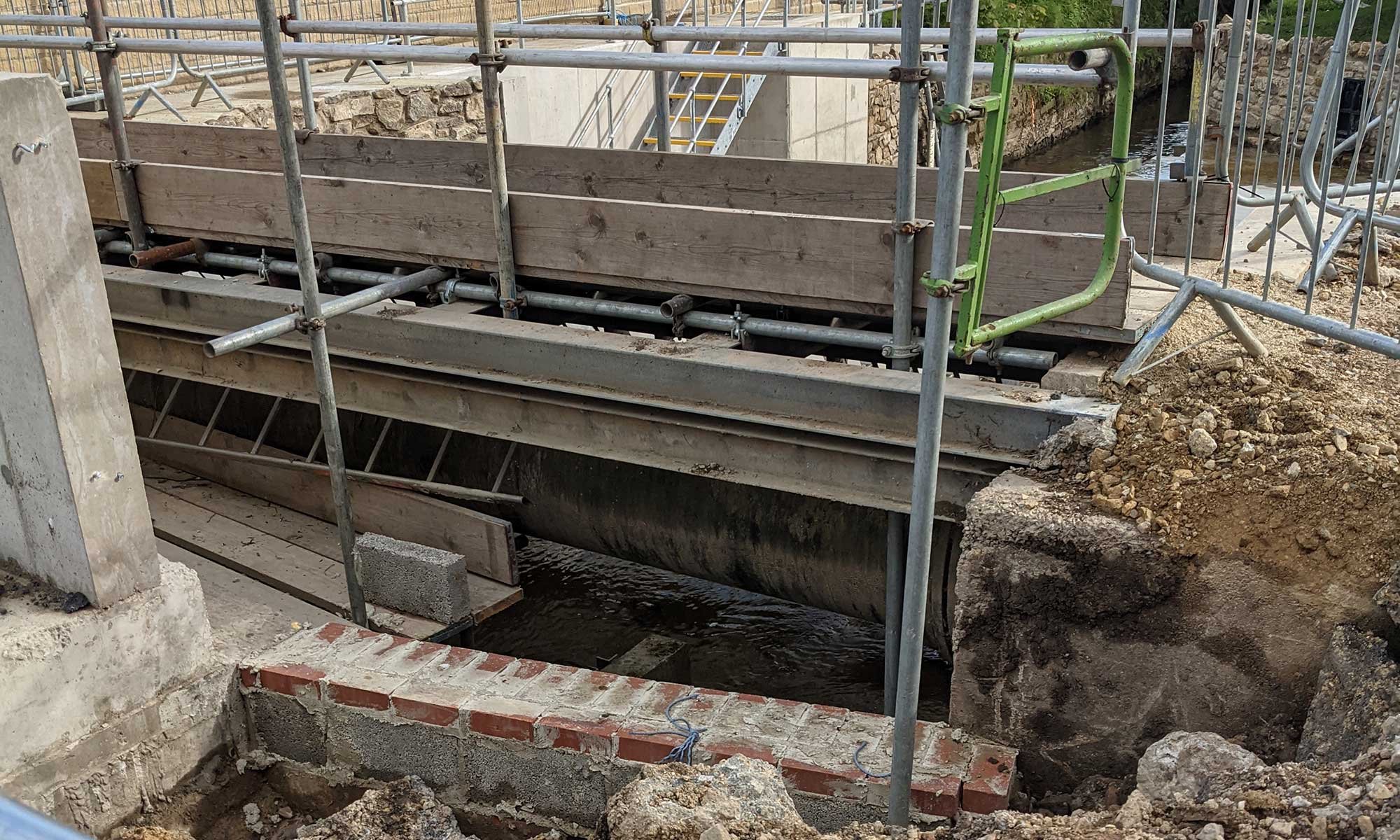
The Marton West Beck Flood Alleviation Scheme on Park Vale Road, Middlesbrough, was delivered by a principal contractor who appointed Geobear. Part of the scheme required a new reinforced concrete base and wall, founded about 2 m below existing ground level.
Initial settlement calculations for the proposed wall predicted long-term settlement of 40–50 mm, well above the maximum allowable value. Geobear were asked to improve the strength and stiffness of the soils below formation level, between 3 m and 5 m below ground level, to bring predicted long-term settlement below 25 mm. The treatment area beneath the proposed foundation measured approximately 5 m by 2 m.
The works were governed by the scheme’s ground improvement performance specification and were planned to take place before excavation, so that the existing 2 m of overburden remained in place during treatment.
The ground at Marton West Beck comprised made ground over silty clay. The engineer’s log for the nearest borehole, BHCP01, recorded soft to firm clay becoming soft and very soft brown silty clay between 3 m and 5 m below ground level. These soft to very soft clays were the reason for the large predicted settlement beneath the new wall.
The nearest exploratory holes, BHCP01 and BH01, were some distance from the proposed foundation, and the site investigation indicated variable ground in this area. That left real uncertainty over whether the soils within the treatment area matched the borehole logs on which any design would be based.
Further site investigation would normally resolve this, but the lead time to procure it was unacceptable for the scheme programme. The performance requirement also needed a measurable test: improved strength and stiffness between 3 m and 5 m had to be verified on site immediately after treatment, using a method agreed in advance.
A gas main and a water main ran next to the works and were monitored by the principal contractor throughout Geobear's work.
Where soft clay beneath a new foundation is predicted to settle beyond tolerance, the conventional responses are to carry the load through the soft layer on piles, or to excavate the soft clay and replace it with engineered fill. At Marton West Beck either option meant working to around 5 m below existing ground level, in wet clay, beside a live gas main and water main.
Excavation and replacement to that depth would have needed temporary support to the excavation, dewatering, removal and disposal of the excavated clay, and import of fill. A piled option would have needed a piling rig, a working platform and redesign of the wall base as a piled foundation.
The Geobear ground improvement solution treated the soft clay in place from existing ground level, before excavation, through small-diameter holes and from a self-contained injection unit. It avoided deep excavation beside the buried services and allowed the wall to be built on the improved ground.
Geobear also removed the investigation bottleneck. Instead of waiting for testing, Geobear carried out its own dynamic probe tests on a separate visit before treatment, at BHCP01 and within the proposed foundation footprint, and used them to develop a site-specific correlation between probe resistance and undrained shear strength. That correlation became the basis for verifying the works.
Geobear designed a soft clay ground improvement solution using targeted geopolymer injection to increase the undrained shear strength of the clay between 3 m and 5 m below ground level. In soft clay, the expanding geopolymer fractures the clay and permeates along the fractures; the treatment was designed from the clay’s undrained shear strength and the overburden pressure, so that the hardened geopolymer would raise the shear strength of the surrounding soil.
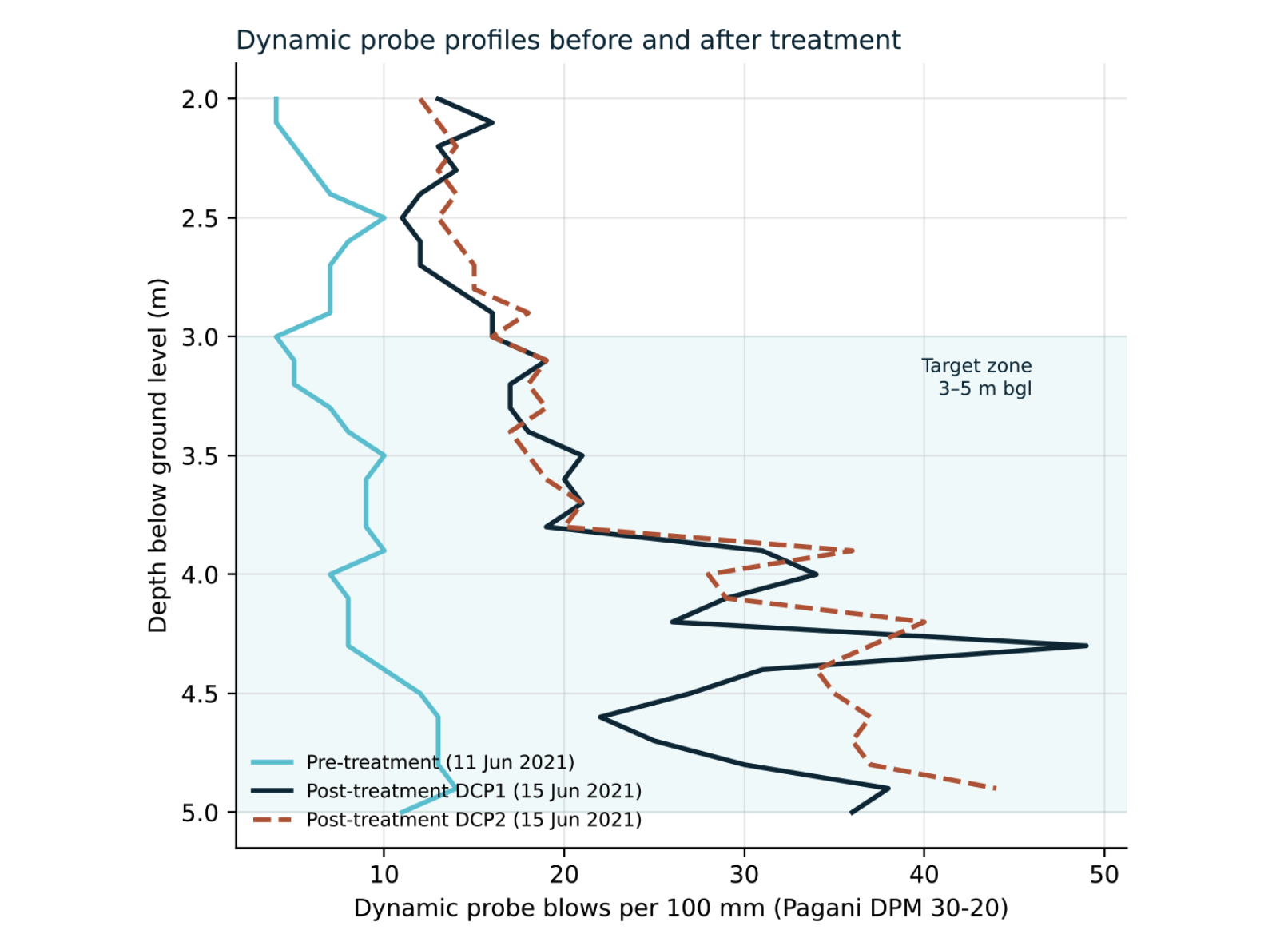
Pre-treatment dynamic probing was carried out on 11 June 2021 with a Pagani DPM 30-20 probe. Blow counts were converted to equivalent SPT N-values, corrected for energy and rod friction, and calibrated so that the derived undrained shear strength matched the logged description of the clay in BHCP01, using the Reid and Taylor (2010) correlation.
The injection works were carried out on 15 June 2021 by a three-person Geobear crew. Injection points were set out clear of services and driven through the made ground, and surface reaction was monitored continuously by laser during injection. Every point on the treatment plan was injected to the specified depth, and post-treatment dynamic probing was carried out the same day at two locations in the treatment area.
Verification
Within the target zone of 3 m to 5 m below ground level, the pre-treatment probe in the treatment area recorded an average of 9.2 blows per 100 mm. The two post-treatment probes recorded averages of 26.0 and 28.0 blows per 100 mm over the same zone. Converted to undrained shear strength using the site-specific correlation, Geobear’s analysis showed an average improvement of 262% across the treatment depth.
Don't let unstable ground put your business at risk. Our commercial team can provide a clear assessment and a fast, effective solution tailored to your operational needs.