Challenge
Column pads and slab of a 1970s CLASP school block were settling into softened, drain-damaged fill, dislocating brickwork on two elevations.
Solution
Geobear designed a ground improvement solution beneath settled column pads and slab, delivered without excavation in eight days of summer holiday.
Days on site
Higher ground resistance
Teaching days lost
Prince Henry’s High School is an upper school on Victoria Avenue in Evesham, Worcestershire, teaching around 1,280 students aged 13 to 18. Its Abbey Block is a 1970s building constructed with CLASP, the prefabricated steel-framed system used widely for UK schools in the post-war decades and originally engineered to tolerate a degree of ground movement. The block stands on a former field site that tapers at one end, with its lightweight frame carried on individual column pad foundations and a ground-bearing floor slab.
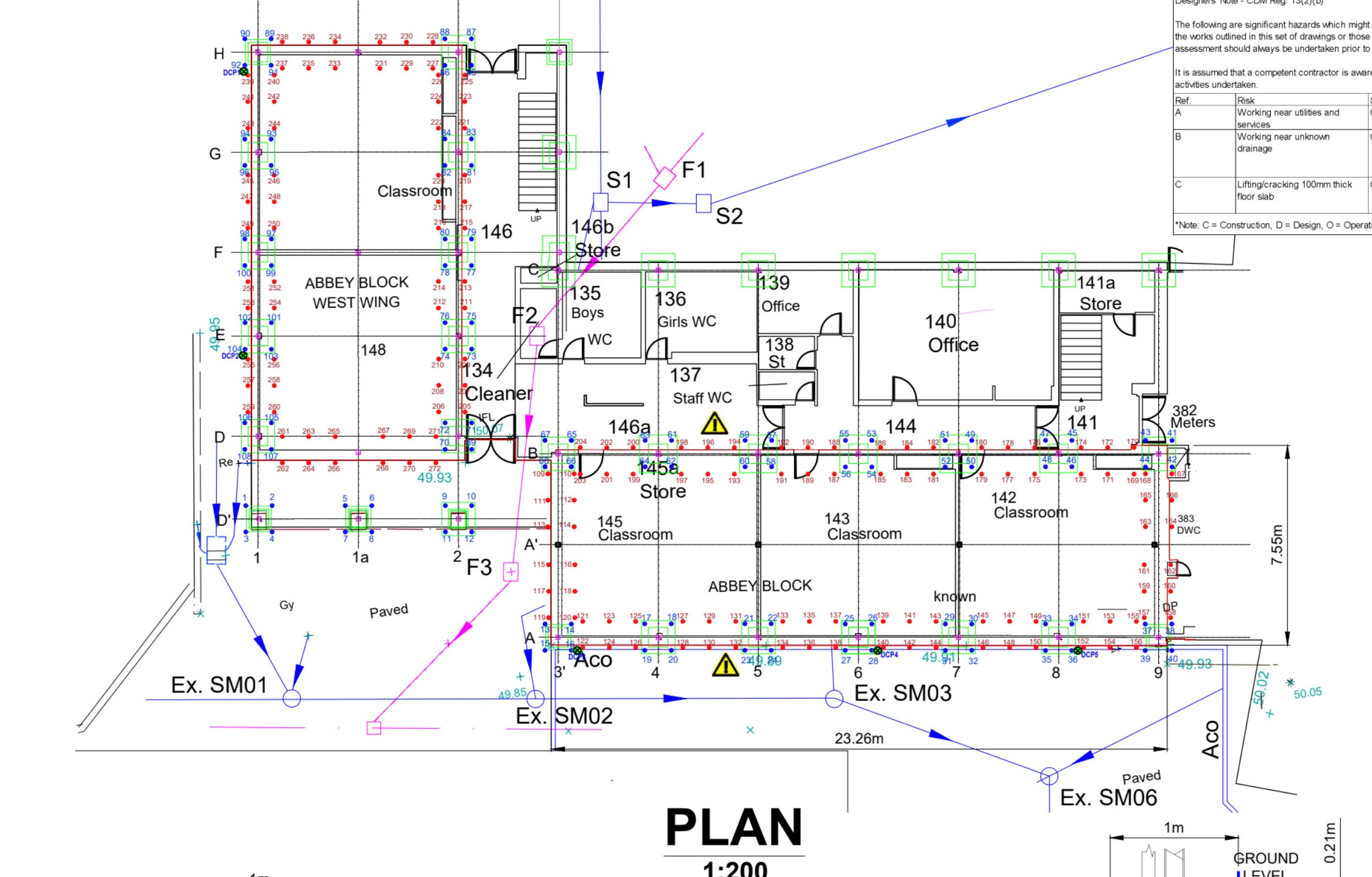
Over time, the block began to show excessive settlement along two elevations. Individual columns had moved vertically, dislocating the surrounding brickwork, and the ground floor slab had settled with them. With classrooms, offices, stores and toilets inside the affected area, the school’s consulting engineers, Davidson Walsh, needed a repair that would stabilise the building while striking the right balance between cost and disruption to school life.
Investigations pointed to several factors acting on the ground beneath the block. Trees and shrubs close to the building, since removed, had previously dried out the clay subsoil. Leaking drainage had then softened the clays and the Made Ground placed when the site was developed. Consolidation of fill beneath the main block following piling for an adjacent new building was also considered a possible contributor.
The drainage evidence was significant. A CCTV survey of 18 drain runs around the building recommended further work on 15 of them, recording cracked pipes, open joints, root ingress and bellied sections holding water, with eight runs needing lining or patch repairs. Water escaping over a number of years, potentially including from the Aco channel drain that skirts the building, was the most likely cause of the softened fill. Site investigation recorded cohesive soils beneath the Made Ground, and Geobear’s pre-works dynamic probing identified locally compromised soils at three of five test locations, with resistance well below the trend of the surrounding ground.
With the drains repaired, the task was to restore competent bearing beneath the settled pads and slab without adding to the problem. The foundations sat inside classrooms, corridors, toilets and stores, where fitted cupboards restricted access and a new classroom floor was being laid ahead of the works. The frame and slab had to be protected from further movement during treatment, and everything had to fit around the school calendar.
Why not traditional underpinning?
The conventional repair for settling internal column pads is underpinning. In a school, that means stripping out fitted furniture and sanitaryware, moving spoil and concrete through the site by skip, and weeks of noisy, dusty work and concrete curing inside teaching spaces, all with a high embodied carbon cost from concrete and steel. Excavating beside pads already sitting on weakened fill also risks triggering further movement in the frame before new foundations take load.
The Geobear ground improvement solution
Geobear’s in-house engineering team designed a ground improvement solution, using geopolymer injection, to strengthen the softened and loosened Made Ground beneath the settled column pad foundations and along a strip of ground floor slab between them. The design was based on the agreed working assumption that settlement had been caused by soils softened by drainage leaks and adjacent piling, rather than ongoing seasonal movement of the clay, with the implicated trees already removed.
Treatment was targeted at the zone of compromised soils identified through investigation and probing, extending into the more competent ground below to create a continuous, improved bearing layer. The expanding geopolymer fills voids and densifies loose soils as it reacts, curing in under a minute so the improvement is immediate. Designed quantities were set for each location, with a clear rule that injection would be reduced or stopped at the first sign of lift.
Delivery on site
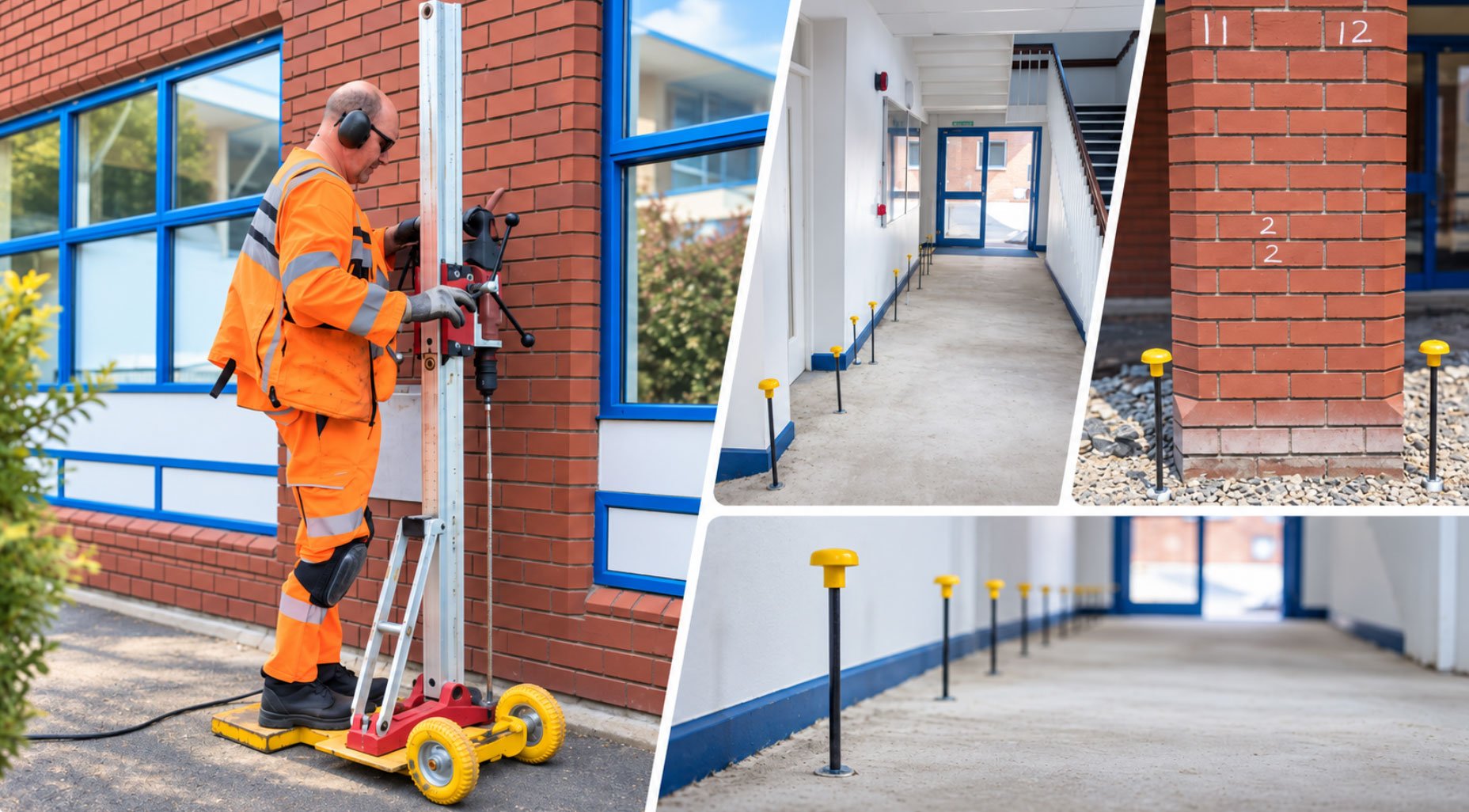
Ahead of mobilisation, principal the contractor cored and sleeved access holes through the slab to each pad and confirmed the repaired drainage was sound and being monitored. Geobear’s fully self-contained injection unit parked in the school car park with hoses run into the building, so no excavation, heavy plant or spoil removal was needed inside.
After pre-works dynamic probing at five locations, Geobear technicians installed injection tubes through the pads and slab and injected in a controlled sequence across the West Wing and main block. Laser levels monitored the structure and internal floors at every injection, giving technicians real-time control over the building’s response. Probing was then repeated at the same five locations to verify the result.
Works ran starting the Monday after the summer term ended, and were completed in eight working days.
Expected outcomes
Improved, competent bearing soils beneath the settled pads and slab, mitigating future settlement of the frame and floor and giving the school’s contractor a stable base from which to complete repairs to brickwork and internal finishes.

Verified ground improvement
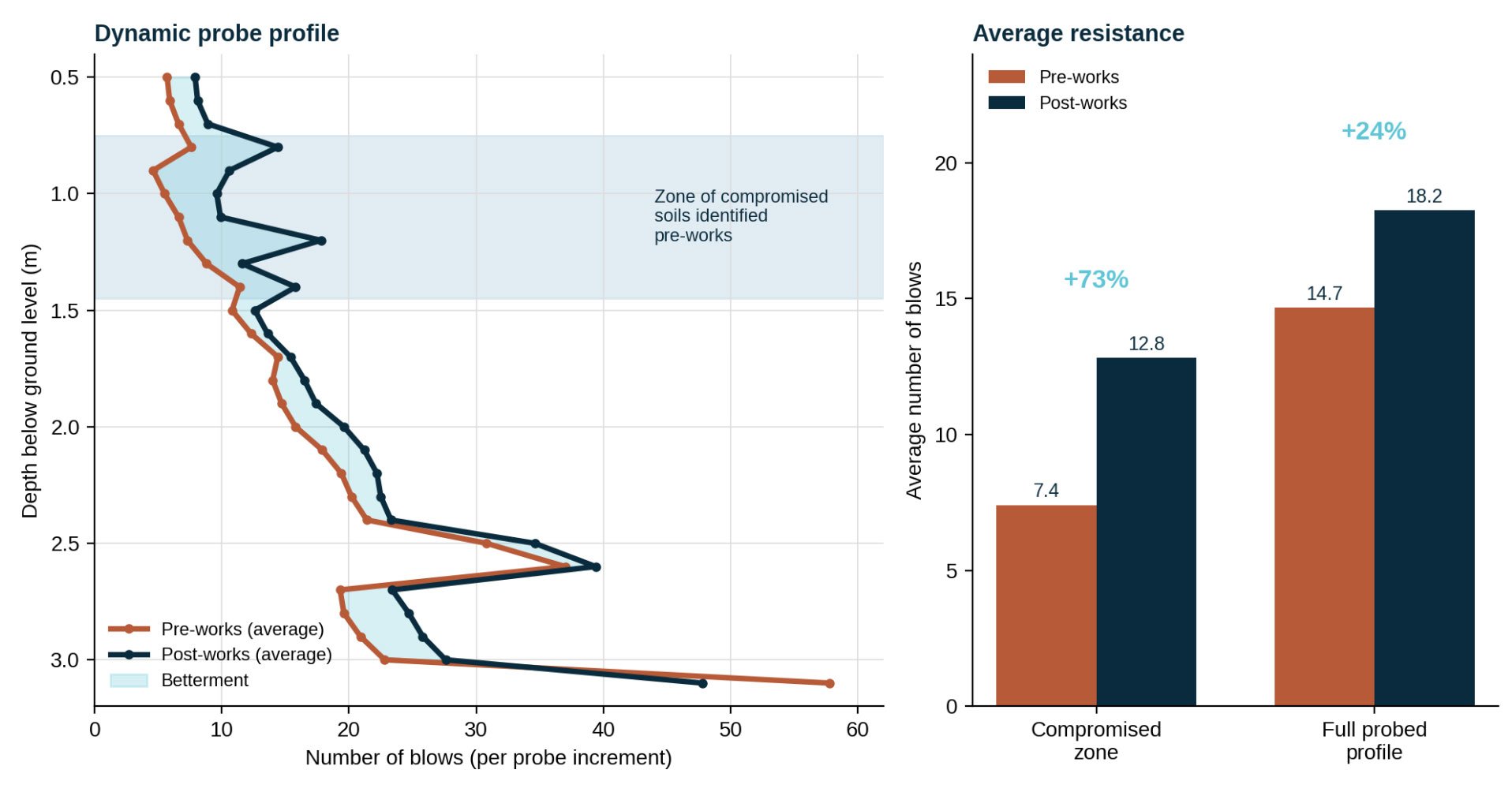
Pre- and post-works dynamic probing provides direct evidence of the improvement. Within the zone of compromised soils, average resistance rose by around 73%, and the weakest average reading roughly doubled. Betterment was recorded throughout the probed profile, extending into the more competent soils below. Geobear’s engineering team concluded that ground improvement had been achieved and that the works are adequate to mitigate future settlement of the structure.
Figure 1: Average dynamic probe (DCP) results from five test locations before and after treatment.
Controlled, monitored delivery
Every injection was monitored by laser level. More than 98% produced no reaction, a flicker or a lift of 0.5 mm or less. The largest reaction recorded, 2 mm, triggered an immediate stop at that location, and movement seen on internal floors was typically 0.5 to 1 mm. Material usage came in below the designed allowance, so no material variation was incurred.
Time saving
Geobear completed the works in eight working days, entirely within the summer holiday, so no teaching days were lost. No programme was prepared for a traditional scheme, so a precise time saving cannot be stated. Underpinning the same column pads would have meant slab break-out, hand excavation, temporary propping, concrete curing and floor reinstatement room by room, a sequence that would have been difficult to complete within a roughly six-week holiday and would have carried a real risk of running into the autumn term.
Cost saving
The Geobear solution avoided the main cost drivers of underpinning: slab break-out and reinstatement, removal and refitting of fixtures, temporary propping, spoil disposal and replacement floor finishes.
The larger saving is indirect. Completing within the holiday avoided the cost and disruption the school would have faced had works run into term, from relocating lessons or hiring temporary classrooms to segregating an active construction site from around 1,300 students. These costs are a major consideration for any operational school.
Carbon saving
Independent life cycle assessment of Geobear’s geopolymer injection service by Carbon Footprint Ltd found carbon savings of over 50% compared with a traditional piled raft foundation repair, driven by avoiding concrete, reinforcement steel, excavation plant fuel and skip removals.
Don't let unstable ground put your business at risk. Our commercial team can provide a clear assessment and a fast, effective solution tailored to your operational needs.