Challenge
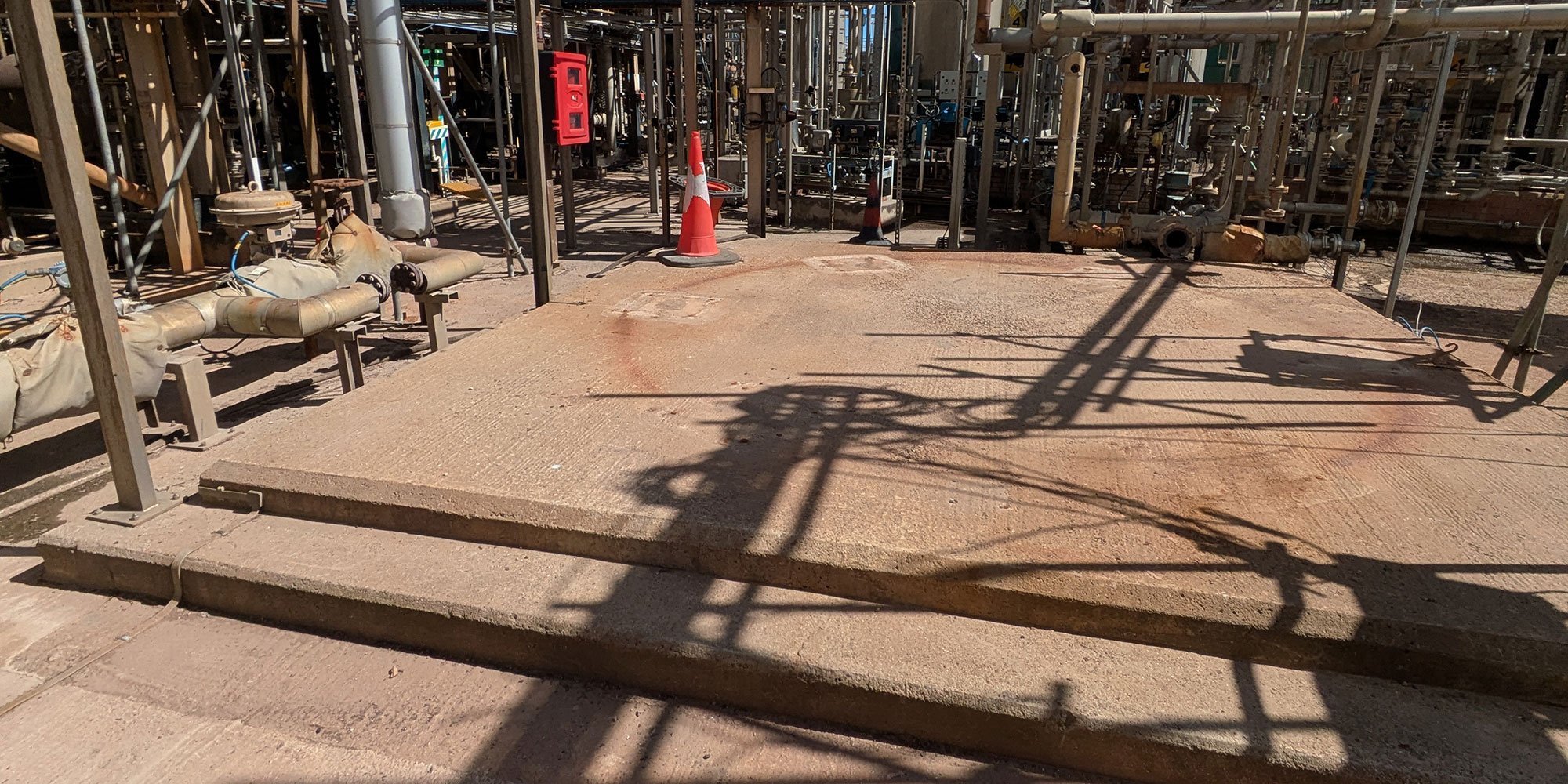
A replacement process vessel would double the bearing pressure on an existing base founded on weak, ash-rich made ground at Hendon Dock.
Solution
Geobear ground improvement solution raised the allowable bearing pressure beneath the existing base to 70 kPa in two shifts, without excavation or new piles.
Bearing pressure achieved
Time on site
Vessel base
Tradebe operates a process site at Hendon Dock in Sunderland. The S3 Kettle, a process vessel on the site, was due to be replaced with a larger unit. According to the manufacturer’s drawing, the replacement vessel weighs approximately 45 tonnes empty and approximately 129 tonnes when full of water.
Tradebe commissioned R & A Kay Inspection Services to assess whether the existing concrete slab and plinth could carry the increased loads, and whether the ground beneath could sustain the resulting increase in bearing pressure. RAK carried out a cover survey, concrete coring and a dimensional survey in spring 2026, and advised Tradebe to commission a ground investigation around the vessel.
The principal designer specified ground improvement beneath the existing base so that it could carry the new vessel. RAK, acting as principal contractor and principal designer, appointed Geobear in July 2026 to design and deliver it in the window between removal of the old vessel and installation of the new one.
The existing reinforced concrete base measures 5.67 m by 5.31 m. Concrete coring by RAK confirmed a slab depth of approximately 440 mm, with 10 mm reinforcement in top and bottom layers.
Four windowless sampler boreholes drilled around the base in May 2026 found made ground throughout, mainly black to dark grey clayey gravel containing ash, coal, clinker and concrete, extending beyond 5 m below ground level in all four holes. Standard penetration tests between 1.0 m and 3.0 m below ground returned N values of between 0 and 9, and in one borehole the SPT sampler sank under its own weight between 2.00 m and 2.50 m. Values increased at 4.0 m, to between 16 and 40. The ground was wet from about 4.5 m, and one borehole recorded a solvent odour in the made ground.
The engineering requirement was set by the replacement vessel. The bearing pressure on the base would rise from 35 kPa to 70 kPa, and the ground beneath had to provide an allowable bearing pressure of 70 kPa with total settlement of no more than 25 mm.
The programme was fixed by the vessel change-over. Geobear’s works could only start once the old vessel had been removed, because the vessel restricted headroom over the base, and had to be complete before the new vessel was installed. All drilling took place under permits issued by the principal contractor.
The conventional alternatives for carrying a heavier vessel on deep, weak made ground would be to construct a new piled foundation, with piles taken through the made ground to stronger strata, or to break out the base, excavate and replace the weak made ground with engineered fill, and recast.
At Hendon Dock, both options carried significant constraints. The made ground extended beyond 5 m, contained ash, coal and clinker, and in one borehole had a solvent odour, so any excavation would have generated arisings needing classification and disposal. A piled solution would have required piling plant inside an operational process area, extending the period between removal of the old vessel and installation of the new one.
A Geobear ground improvement solution strengthens the made ground in place, through small holes drilled in the existing base, and keeps the base itself in service.
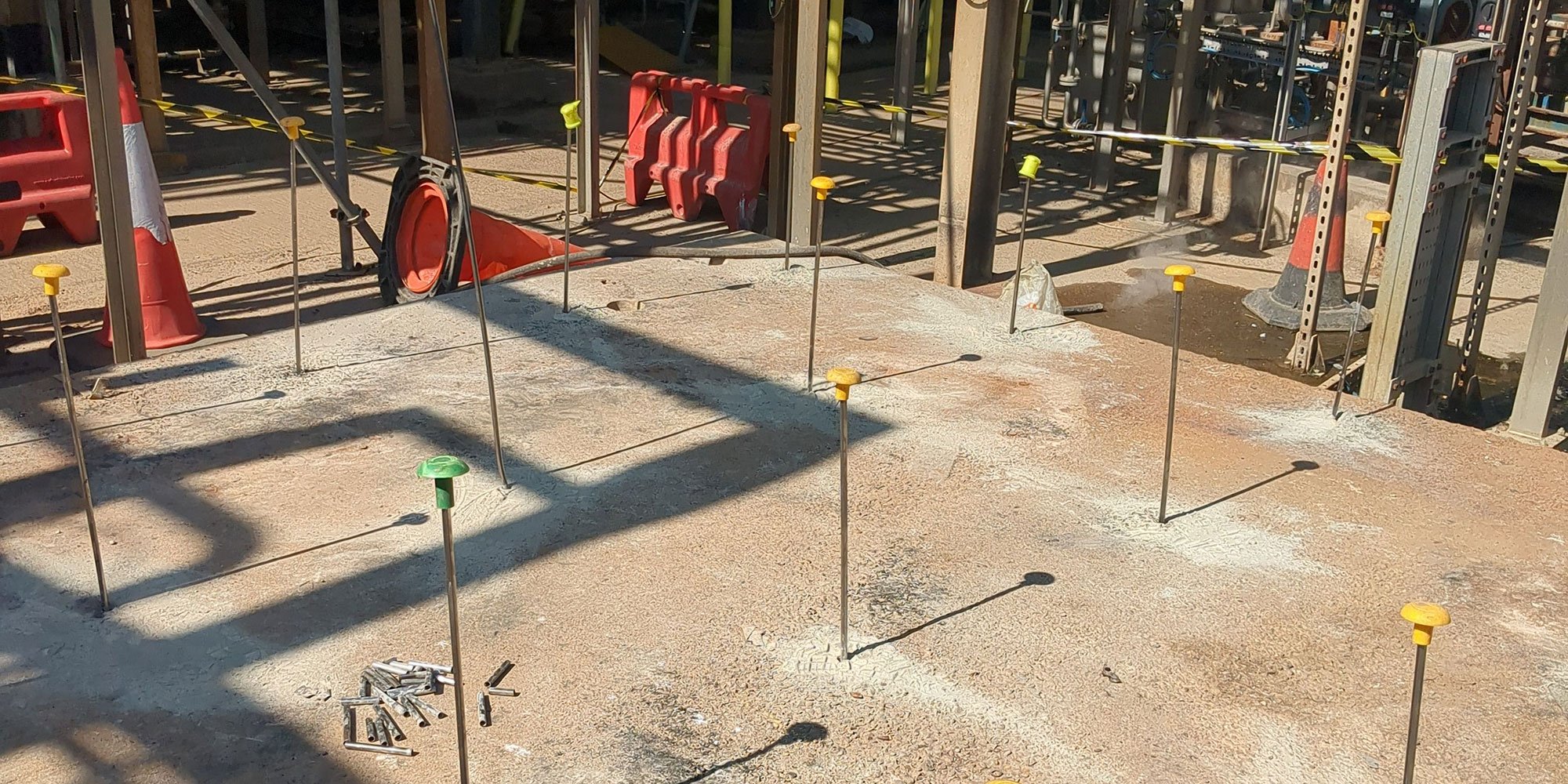
Geobear designed a ground improvement solution using targeted geopolymer injection to strengthen the made ground beneath the full footprint of the existing 5.67 m by 5.31 m vessel base, approximately 30 m², so that it could carry an allowable bearing pressure of 70 kPa. The geopolymer expands as it is injected, compacting and binding the loose made ground around each injection location.
Geobear’s team mobilised once the old vessel had been removed. They drilled through the existing reinforced concrete base, installed injection tubes and injected geopolymer from a self-contained injection unit parked within 100 m of the base. Laser sensors monitored the base throughout. They recorded no movement at all but two of the injection stages, where a momentary flicker was noted, confirming that the ground was strengthened without lifting or disturbing the base. The works were completed in two shifts, on 23 and 24 July 2026.
Verification
Geobear verified the ground improvement by dynamic probing through the base with a Pagani DPM 30/20 probe after treatment. The average post-treatment blow count was approximately 7 blows per 100 mm, which converts to an equivalent SPT N value of 5. Using a published correlation between SPT N and soil stiffness for normally consolidated sands (Stroud, 1989), this gives a stiffness of about 5 MPa.
|
Depth (m bgl) |
WS01 |
WS02 |
WS03 |
WS04 |
|---|---|---|---|---|
|
1.0 |
3 |
2 |
6 |
2 |
|
2.0 |
0* |
4 |
4 |
4 |
|
2.5 |
4 |
– |
– |
– |
|
3.0 |
5 |
9 |
7 |
6 |
Table 1: Pre-treatment SPT N values in the made ground from the ground investigation, May 2026. *Sampler sank under its own weight between 2.00 m and 2.50 m.
|
Measure |
Pre-treatment (ground investigation) |
Post-treatment (Geobear probing) |
|---|---|---|
|
SPT N, 1.0–3.0 m below ground |
0 to 9 (8 of 13 tests ≤ 4) |
Average equivalent N = 5 |
|
Allowable bearing pressure |
Ground improvement specified by the principal designer |
70 kPa achieved (24.5 mm predicted settlement, 25 mm limit) |
Table 2: Pre- and post-treatment comparison. Post-treatment value converted from Pagani DPM 30/20 blow counts.
Before treatment, 8 of the 13 SPT results between 1.0 m and 3.0 m below ground were 4 or less, including one where the sampler sank under its own weight. After treatment, the probing averaged the equivalent of SPT N = 5 across the treated ground, the value needed to meet the settlement criterion at 70 kPa.
Key project outcomes
Allowable bearing pressure of 70 kPa achieved beneath the existing vessel base, double the previous 35 kPa.Predicted settlement of 24.5 mm under the new vessel load, within the 25 mm limit
Post-treatment probing averaged the equivalent of SPT N = 5, against pre-treatment values as low as 0–2 in the made ground
Approximately 30 m² of base treated in two shifts, on 23 and 24 July 2026Existing reinforced concrete base retained – no excavation, piling or new foundation
Laser monitoring confirmed the base was not lifted or disturbed during treatment
Don't let unstable ground put your business at risk. Our commercial team can provide a clear assessment and a fast, effective solution tailored to your operational needs.