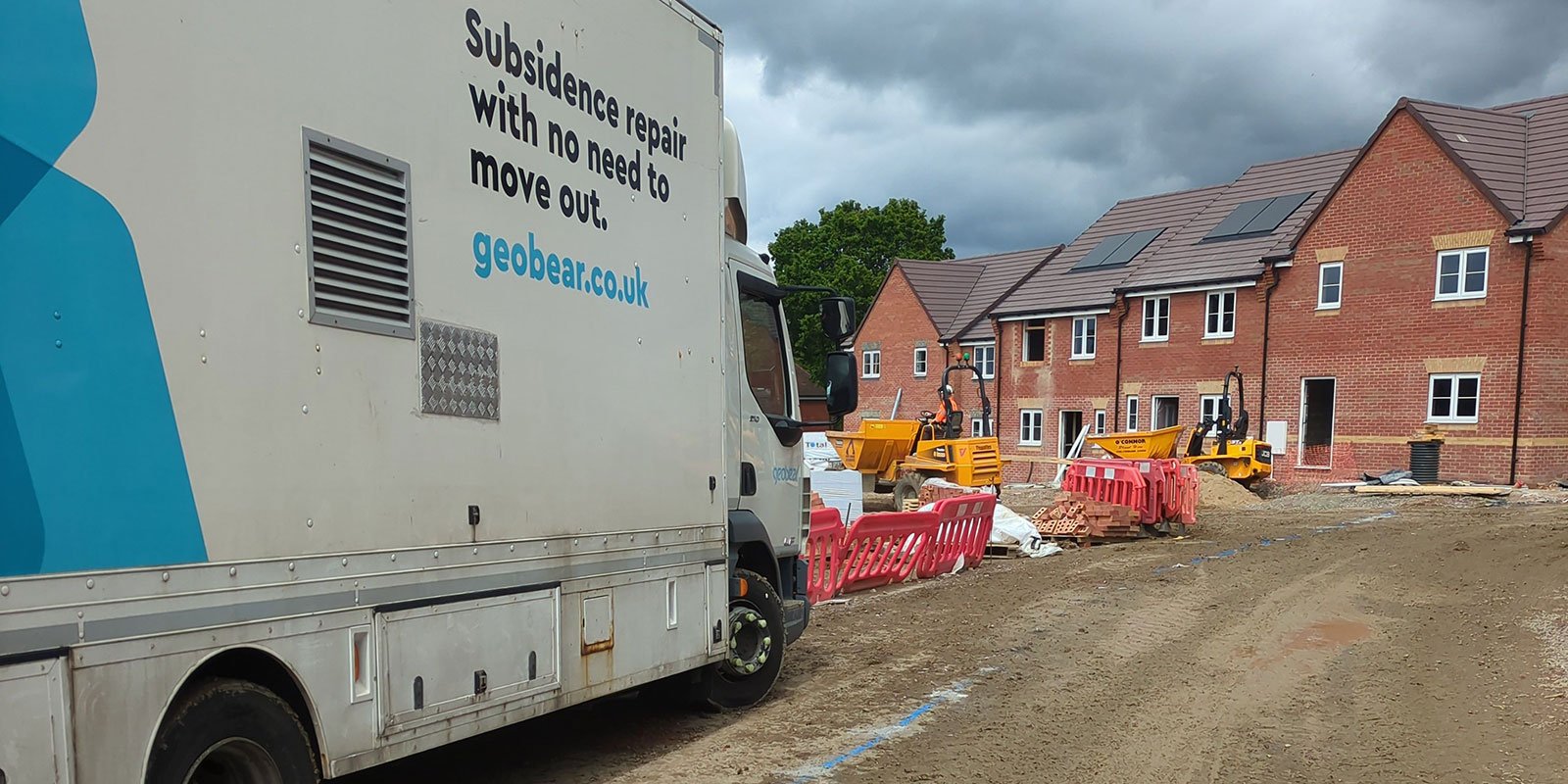
New build development
Challenge
Settlement of backfilled utility trenches caused significant pavement deformation across a new residential development following prolonged wet weather.
Solution
Geobear delivered targeted geopolymer ground improvement beneath the affected foul and storm sewer trenches, restoring ground performance without excavation.
Material required
Treatment depths required
Injection points
Geobear was appointed to deliver ground improvement at a new housing development in South West England, after significant settlement developed above newly installed utility trenches. The affected areas formed part of the development's foul and storm drainage infrastructure, where trenches had been backfilled using site-won material excavated during construction.
The excavated soils had been stockpiled throughout a prolonged dry summer before being re-used as trench backfill. As the material had dried considerably before placement, compaction resulted in a relatively high void ratio within the trench fill. Following extended periods of wet weather, moisture infiltrated the backfill, causing consolidation and surface settlement measuring several hundred millimetres in places.
The objective was to improve the engineering performance of the trench backfill above the drainage network, restoring support to the pavement while avoiding extensive excavation and reconstruction.
The project required treatment of multiple sections of foul and storm sewer trench running through a live residential development where finished roads and infrastructure had already been constructed. Traditional excavation would have required removal and reinstatement of significant lengths of pavement together with disruption to completed drainage assets.
Ground investigation using a Pagani 30/20 dynamic probe confirmed that the trench backfill exhibited exceptionally low strength throughout much of the treatment depth.
The treatment needed to accommodate both foul and storm drainage runs with varying trench depths while ensuring the drainage infrastructure remained fully operational throughout the works. Verification testing identified areas requiring additional improvement passes, demanding a flexible engineering approach rather than a single installation programme.
Geobear designed a targeted geopolymer ground improvement solution to increase the density and bearing capacity of the trench backfill above the drainage infrastructure.
Treatment was undertaken between May and June 2026 using a phased injection programme. The original design comprised full treatment of the foul sewer trenches from approximately 0.5 m below the pavement surface to depths between 1.5 m and 3.5 m below ground level. Injection points were positioned at 1.0 m centres along the trench alignment, with injections delivered at predetermined vertical intervals to provide uniform improvement throughout the backfill profile. During design development, additional deep treatment was incorporated within Run D to address identified voiding. The treatment also included targeted improvement above sections of the storm sewer network.
Ground improvement was continuously validated using Pagani 30/20 probing. Following the initial installation, post-treatment verification identified areas where further improvement was required. A secondary treatment pass was therefore completed, followed by targeted tertiary injections on Runs 8, 9, 14 and 18 where isolated low-strength zones remained.
Verification through repeated probing confirmed the effectiveness of the ground improvement across the treated trench network.
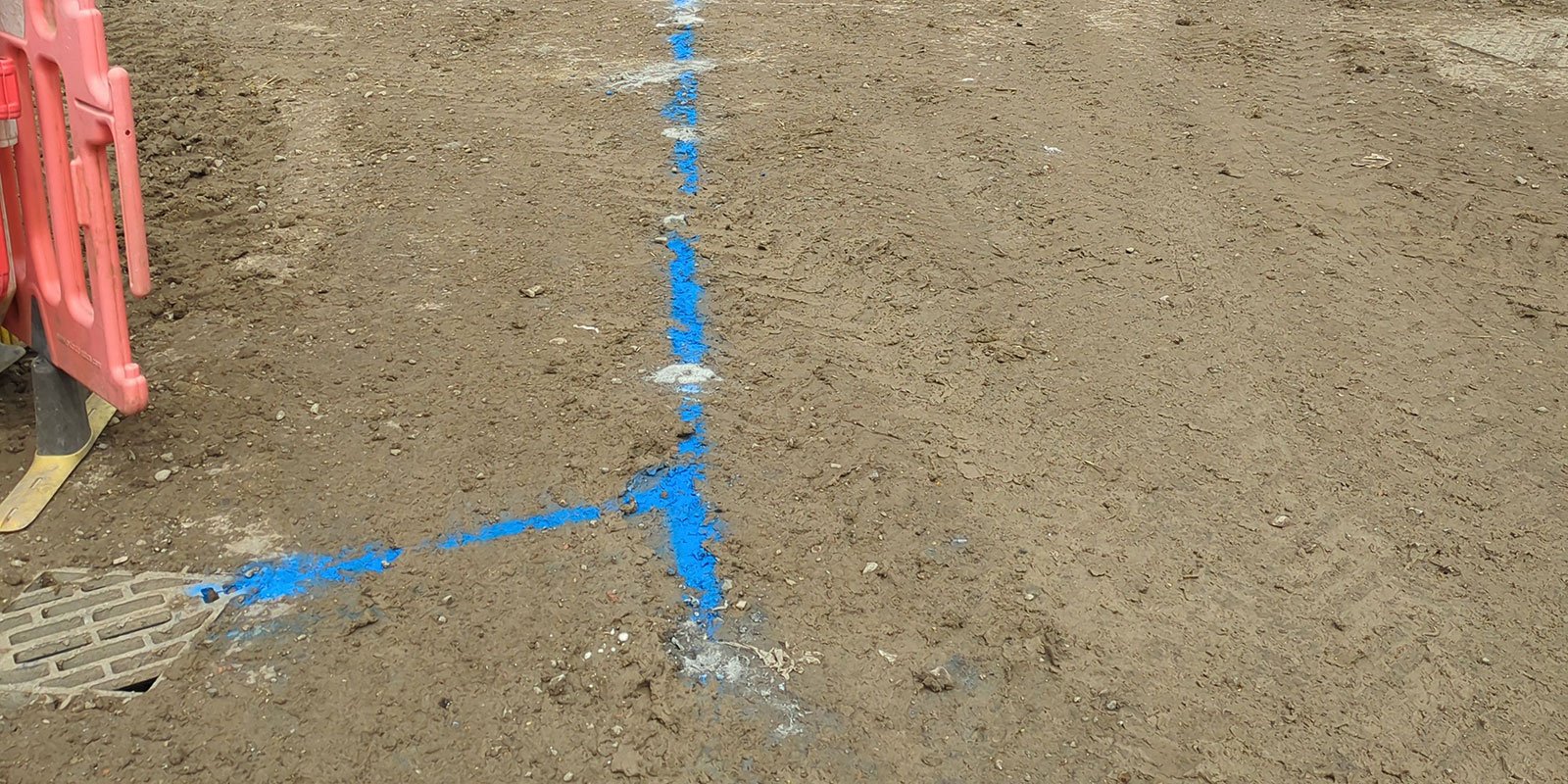
Injection location marked on ground
The completed works successfully improved the engineering performance of the trench backfill across the affected sections of the development. Progressive verification testing demonstrated significant improvement in the strength of the treated material following the secondary and targeted tertiary injection phases.
By improving the existing trench fill in situ, Geobear avoided the need for extensive excavation, removal and replacement of recently completed roads and utility corridors. The controlled geopolymer injection process enabled the ground to be strengthened beneath the finished pavement while maintaining the integrity of the drainage infrastructure.
Following completion of the verification programme, Geobear's engineering team confirmed that satisfactory ground improvement had been achieved throughout the treated length of trench above the drainage pipelines. The project demonstrates how targeted geopolymer ground improvement can efficiently remediate settlement associated with poorly performing trench backfill on residential developments, reducing disruption while restoring long-term ground performance.
Don't let unstable ground put your business at risk. Our commercial team can provide a clear assessment and a fast, effective solution tailored to your operational needs.