Challenge
Clay shrinkage, drainage defects and shallow foundations caused structural movement at occupied social housing properties, requiring long-term stabilisation while retaining mature trees and allowing tenants to remain safely at home.
Solution
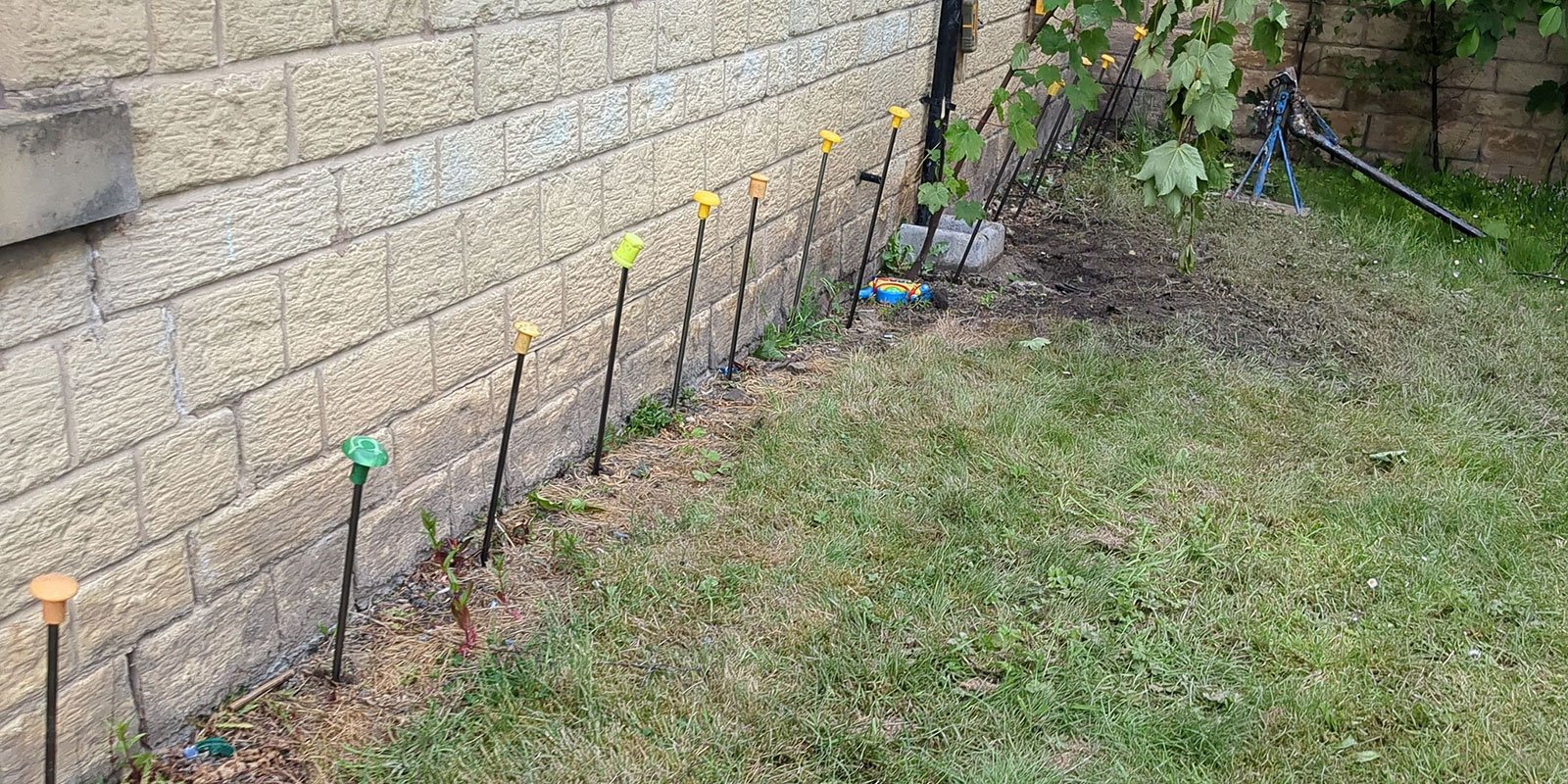
Following drainage repairs, Geobear injected geopolymer beneath affected foundations, reducing clay permeability, strengthening supporting soils and mitigating future shrink-swell movement without excavation or tenant displacement.
Injection points
Project completed
Tenants relocated
Kirklees Council appointed Geobear to stabilise a terrace of social housing properties at Wesley Close, Birstall, West Yorkshire after subsidence caused cracking and movement to the rear elevations and right-hand flanks of the homes.
Site investigations identified very stiff sandy silty clay beneath the foundations, with movement attributed to a combination of clay shrinkage, drainage defects and shallow foundation construction. Despite the structural movement, it was essential that residents remained safely in occupation throughout the repair programme.
The council required a permanent, low-disruption solution that would minimise inconvenience to tenants while preserving the surrounding environment.
The project presented several engineering and operational challenges.
The affected properties remained occupied throughout the works, making tenant safety and minimal disruption key project requirements. Existing drainage defects first required repair before ground improvement could commence.
Mature trees located close to the affected properties also needed to be retained wherever possible, avoiding the environmental impact often associated with traditional clay shrinkage mitigation.
The solution therefore needed to provide long-term foundation stability while reducing future shrink-swell movement within the clay soils.
Following completion of the drainage repairs by others, Geobear designed a bespoke geopolymer ground improvement solution targeting the rear elevations and right-hand flanks of the affected properties.
The treatment included:
Site investigations confirmed suitable ground conditions for treatment and found no tree roots within the trial pits, allowing all mature trees to be retained.
The entire stabilisation programme was completed in two shifts, with no large-scale excavation or disruption to residents
The geopolymer treatment improved the engineering properties of the clay soils beneath the affected foundations while reducing the permeability responsible for seasonal shrink-swell movement.
For Kirklees Council, the project delivered a practical, sustainable and tenant-friendly alternative to traditional underpinning.
Project outcomes included:
Compared with traditional underpinning, Geobear's geopolymer solution delivered significant operational and environmental advantages:
Don't let unstable ground put your business at risk. Our commercial team can provide a clear assessment and a fast, effective solution tailored to your operational needs.