Foundation problems are never one-size-fits-all. The “best” solution depends on what’s causing the issue, how severe the movement is, and the type of foundation your home has.
Foundation settlement and subsidence are especially common. Understanding what subsidence is, together with what your repair options are, can help you make confident, cost-effective decisions when problems arise.
Step 1: Identify the root cause with a foundation inspection
Before choosing a repair method, it’s critical to understand why the foundation is moving. Treating symptoms without fixing the underlying cause can lead to recurring issues. Common causes of foundation problems in Southern California include:
- Soil settlement or compression beneath slabs
- Subsidence from erosion or voids caused by leaking pipes or poor drainage
- Expansive clay soils that shrink during drought and expand with moisture
- Seismic ground movement
- Poorly compacted fill soils beneath older homes
A professional foundation inspection helps pinpoint whether the issue is structural, soil-related, or moisture-driven. This can help you make the best decision for your home – and ensure the root problem is solved.
Step 2: Prepare for any work that is required
Once you’ve identified the root cause, you may have additional work that needs to be completed prior to fixing the foundation issue itself. If your foundation problems are related to large trees near the home, poor drainage, leaking plumbing, or certain other issues, it’s important to fix those issues to prevent further problems.
Your expert team should advise you of any issues like these prior to starting the work on your foundation repairs. Some common actions prior to having work completed may include:
- Fixing gutters or drainage that allows water to pool near or under your foundation
- Relocating or removing any trees with root structures that disrupt your foundation
- Repairing any leaks, broken pipes, or other water sources that have caused washout or soil disruption
These issues are not always relevant. Talk to your foundation inspectors to better understand which issues may be applicable.
Step 3: Understand common foundation repair & stabilization options
Slab lifting (mudjacking or polyjacking)
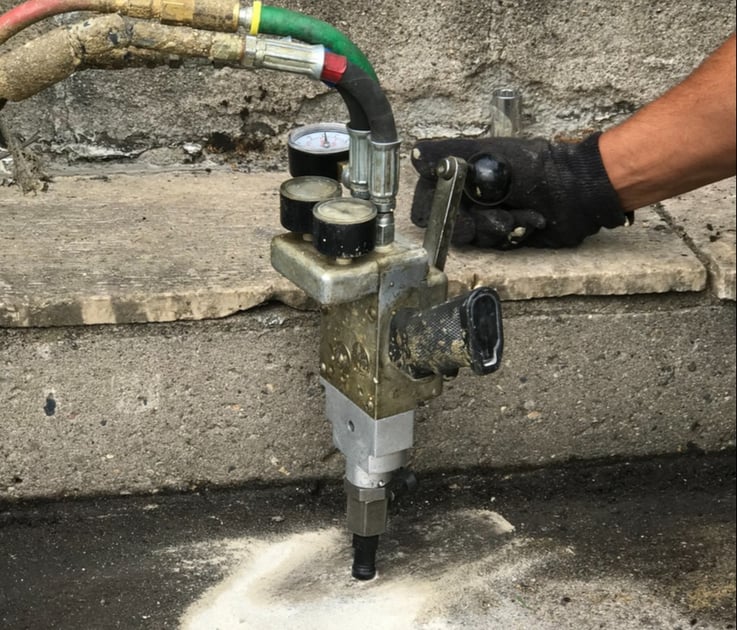
Slab lifting involves injecting material beneath a sunken concrete slab to raise it back to level. It’s best for sunken slabs, garages, patios, and driveways or other localized settlement areas with accessible voids.
Mudjacking and polyjacking are similar processes that use different materials. Both methods can be effective for concrete flatwork. They may not address deeper soil instability.
- Mudjacking uses a cement-based slurry. It’s a heavier material that can add load to weak soil. This is a common solution for small areas, such as walkways or driveways, to support the soil and level the area
- Polyjacking uses lightweight expanding foam. With faster cure times than cement and less added weight, it can work for larger areas and more applications than mudjacking
Underpinning & structural reinforcement
Underpinning strengthens foundations by transferring loads to deeper, more stable soil. Typically, underpinning requires excavation, longer timelines, and more disruption of the property. It’s important to take these things into consideration when exploring your foundation repair options, foundation repair cost, and next steps.
Push piers and helical piers are among the most common traditional solutions; push piers are driven deep into stable soil using the weight of the structure, while helical piers are screw-like steel shafts installed into the ground to support lighter or more sensitive structures. Other approaches include drilled concrete piers or caissons, which involve excavating holes and pouring concrete to create deep foundation supports.
Piering or underpinning is commonly best for significant settlement, load-bearing structural issues, and homes requiring permanent lift and stabilization. They’re also more commonly used in situations where sloped land (e.g., hillside homes) creates shifting or movement of the home.
Engineered geopolymer injection
For many Southern California homes, foundation problems aren’t caused by the structure itself, but by weak or unstable soil beneath it. Modern ground improvement techniques focus on strengthening and stabilizing the soil, rather than replacing or heavily modifying the foundation.
Geobear’s in-house engineers are experts at solving a variety of foundation problems and designing customized solutions that match the problem, soil type, and the cause of your home’s foundation problem. With experience in techniques from simple injections to complex solutions such as soil matrix, deep soil injection, and void filling, every project is tailored to the property. Many problems can be addressed with less disruption, less cost, and much shorter timelines when compared to other common solutions.
Benefits include:
- Stabilizing soils beneath slabs and foundations
- Filling hidden voids caused by erosion or pipe leaks
- Improving load-bearing capacity
- Minimal excavation and disruption
- Faster installation than traditional methods
What’s the best way to fix foundation problems?
The best foundation repair solution depends on:
- The cause of settlement or subsidence
- The severity and progression of movement
- The soil conditions beneath the home
- The foundation type and construction
- The homeowner’s budget, timeline, and tolerance for disruption
For many homeowners, non-invasive ground improvement offers a practical alternative to major structural work. Reputable foundation repair companies can offer inspections, help you understand your problem and recommend the right solution for your home. No solution is one-size-fits-all, so it’s important to work with a company you can trust to tailor a solution to your home.
What should homeowners do if they think they may need foundation repair?
If you’re asking, “What is the best way to fix foundation problems?”, you’re already taking the right step. Here are some steps to get started:
- Documenting visible damage and changes
- Monitoring cracks, doors, and floors over time
- Scheduling a professional foundation inspection
- Exploring repair options that address both the structure and the soil
Geobear specializes in non-invasive ground improvement solutions designed to stabilise the soil beneath homes affected by settlement or subsidence - helping homeowners protect their property with minimal disruption.
If you’re concerned about foundation issues in your home, reach out to Geobear to schedule a foundation inspection and understand which solution is right for your situation.