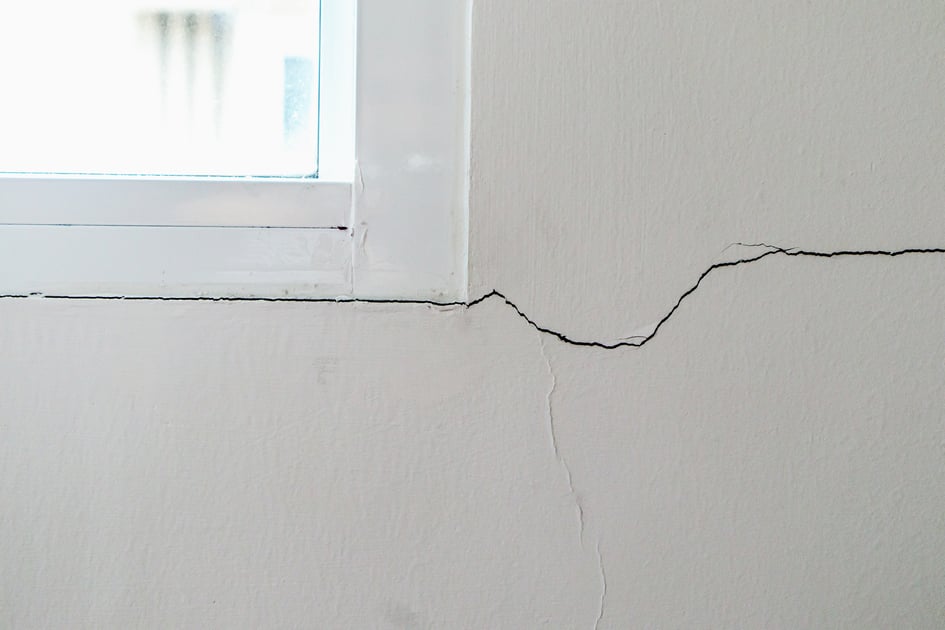
Finding home foundation cracks is disorienting. You don't know whether to panic or convince yourself it's nothing. That uncertainty is the hardest part, and it keeps a lot of homeowners stuck between ignoring the problem and catastrophizing it.
Here's what actually matters: a crack is a symptom, not a diagnosis. What you see on the surface tells you something, but what's happening in the ground beneath your home tells you everything. That's why Geobear is built around diagnosing root causes, unstable soil, clay shrinkage, hidden voids, rather than patching what's visible. By the end of this article, you'll know which cracks to watch, which to act on immediately, and what to do next.
What the shape of your home foundation cracks is actually telling you
Crack patterns are the first clue. Before you measure anything or call anyone, stand in front of the crack and look at its shape. The direction and pattern of a crack reflect the type of force that created it, and that tells you something real about what's going on underground.
Hairline and vertical cracks: usually the least alarming
Hairline cracks, thinner than 1/16 inch, and straight vertical cracks are typically byproducts of normal concrete shrinkage during curing or minor uniform settling. They're especially common in newer homes during the first few years. Most are cosmetic and stay that way.
What changes the picture: if a vertical crack is wider at the top than the bottom (or vice versa), or if it measures beyond 1/8 inch, it's no longer in the "don't worry about it" category. Width and uniformity matter here more than orientation.
Diagonal and stair-step cracks: the settlement signal
Diagonal cracks running at roughly 45-degree angles point to differential settlement, one section of the foundation is sinking faster than another. Stair-step cracks, which zigzag along mortar joints in brick or block walls, tell the same story. The soil beneath one part of your home has shifted, softened, or compacted unevenly.
Displacement makes these cracks more serious than width alone. If one side of a stair-step crack sits higher than the other, or pushes outward, the ground is actively moving. That changes the conversation from "monitor this" to "get eyes on it now."
Horizontal foundation cracks: the type that changes everything
Horizontal foundation cracks running parallel to the ground are the most serious type, without exception. They indicate external pressure building against your foundation wall, from saturated soil, hydrostatic water pressure, or frost heave, and can signal the early stages of wall bowing or structural failure. Basement cracks of this kind are especially common where soils stay wet for extended periods.
Any horizontal crack warrants a professional call regardless of its width. There's no version of a horizontal crack that falls into the "watch and wait" category.
The ground movement happening beneath the crack
The crack is visible. The cause is underground. Understanding what's happening below your home changes how you think about the repair, and whether any surface fix will actually hold.
Clay soil and seasonal shrinkage in Southern California
Expansive clay soil swells when it gets wet and contracts sharply during dry periods. In Southern California, where heavy winter rains are followed by extended drought, this cycle is extreme and repeated. Clay soils can swell considerably when saturated and then shrink dramatically as they dry, creating voids under slabs and uneven pressure against foundation walls.
Homeowners in clay-heavy areas often notice cracks worsen each summer. That's not coincidence; the ground is literally pulling away from the foundation below the structure. Unlike regions with more consistent moisture, Southern California's distinct wet-dry cycles create differential movement rather than uniform contraction, which is why crack patterns here tend to be irregular and progressive.
Soil voids, drainage failures, and hidden erosion
Broken or leaking underground pipes can erode the soil beneath a slab over time, creating invisible voids that cause sudden, concentrated settlement. Poor grading and clogged gutters that pool water against a foundation wall build hydrostatic pressure gradually, until something gives.
This is why two homes with identical-looking cracks in home foundations can have completely different causes and completely different repair needs. Surface appearance doesn't reveal source. A proper diagnosis does, and that's what separates a repair that holds from one that fails within a few seasons.
How to inspect and monitor home foundation cracks yourself
Monitoring is not the same as ignoring. It's gathering data. If you track a crack consistently, you'll know whether it's stable or active, and that information is genuinely useful when you eventually talk to a professional.
Simple tools for tracking crack growth
Mark each end of the crack with a pencil and write the date next to your marks. Use a ruler to get a width measurement, or use a dime as a rough gauge, a dime is about 1/16 inch thick. Photograph the crack against a ruler so you have a dated visual record you can compare over time. For online assistance with interpreting those measurements, a crack width calculator can help confirm whether changes are meaningful.
Check again after heavy rain and at the end of each dry season. For more precision, a crack comparator card (available cheaply online) gives you a visual width reference down to fractions of a millimeter. The goal isn't perfection; it's consistency, so you can see whether things are changing.
Monitoring home foundation cracks: width and movement thresholds that matter
A crack under 1/16 inch that hasn't moved in months is generally cosmetic. Once a crack reaches 1/8 inch, it deserves professional eyes. If you'd like a quick reference on recommended inspection thresholds and how professionals think about crack width, see the concrete industry's FAQ on crack measurement for context: concrete crack guidelines.
Displacement is a more urgent signal than width alone. If one side of the crack sits higher or pushes outward relative to the other side, that physical offset tells you the ground is moving in a way that width measurements alone won't capture.
When to stop monitoring and call a professional
Crack width is one signal. But foundation movement rarely stays contained to a single crack on a single wall. When other parts of your home start telling the same story, the picture becomes clear.
Associated symptoms that confirm foundation movement
Sticking or misaligned doors and windows are a strong indicator that your home's frame is shifting. When a foundation moves unevenly, it distorts the openings above it, doors drag, windows stop latching, frames develop visible gaps at corners. These aren't coincidences.
Sloping or bouncy floors, gaps between walls and ceilings, and diagonal cracks appearing on interior drywall (especially above door frames) all point to movement that goes beyond a surface crack. Any of these symptoms alongside foundation cracks in your home means your structure is sending a consistent message. That's when monitoring gives way to action.
Why the diagnosis matters as much as the repair
Sealing a crack without understanding what caused it is temporary at best. If the soil beneath your foundation is still moving, shrinking, voiding, or saturating, a sealed crack will reopen. The repair isn't the solution; the diagnosis is the starting point.
This is exactly what Geobear US focuses on. Their process starts with identifying whether the issue is clay shrinkage, a drainage failure, a soil void, or poor original compaction, then addressing that directly using engineered ground stabilization. There's no generic fix-all. Every treatment plan is built around the specific ground conditions of that property, which is why results last.
What foundation crack repair actually looks like, and what it costs
Different cracks call for different repairs. Matching the method to the actual problem, not just the visible symptom, is what separates a lasting fix from a short-term patch.
Matching the fix to the type of crack you have
Dormant structural cracks that are stable and no longer moving are typically repaired with epoxy injection, which restores tensile strength and bonds the crack into a solid, unified surface. Active cracks, those still moving due to seasonal soil shifts or ongoing settlement, need polyurethane foam injection instead. Polyurethane stays flexible, so it won't re-crack as the ground continues its seasonal movement.
For hairline surface cracks with no structural concern, routing and sealing keeps moisture out at low cost. Settlement-driven cracking requires ground stabilization before any surface repair makes sense. Patching a crack while the soil beneath the slab is still shifting is like painting over rust, it delays the problem rather than solving it.
Current cost ranges for homeowners
A professional inspection typically runs $150 to $400, though a full structural assessment can reach $1,000. Basic crack sealing costs $3 to $15 per linear foot. Epoxy injection for structural cracks ranges from $20 to $60 or more per linear foot depending on depth and access. Polyurethane injection for active or wet cracks runs $8 to $25 per linear foot.
Ground stabilization and underpinning for settlement-driven damage starts around $500 for limited work and scales significantly with the extent of the soil problem. In Southern California, where labor costs are higher and soil conditions more complex, expect costs toward the upper end of those ranges. The lowest upfront cost is rarely the lowest long-term cost, especially when the root cause hasn't been addressed.
The crack is the symptom; the ground is the story
Most home foundation cracks are manageable when caught early and assessed correctly. The mistake homeowners make is letting monitoring drift into ignoring, months pass, seasons change, and a stable crack becomes an active one.
The right question was never "how do I fix this crack?" It's always "what's causing this crack?" That shift in framing is what leads to repairs that hold instead of repairs that need to be redone in three years. Start there, and the path forward becomes a lot clearer.
If you notice home foundation cracks alongside sticking doors, sloping floors, or other signs of movement, a professional assessment is the logical next step. Geobear US offers a free, no-obligation consultation by video call, followed by a detailed cost proposal. No excavation, no pressure, just a clear picture of what's happening beneath your home and what it takes to fix it properly.