If you've been asking yourself, how do I know if my house has foundation problems, you're not alone, and you're asking the right question. Last spring, a homeowner in Riverside noticed her front door had started dragging across the threshold. She blamed the humidity, adjusted the strike plate, and moved on. By fall, three more doors were sticking, a diagonal crack had appeared above her kitchen window, and the floor in the hallway had a subtle but unmistakable tilt. None of those signs appeared overnight. They had been building for months while she explained them away.
That pattern shows up constantly in foundation repair work across Southern California. The signs are rarely dramatic at first. They look like normal house quirks, seasonal shifts, or settling that every older home does. The problem is that most homeowners wait until several of those small things have stacked up into something undeniable, which usually means a more involved repair than if they'd acted earlier.
This guide walks through all 12 warning signs in order of severity, gives you specific DIY checks to run right now, and tells you exactly how to document what you find. Geobear US offers free video consultations so you can get a real assessment before any crew shows up. You don't need to guess what you're looking at. You just need to know what to look for.
How do I know if my house has foundation problems, early signs most homeowners explain away
The first signs of foundation movement are easy to rationalize. A door that swells in summer, a hairline crack in the drywall after a remodel, a window that needs a little extra force on cold mornings. These things feel like house personality, not structural warnings. The distinction worth knowing is that genuine foundation movement tends to be progressive and affects multiple spots at once.
1. Doors that drag, stick, or won't latch properly
When a foundation shifts even slightly, it pulls the framing out of square. Door frames that were plumb when the house was built become slightly parallelogram-shaped, and the door binds against the frame on one side while leaving a gap on the other. The telling sign isn't a single sticky door on a humid August afternoon. It's a door that sticks year-round, or that suddenly requires force to close when it never did before. Multiple doors sticking in different parts of the house at the same time is a red flag, not a coincidence.
2. Windows that are suddenly hard to open or close
Windows react the same way doors do when the frame shifts out of plumb. Double-hung windows that once slid easily start binding in their tracks. Casement windows develop uneven gaps along one side of the frame. Like doors, the key word is "suddenly." Windows that have always been stiff aren't necessarily a foundation issue. Windows that were easy to operate last year and aren't now deserve a closer look.
3. Thin diagonal cracks at the corners of door and window openings
These show up as hairline cracks radiating diagonally from the upper corners of door and window frames, classic foundation cracks in a house that's beginning to rack. They follow the path of least resistance when the structure distorts. A single crack at one corner, stable and unchanged for years, is low urgency. Multiple cracks on multiple openings, or any crack that has grown wider than 1/4 inch, moves into the next severity tier. The location at corners is the diagnostic detail: that's where stress concentrates when the frame is racked.
Mid-level signs that tell you something is moving
These symptoms confirm that foundation movement is active, not just historical. If you're seeing multiple signs from this category, the right move is to stop monitoring and start documenting. These aren't signs you watch for another season.
4. Diagonal cracks running across drywall at 45 degrees
Diagonal cracks in drywall follow the stress line generated by differential settlement, where one part of the foundation drops more than another. They typically run at roughly 45 degrees from a corner, longer and more defined than the hairline cracks at door corners. The 1/4-inch rule applies here: a crack at or wider than 1/4 inch is structurally concerning, not cosmetic. A crack that has visibly grown since you first noticed it is more urgent than a stable crack twice the size.
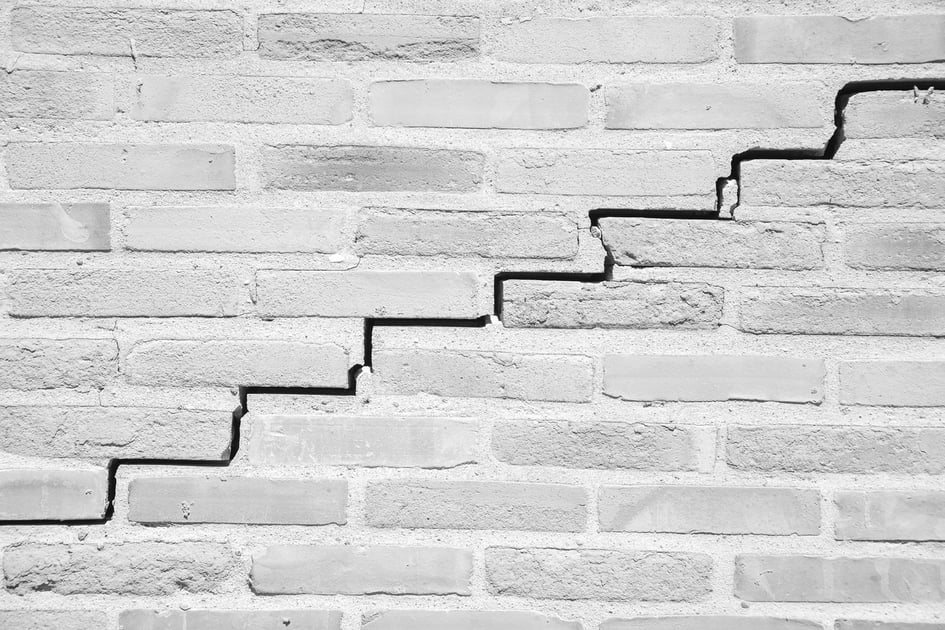
5. Stair-step cracks in brick or block walls
Stair-step cracks follow the mortar joints in brick or concrete block construction, creating the characteristic zigzag pattern up or across a wall. These indicate differential settlement: the brick is separating along its weakest path as different sections of the foundation move at different rates. Width matters here too. A stair-step crack wider than 1/4 inch, or one that continues to grow, is a sign of ongoing movement that won't resolve on its own. If you're trying to tell stair-step cracks from other patterns, resources on horizontal vs. stair-step foundation cracks explain what each pattern means.
6. Floors that slope noticeably in one direction
Furniture that leans, water that rolls consistently toward one corner of a tiled room, the sense that a room isn't quite flat, these are the early readings of floor slope caused by foundation settlement, a common slab foundation problem. A 4-foot spirit level is the right tool: place it flat on the floor and read the bubble. A reading of 1 inch or more over 4 feet is significant. Walk every room rather than checking just one spot, and note whether the slope is consistent across the house or varies by area. Inconsistent slopes in different directions suggest differential settlement, which is more serious than uniform settlement.
7. Floors that dip, sag, or feel soft underfoot
A floor that slopes is different from a floor with a specific soft spot or depression. Dips and sags point to voids beneath the slab, which form when supporting soil shifts away, erodes from a slow plumbing leak, or shrinks during an extended dry season. That one spot in the hallway that has always felt slightly springy deserves attention, not dismissal. Voids don't fill themselves, and the slab above them has no support.
8. Gaps forming along baseboards, ceilings, or exterior siding
When the structure racks out of square, materials separate at their joints. Floors pull away from baseboards, ceilings separate from walls, and exterior siding develops gaps along the foundation line. Gaps near exterior corners can be especially informative about where movement is centered. The width and location tell you something about the direction and source of that movement. These gaps aren't a finishing problem. They're a geometry problem, and the geometry is changing because the ground underneath is.
Serious foundation signs that need a specialist now
The signs in this category indicate structural threat. These are not signs to monitor for another season. The question at this severity level isn't whether to call a professional. It's how quickly.
9. Horizontal cracks in basement or stem walls
Horizontal cracks are the most serious crack pattern a homeowner can find. Unlike diagonal or vertical cracks, which indicate settlement, horizontal cracks indicate lateral soil pressure pushing the wall inward. The wall is being pushed, not just pulled downward. Even a hairline horizontal crack is more serious than a wide vertical crack. To check for bowing, hold a straight edge against the wall surface and look for a gap between the edge and the wall face. Any deviation indicates the wall is moving inward under pressure.
10. Walls that bow inward or lean visibly
Basement walls that curve inward and exterior walls that lean away from plumb both indicate significant structural movement. These aren't subtle signs. By the time a wall is visibly bowing, substantial soil pressure or settlement has already occurred. A professional needs to assess this, not just to confirm what you can already see, but to determine how much movement has occurred and whether it is ongoing. Learn when to hire a residential structural engineer to evaluate movement and guide the next steps.
11. Chimney separating from the main structure
A chimney pulling away from the house is a reliable indicator of significant differential settlement. Chimneys have their own footing, and when that footing settles at a different rate than the main foundation, the gap opens at the roofline or along the exterior wall. The separation is visible from the street. If your chimney has moved noticeably away from the house, the ground conditions beneath one or both structures have changed substantially.
12. White chalky deposits or water intrusion on concrete walls
Efflorescence, the white powdery residue that appears on concrete or masonry, forms when water moves through the material and deposits minerals on the surface. It's evidence that water is penetrating the foundation wall. Combined with any of the signs above, it confirms that water is actively involved in the soil conditions beneath the structure. Standing water near the foundation exterior, or damp basement walls with no obvious source, fits the same diagnostic pattern.
DIY checks: how to tell if you have foundation problems before calling anyone
You don't need specialized equipment to gather useful information before a consultation. Three checks will tell you a great deal about what's happening and give a specialist exactly what they need to provide a real assessment rather than a generic one, and most homeowners can complete all three in a single walkthrough. These same simple checks are also what what homeowners should look out for when viewing a property recommend for pre-purchase inspections and quick condition checks.
The floor level test
Use a 4-foot spirit level or roll a marble across hard floors in every room. A reading of 1 inch or more over 4 feet is the threshold that warrants attention. Note which direction the floors slope and whether the pattern is consistent from room to room or shifts direction. Consistent slope across the house suggests uniform settlement. Slopes that change direction between rooms point to differential settlement, a more complex condition that indicates the soil is moving unevenly beneath the slab.
The door and window operation test
Open and close every door and window in the house. Note which ones stick, which ones swing open or closed on their own (indicating the frame is out of level), and which show uneven gaps at the top or sides. Seasonal humidity can cause temporary sticking; compare performance across seasons if possible. A door that sticks regardless of weather conditions is more likely structural than seasonal.
Photographing and measuring cracks correctly
Place a coin or tape measure next to each crack before photographing it, so the specialist can assess width and length accurately. Mark the ends of cracks with a pencil and write the date next to the mark. This tells you and any specialist whether the crack grew between your inspection and a follow-up visit. Photograph from directly in front of the crack, not at an angle, and capture both the crack itself and its location within the room. This documentation is exactly what a specialist needs to give you a useful house foundation inspection remotely.
Why Southern California homes are especially vulnerable
Understanding why your house moves helps explain why foundation settlement symptoms sometimes appear suddenly in homes that seemed stable for decades. This isn't bad luck. It's the predictable result of specific soil and climate conditions.
Expansive clay soil and what dry seasons do to your foundation
Southern California is heavily underlain by expansive clay soils that swell when wet and contract sharply during dry seasons. The contraction during drought pulls support away from the foundation, creating voids and causing differential settlement across the footprint of the house. This cycle repeats every year, and the accumulated movement adds up over time. Homes that sat stable for 15 or 20 years can start showing symptoms in a single severe drought year because the soil has finally contracted beyond what the foundation can accommodate without distorting. Extension resources on shrink-swell clay soils explain how that behavior creates risk for foundations.
Drainage problems and slow plumbing leaks
Poor grading around a house directs rainwater toward the foundation instead of away from it. Clogged gutters and downspouts that discharge close to the exterior wall saturate and soften the supporting soil. The more specific risk in older Southern California homes is leaking underground pipes. A slow sewer or water line leak can erode soil and create voids beneath a slab over months, with no visible surface symptom until the slab itself begins to move. By the time the floor dips, the void has already been forming for a while.
What to do once you've spotted the signs
Knowing what you're looking at is half the problem. The other half is knowing who to call and when, and making that call before minor foundation repair signs become major structural ones.
Skip the general contractor and go to a foundation specialist
A general contractor can plane a sticking door and patch a crack. Those repairs are real, but they address symptoms rather than causes. If the soil beneath the foundation hasn't been stabilized, both problems return within a year or two. A foundation specialist evaluates the ground conditions beneath the structure, not just what's visible on the surfaces above. At any severity level above the early-sign category, a specialist is the right first call.
How a free video consultation removes the guesswork
Geobear US offers free, no-obligation video consultations for Southern California homeowners who suspect foundation problems. A foundation specialist reviews your photos, crack measurements, and floor level readings remotely and gives you a real assessment: whether what you're seeing is cosmetic, moderate, or urgent. This happens before any crew visits the property, which means you get real information without waiting weeks for an in-person appointment slot. For homeowners sitting between "I'm worried" and "I have a repair crew at my door," this is the most useful next step available.
The case for acting earlier rather than later
Most homeowners who contact a foundation specialist wish they had called sooner. Not because they were in more danger than they realized, but because early-stage diagnosis is almost always less disruptive and less expensive than late-stage repair. A slight floor slope and two sticking doors are a different project than horizontal wall cracks and visible chimney separation.
The severity framework here is straightforward. Early signs call for documentation and a professional assessment. Mid-level signs mean stop watching and start making calls. Serious signs mean act now, without another season of monitoring. Knowing which category you're in is the value of understanding what you're looking at.
If you're in the market or thinking about buying, it's also worth remembering why experts recommend you have a house surveyed before you buy it, early detection before purchase saves cost and surprise later.
Your house tells you what's happening beneath it. The signs are specific, recognizable, and consistent across homes. What changes is how long homeowners wait before paying attention. If you're still asking yourself, how do I know if my house has foundation problems, the answer starts with the 12 signs above and ends with a conversation. For more on what subsidence looks like and whether underpinning is necessary, see Geobear's guidance on how to spot the signs of subsidence and know if your house needs underpinning. Geobear US's free video consultation is exactly that second step, it starts with a call, not a crew.