What is underpinning?
Underpinning is a construction method used to strengthen and support the foundations of an existing building. It works by extending the foundations to a stronger bearing layer or by distributing the building’s load across a larger area. Typically, underpinning is required where subsidence has occurred or is occurring (what is subsidence?). Essentially, it’s a major subsidence repair technique. However, there are different ways of doing it. To ensure the right underpinning method is chosen, the current situation needs to be understood when it comes to the condition of the original foundations.
What are the different types of underpinning?
There are several different methods of traditional underpinning that are used to repair building foundations. The method of conventional underpinning used, all of which are different from Geobear’s innovative solution, will depend on the individual case. Here are the different types of traditional underpinning methods:
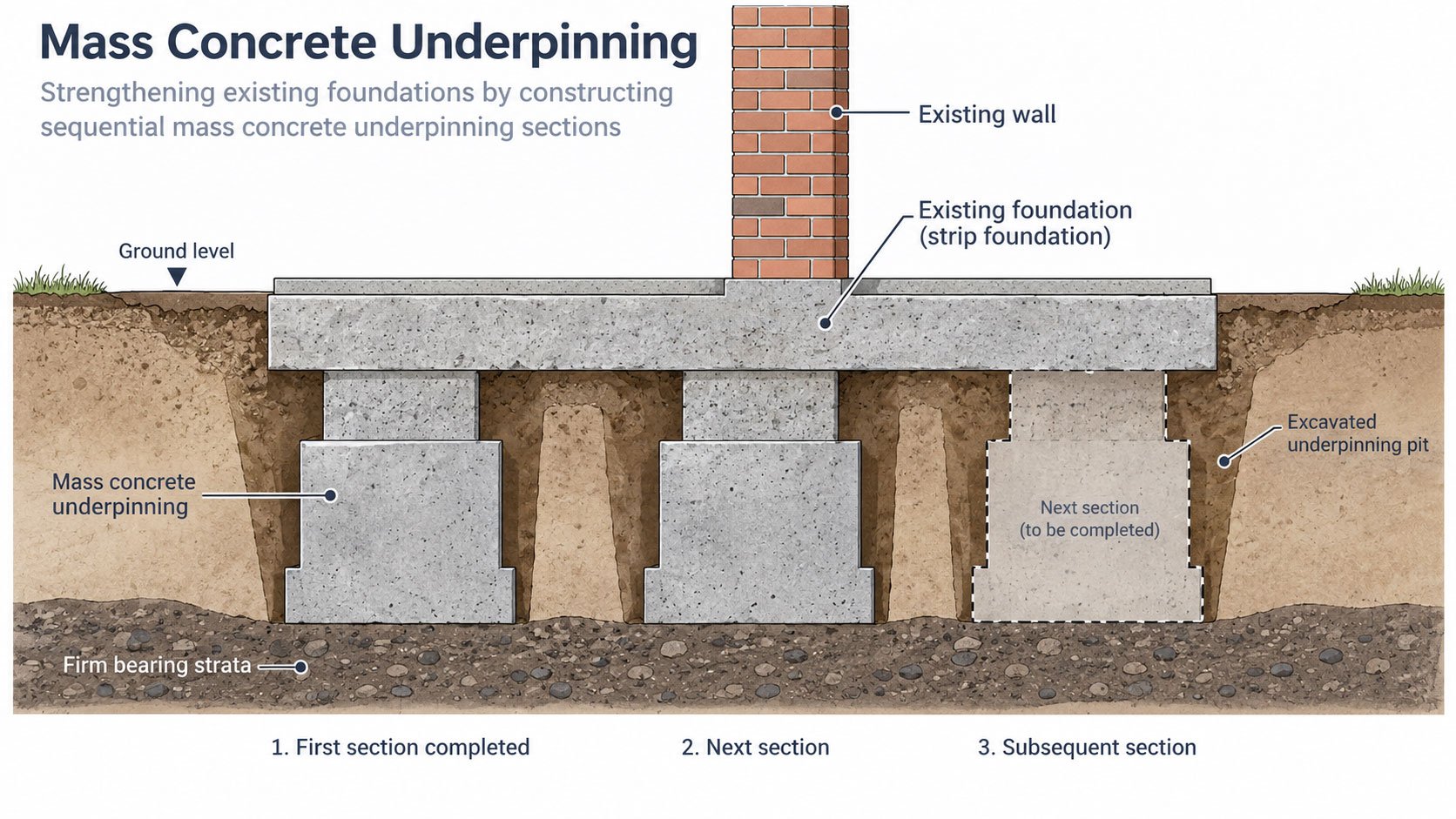
Mass concrete underpinning (pit method)
This is a traditional technique that involves excavating a series of pits beneath the existing foundations. They’ll then be filled with reinforced concrete for added strength and stability. The work is completed in stages so as to ensure that the building is supported while the foundations are extended to a more stable soil layer.
Beam & base underpinning
Beam and base underpinning uses a reinforced concrete beam. This beam is installed beneath the existing foundations to transfer the load of the building onto the new foundations. The load can also be distributed evenly across mini-piles or piers. This method is typically used where foundations require additional support or where the structural loads have increased over the course of time.

Why is underpinning necessary?
There are several reasons as to why a property owner, either domestic or commercial, may need to have underpinning services carried out. Usually, it’s because the building is subsiding. However, there are other reasons why a property owner would need to have the structure underpinned, including:
The ground has weakened
Soils will never remain static. Clay soil, for instance, shrinks in the heat and swells when it rains. On the other hand, loose soil or sandy soil can settle unevenly. Tree and shrub roots can also extract moisture from the soil, causing it to contract. The aforementioned will contribute to ground movement as the soil has been weakened over time.
The building has subsidence
Subsidence is the downward movement of a structure into the ground as it loses its load-bearing capacity. Not addressing the issue will make this problem worse. Instead, professional help will need to be sought to rectify subsidence with the help of underpinning services. Underpinning stops the ground movement, stabilises the property and prevents the subsidence from getting any worse.
The load has changed
If you’re adding an extension, converting a garage or a loft, then it’s important to consider that the original foundations may not be strong enough to sustain the additional weight. This is when underpinning may be needed. Underpinning will simply strengthen the ground below the foundations, giving you peace of mind that your extension, bay window or even your house will be stable after property adaptations have been made.
The original foundation wasn’t sufficient
Properties that have shallow, old or outdated foundations may need underpinning to bring them up to the standards of today. Underpinning strengthens and updates the original foundations without needing to rebuild the entire structure.
The adjacent ground has been disturbed
When the ground surrounding the original foundations has become disturbed, it can compromise your property’s foundations. Construction works next door, deep excavations, new basements or tunnelling can all contribute to foundation weakening. This can sometimes mean that underpinning is necessary.
How to know if your property needs underpinning
When a property requires underpinning, it’s usually somewhat obvious. There are several signs that will appear in and around your property that will suggest ground movement is at play. Some of the signs that your house needs underpinning include:
- Cracks that are wider than 3mm both on the interior and exterior of the house
- Cracks that run diagonally or that follow the mortar line
- Cracks on the inside that mirror visible cracks on the outside
- Windows and doors that are difficult to open
- Windows and doors that are difficult to close
- Gaps between skirting boards and floors
- Gaps between coving and ceilings
- Wallpaper rippling when no damp is present
- An extension coming away from the main building
- The building is visibly leaning to one side
How much does underpinning cost?
Traditional underpinning methods that involve extensive excavation and possible relocation for the occupants will be costly. On average, conventional underpinning services in the UK can cost anywhere between £1,000 and £1,500 per linear metre. In London, this can be even more, often costing around £2,000+ per linear metre. You might now be wondering why those figures differ so considerably. This is usually down to a combination of several factors.
Everything that can affect the overall cost of traditional underpinning services across the country is as follows:
- The depth of the excavation required to reach the original foundations
- The weight and size of the building itself
- The type of traditional underpinning method required
- The conditions of the ground, including soil type
- Access restrictions to the property
- Additional preparation, groundworks or reinstatement works if and when required
Do you need planning permission to have a building underpinned?
Generally, planning permission is not needed in the UK to have underpinning carried out on your home. This is because work is usually carried out on the existing and original building foundations. However, there are some instances where planning permission for underpinning may be needed, such as:
- Your property is a listed building
- Your property is in a conservation area
- The underpinning will change the outer look of the property
- Underpinning is needed to sustain a house extension or a room conversion within the existing structure, such as a loft or garage conversion
Underpinning doesn’t always require planning permission, but it must still comply with all current building regulations. This is because underpinning counts as major building work, and so a structural design from a qualified engineer will need to be submitted by either the homeowner or the underpinning contractor.
The subsequent work needs to then be inspected to ensure it stops the structural movement and protects sewers and drains that may sit nearby. Each situation is different when it comes to planning permission, but building regulations approval is mandatory when it comes to underpinning.
Should I buy a house that’s been underpinned?
You need to think carefully about buying a property that’s been underpinned. However, if the work has been carried out to a high standard, then there’s no reason not to follow through with the purchase.
Before committing, you should ask to view relevant and legitimate paperwork from the current homeowners that proves that underpinning was done. This will also include further details that you can check up on, such as the firm that did it and when it was done.
This too will make it easier to come to a final decision on whether a property should be purchased if it has been underpinned. In addition, it’s recommended that you have a structural survey carried out on the property for added peace of mind.

As well as this, some house buyers may want to consult with a house insurance firm, specifically from the perspective of building and contents insurance. This is usually done as a way to gain clarification on premiums and monthly payments, which may increase if it’s found the property has been underpinned or if it has an ongoing subsidence history.
While purchasing a property that has been underpinned may be more straightforward, buying a house that still requires underpinning as a result of subsidence may be somewhat more difficult to navigate. However, by taking all of the above points and recommendations into consideration, you’ll be able to make an informed decision about whether or not you should purchase the property.
Despite all of this, we cannot say definitively whether or not you should buy a property that has been underpinned. You need to do your research beforehand. But bear in mind, just because a house has been underpinned doesn’t mean that it’s structurally weak. It just means that it was an issue, and now it isn’t.

How does underpinning affect my house insurance?
Usually, underpinning can make your home or house insurance more expensive. It can also be more difficult to find cover if the house has a history of subsidence. This is because most insurers will view past structural movement as an ongoing risk, even in cases where subsidence has been rectified. In addition, you must declare both past and present instances of subsidence and underpinning work when applying for insurance coverage. Some of the main ways in which house insurance will be affected by underpinning include:
- Increased monthly payments - insurers can charge higher premiums for underpinned homes or for houses that are yet to be underpinned
- Higher excess - you may need to pay a higher excess amount if underpinning needs to be done, or if it’s been done in the past and needs to be underpinned again
- Limited product choice - mainstream providers can decline building insurance entirely if the property has been underpinned in the past. This may force you into using a more expensive, specialist insurance provider
Do I have to declare underpinning work if I am selling my property?
Yes. You must declare past subsidence instances and any subsequent underpinning work. This is the same whether you’re applying for insurance or selling your home. If you do not declare subsidence and underpinning, you may be presented with a misrepresentation claim, even after sale completion. Some of the essential paperwork you will need to provide when selling a house that needs or has undergone underpinning services includes:
- A Certificate of Structural Adequacy
- An Underpinning Completion Certificate
- Any warranties or guarantees associated with underpinning work already done
- A history or related building insurance claims
If you’re unsure about selling a property that has been underpinned or that requires underpinning, consult with your conveyancer for further legal advice, ensuring that you’re as open and honest as possible about the structural condition of the property.
What are the benefits of underpinning?
Underpinning has its benefits in its more traditional, conventional form. Where the Geobear geopolymer resin injection method is incredibly efficient, effective and non-disruptive, traditional underpinning methods also have their advantages, albeit not as many. Let’s take a look at the benefits of conventional underpinning:
- It provides a permanent structural solution to subsidence issues, just like the Geobear geopolymer resin injection method
- It’s suitable for a wide range of soil types, as is the Geobear solution
- It can be used to repair even the most extensive of subsidence problems, much like the Geobear method
- It can be used on both commercial and domestic properties, which is the same for Geobear’s geopolymer resin injection method
What are the downsides of traditional underpinning?
When compared with other, more modern methods of underpinning, like the Geobear geopolymer resin injection method, traditional underpinning methods do have several downsides, all of which are avoided when more innovative solutions are chosen, such as that offered by Geobear. The disadvantages of conventional underpinning methods include:
- The process is disruptive
- It’s more time-consuming
- The cost is often far higher than modern alternatives to underpinning
- Extensive excavation is required, increasing mess and disruption in the process
- Occupants of the address may have to relocate temporarily while work is carried out
- Driveways, gardens and patios may be significantly disturbed to gain access to the foundations
Conventional underpinning vs. the Geobear geopolymer resin injection method: How are they different?
While they might seem like a similar approach to resolving subsidence, traditional underpinning and the Geobear innovative subsidence solution are very different. Here’s how they compare:
|
Traditional Underpinning |
Geobear’s Geopolymer Resin Injection Method |
|
Weeks of excavation are needed |
Work will be completed in 12 days (depending on the severity of the case) |
|
Large trenches will need to be dug to access the foundations |
The ground will be injected, creating small holes to allow for the geopolymer resin to work its way along gaps and voids |
|
Gardens, driveways and patios will be disturbed, which can require costly repairs |
No excavation is needed, so disruption is minimal |
|
Occupants may need to temporarily relocate while work is being undertaken |
Occupants can remain at their property as everyday life will not be disrupted |
|
Significant reinstatement |
Little to no reinstatement |
|
Carbon footprint is often high |
Carbon footprint is considerably lowered with the Geobear method |