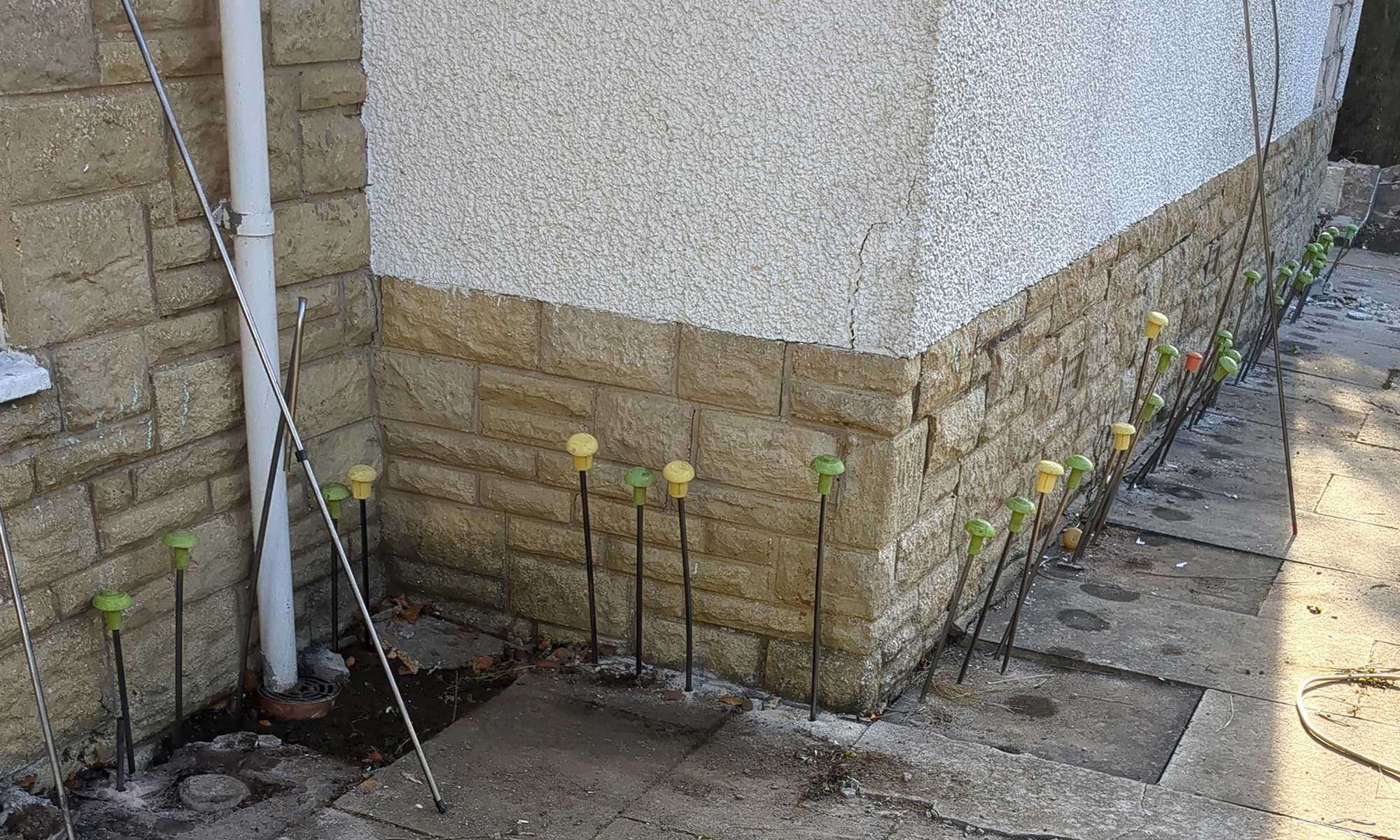
Challenge
The rear of a bungalow in Kirkcaldy was settling and cracking because it stands on loose fill in a backfilled quarry.
Solution
Geobear ground improvement solution designed to densify the loose made ground beneath the foundations in a programmed eight shifts, without excavation or piling.
Depth probed in fill
Programmed time on site
Guarantee on treatment
The property is a single-storey brick house in Kirkcaldy, Fife. It stands at the top of a wooded embankment, with the ground falling steeply away beyond the garden.
The owner was planning alterations, including a part garage conversion and a new decking area, and the consulting engineers for that scheme commissioned a ground investigation in the back garden.
The rear of the house was pulling down, with minor cracking inside and out that had been developing for more than a year. The owner contacted Geobear and the ground improvement was carried out.
The investigation put down boreholes with standard penetration tests in the back garden to about 5 m, and continued each position with super-heavy dynamic probing to 10 m. The logs describe made ground throughout: loose, occasionally medium dense, dark brown sand and gravel of mixed lithology, with cobbles, brick, mudstone fragments and sandstone rubble, and in one borehole a very loose layer over soft silty sand. No groundwater was observed.
The probe records show low blow counts through much of the upper fill, with resistance increasing at depth. Fill of this kind, placed without controlled compaction, continues to settle under its own weight and under building loads, and settles unevenly where its thickness or density varies.
Geobear assessed the cause of the subsidence as poorly compacted fill in the backfilled quarry. That is consistent with the historic mapping and the investigation, but it remains an engineering assessment rather than a tested conclusion. The foundations were assumed to be shallow strips bearing in the fill.
Drains ran close to the treatment area and had to be monitored during injection, and hatches had to be cut in the floor so that the ground beneath internal walls could be reached.
For a house on deep, loose fill, the usual conventional option would be piled underpinning: mini-piles installed through the fill to a competent stratum, with needle beams or a new reinforced slab to carry the walls. With loose fill proved to at least 5 m and probing continued to 10 m, traditional mass concrete underpinning would not have been practical.
Piling would mean rigs working inside and around the house, breaking out floors and extensive reinstatement.
A Geobear ground improvement solution injects expanding geopolymer into the fill beneath the foundations through small drilled holes. The expansion compacts the loose material and fills voids, increasing its density and bearing capacity without excavation.
Geobear designed a ground improvement solution using targeted geopolymer injection beneath the foundations of the bungalow in Kirkcaldy. The engineering objective was to densify the loose made ground beneath the footings and stop further settlement of the rear of the house.
The house was empty at the time of the survey, which was carried out by video. The owner arranged a drainage survey and the floor hatches set out on the treatment plan, and drains were monitored during injection.
Every home is unique. Our experts are ready to listen and provide answers tailored to your specific property and concerns.