Challenge
Foundation movement on shrinkable clay had damaged the rear bay of a tenanted London house, with cracking escalating over three years.
Solution
Geobear clay solution treated the clay beneath the front and rear foundations in a programmed four shifts, as an alternative to traditional underpinning.
Programmed time on site
Of escalating damage
Insurance-backed guarantee
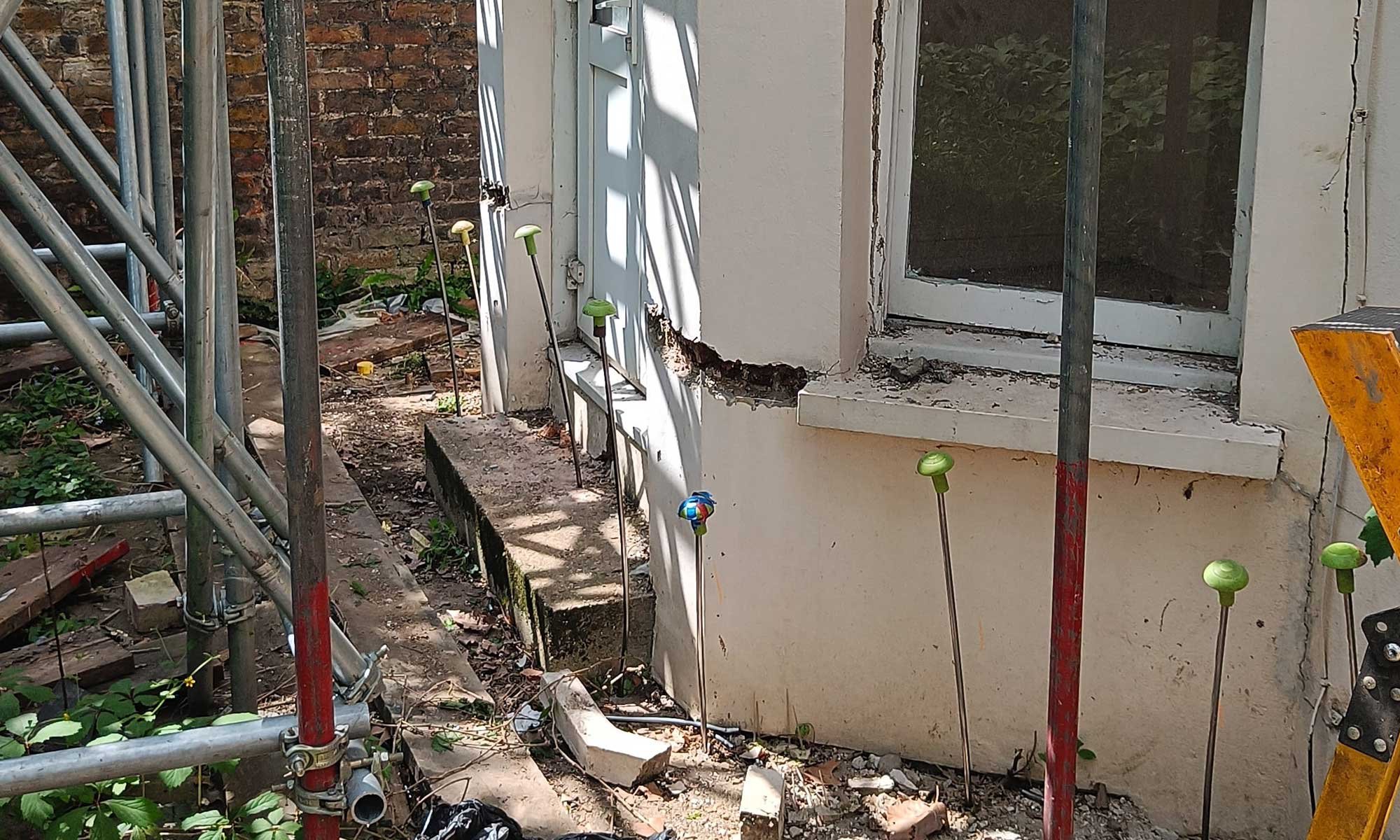
The property is a three-storey brick house in west London, owned by a housing association and occupied by its tenants. At the rear, a two-storey bay with a roof terrace above had been damaged by foundation movement.
The housing association’s structural engineer prepared a remedial scheme and in the interim the bay was propped on a temporary scaffold. Over time the damage had increased, the scaffold had settled away from the bay and its timber packing had fallen out, so it was no longer giving support.
The housing association approached Geobear for an alternative way of stabilising the foundations. Geobear surveyed the property commissioned a site investigation and drainage survey and designed a treatment.
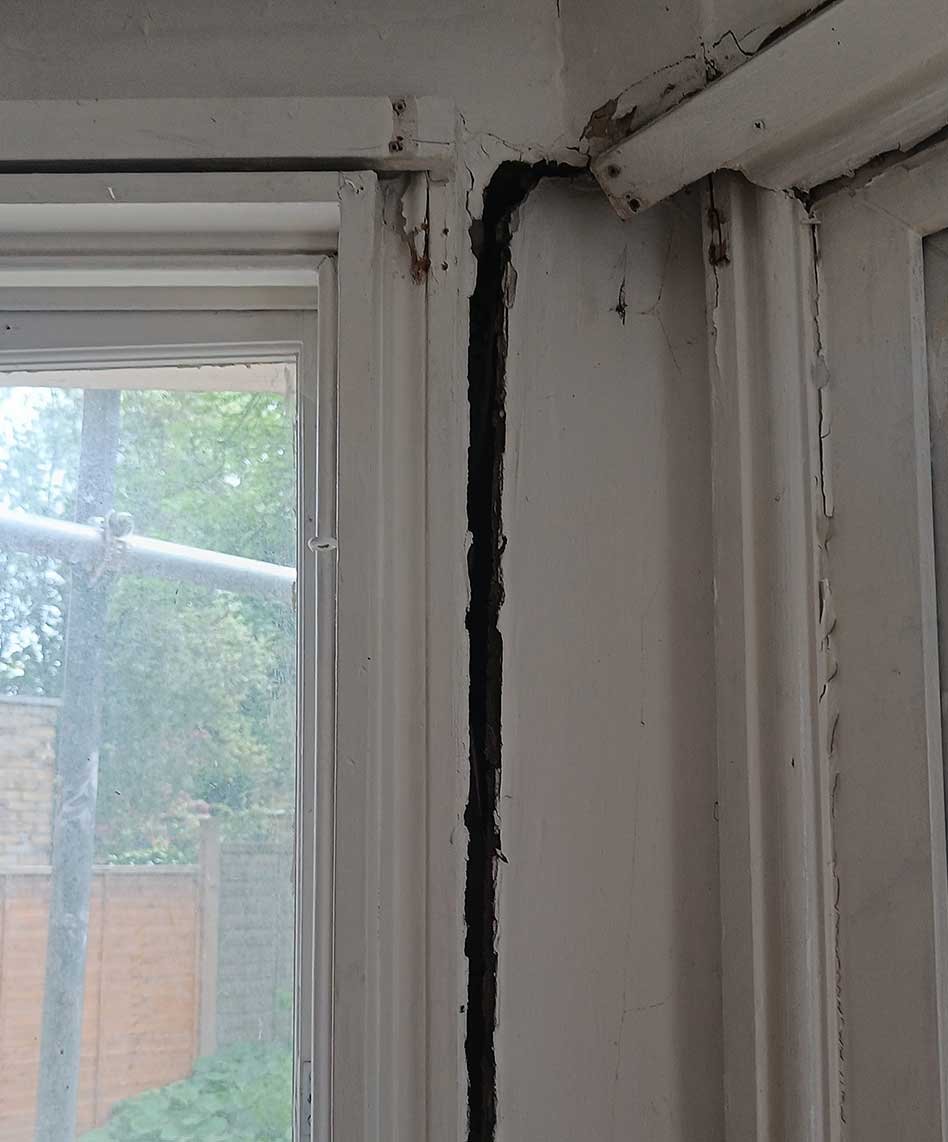
The engineer’s inspection compared the damage with photographs from previous years and found that it had escalated over three years, attributed partly to the very dry weather. Geobear’s own survey recorded cracking at both the front and rear of the house.
The site investigation comprised two trial pits and two boreholes, one taken to 5.0 m. Beneath the foundations it found stiff to very stiff brown and grey-veined silty clay with claystone nodules, with hand vane readings above 140 kPa at every depth tested. Roots were recorded to 1.8 m and the boreholes were dry. The clay was therefore strong but dry, pointing to shrinkage of the clay as it loses moisture, rather than weak ground, as the mechanism of subsidence.
A CCTV survey of the rainwater drainage on the same day found a second contributing factor. At the rear, the rainwater gully was broken and discharging water directly into the ground, and the drain run beyond it had an open joint and was in very poor condition. At the front, the run beneath the property had circumferential fractures and a liner that had not inverted properly, leaving voids behind it.
The house was occupied, with buried gas, water, electricity and fibre services close to the treatment areas and only on-street parking for the injection vehicle.
The alternative called for the two-storey bay and terrace parapet to be dismantled, the old stepped brick footing grubbed out, and new mass concrete bases cast in a five-bay sequence.
For the foundations, traditional underpinning meant hand excavation in sequence, concrete deliveries through an occupied terraced house, spoil removal and prolonged disruption to the tenants.
A Geobear clay solution treats the ground through small-diameter holes drilled beside the foundations, with no excavation beneath the house.
Geobear designed a clay solution using targeted geopolymer injection beneath the foundations at the front and rear of the house. The treatment reduces permeability, so the clay gains and loses less moisture through the seasons and its shrink–swell movement is limited.
The Geobear works were programmed as four shifts, the main benefit was avoiding excavation beneath an occupied home. The treatment is covered by a 10-year insurance-backed guarantee.
Every home is unique. Our experts are ready to listen and provide answers tailored to your specific property and concerns.