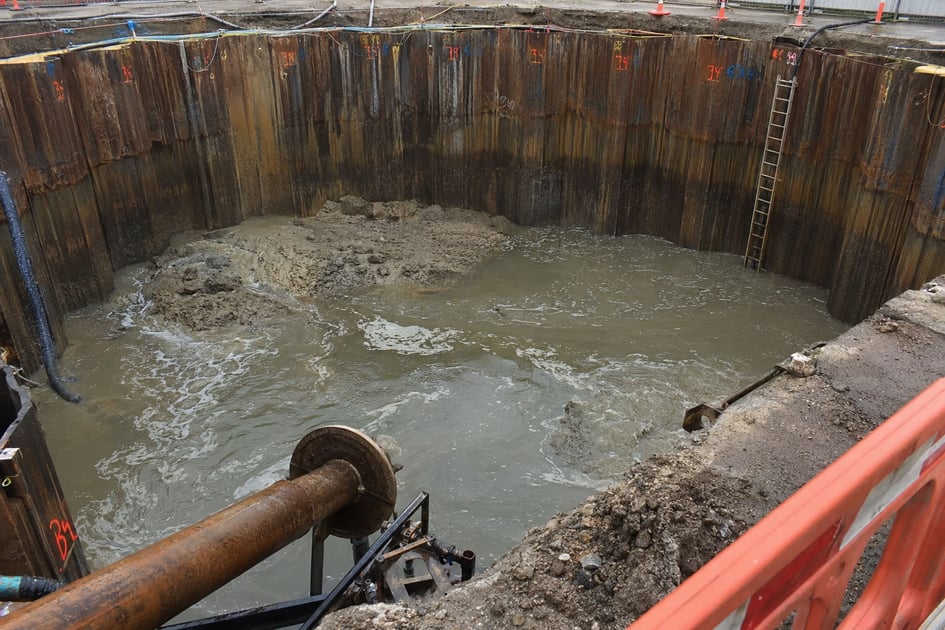
Sheet pile wall plug failure: Why excavations collapse and how to prevent costly delays
Understanding plug failure in sheet pile excavations
Deep excavations supported by sheet pile walls are common across infrastructure, marine, commercial, and residential construction projects. While attention is often focused on wall deflection, bending moments, and structural capacity, one of the most critical geotechnical risks can be overlooked: plug failure.
When plug failure occurs, the consequences can be severe, leading to flooded excavations, ground loss, damage to adjacent assets, programme delays, significant cost overruns, and in extreme cases, excavation collapse.
Understanding the causes, warning signs, and mitigation options is essential for developers, designers, and contractors seeking to minimise project risk.
What is plug failure?
The "plug" is the mass of soil beneath an excavation enclosed by sheet pile walls. The embedded section of the sheet piles is designed to provide both structural support and a hydraulic barrier, helping resist:
- Groundwater uplift
- Hydraulic heave
- Piping
- Basal instability
Plug failure occurs when this soil mass loses stability and moves upward or inward into the excavation.
Hydraulic plug failure
Hydraulic plug failure occurs when groundwater pressure beneath the excavation exceeds the weight of the soil plug.
Typical consequences include:
- Upward movement of the excavation base
- Sand boils
- Piping
- Sudden water ingress and flooding
Geotechnical plug failure
Geotechnical plug failure occurs when the soil beneath the excavation lacks sufficient shear strength to resist excavation-induced stresses.
Typical consequences include:
- Base heave
- Progressive soil movement
- Loss of wall support
- Excessive deformation
Common causes of plug failure
1. Insufficient sheet pile embedment
One of the most common causes of plug failure is inadequate pile penetration into competent ground.
This may result from:
- Unexpected refusal during installation
- Incorrect interpretation of ground investigation data
- Value engineering decisions
- Construction tolerances
Without sufficient embedment, both passive resistance and hydraulic cut-off performance can be compromised.
2. Underestimated groundwater conditions
Groundwater behaviour is often more complex than initial investigations suggest.
Potential issues include:
- Artesian pressures
- Seasonal groundwater fluctuations
- Permeable sand lenses
- Previously unidentified aquifers
Even modest increases in groundwater head can significantly reduce excavation stability.
3. Weak or variable ground conditions
Many failures occur because actual ground conditions differ from those assumed during design.
Problematic materials may include:
- Soft alluvial deposits
- Peat
- Loose sands
- Organic soils
- Variable made ground
Even a relatively thin weak layer can form a critical failure surface beneath an excavation.
4. Excessive excavation depth
Over-excavation, even by a relatively small amount, can significantly reduce the factor of safety against plug failure.
This can occur when excavation levels are adjusted on site to facilitate construction activities.
5. Groundwater drawdown outside the excavation
Dewatering systems can create complex groundwater gradients that increase seepage forces beneath the excavation.
Poorly managed groundwater control can:
- Induce piping
- Accelerate soil migration
- Increase uplift pressures
- Reduce overall stability
6. Inadequate ground investigation
Many plug failures can ultimately be traced back to insufficient site investigation.
Common shortcomings include:
- Widely spaced boreholes
- Limited groundwater monitoring
- Inadequate laboratory testing
- Failure to identify local geological anomalies
Warning signs of impending failure
Early identification can prevent a major incident.
Common warning signs include:
- Unexpected water inflows
- Sand boils at formation level
- Softening of the excavation base
- Localised ground heave
- Increased sheet pile wall movement
- Monitoring results exceeding predicted values
- Rising pumping volumes
These indicators should always be investigated promptly.
The impact on developers and contractors
The true cost of plug failure often extends far beyond the immediate repair works.
Programme delays
Excavation works may need to stop immediately while emergency stabilisation measures are designed and implemented. Delays can range from weeks to several months.
Increased construction costs
Additional costs commonly include:
- Emergency pumping
- Temporary works redesign
- Additional sheet piling
- Ground treatment
- Specialist geotechnical investigations
Damage to adjacent assets
Ground movement can affect surrounding infrastructure and structures, leading to:
- Settlement
- Utility damage
- Pavement movement
- Property damage
Reputational risk
High-profile failures can impact stakeholder confidence, client relationships, and future project opportunities.
Remediation options
The appropriate solution depends on the failure mechanism, soil conditions, groundwater regime, and project constraints.
Additional sheet pile penetration
Where feasible, increasing embedment depth can improve:
- Passive resistance
- Hydraulic cut-off performance
- Overall excavation stability
However, this option is often impractical once excavation has commenced.
Internal bracing or anchors
Additional support systems may help reduce wall movement and improve structural performance.
Examples include:
- Temporary struts
- Waler systems
- Ground anchors
While effective for structural issues, they may not address hydraulic instability.
Groundwater control
Groundwater management measures may include:
- Deep wells
- Wellpoint systems
- Relief wells
- Recharge systems
Careful hydrogeological assessment is essential to avoid unintended consequences.
Jet grouting
Jet grouting can create a stabilised plug beneath the excavation by forming high-strength soilcrete columns.
Advantages:
- High strength
- Excellent groundwater control
Disadvantages:
- Relatively expensive
- Slower installation
- Increased site disruption
Secant or diaphragm wall upgrades
In severe cases, a more robust retaining structure may be required where the original sheet pile solution no longer provides adequate performance.
Geobear ground improvement solutions
In suitable ground conditions, Geobear's geopolymer ground improvement technology can be used to:
- Increase soil stiffness
- Improve bearing capacity
- Reduce permeability
- Enhance plug stability
Key benefits include:
- Minimal disruption
- Rapid installation
- No excavation required
- Reduced programme impact
This approach can be particularly attractive where access constraints, operational requirements, or programme pressures make traditional ground improvement methods challenging.
Preventing plug failure
Prevention remains the most effective strategy.
For designers
- Undertake robust basal stability assessments
- Consider worst-case groundwater scenarios
- Perform sensitivity analyses
- Ensure adequate ground investigation coverage
For main contractors
- Monitor excavation levels carefully
- Maintain groundwater monitoring throughout construction
- Implement trigger-action-response plans
- Escalate unexpected ground conditions immediately
For developers
- Invest in comprehensive site investigations
- Challenge unrealistic programme assumptions
- Address geotechnical risks early in the design process
Conclusion
Plug failure is one of the most significant geotechnical risks associated with sheet pile wall excavations. While failures can appear sudden, the underlying causes are often present long before instability becomes visible.
Successful projects depend on robust design, accurate ground investigation, careful construction control, and proactive monitoring. Where instability is identified early, a range of remediation measures—from groundwater management and structural reinforcement to advanced ground improvement techniques—can often stabilise the excavation before major delays and costs are incurred.
Understanding plug failure is therefore not simply a geotechnical consideration; it is a critical aspect of effective project risk management.