Highways

Rapid pavement stabilisation on the A14: Restoring safety through precision engineering

Challenge

Uneven slabs on a heavily trafficked route required rapid re-levelling, minimal excavation, and strict control of night-time possessions to avoid commuter disruption.

Solution

Geobear injected expanding geopolymer beneath affected slabs, filling voids, displacing water, and precisely re-levelling the pavement within tightly controlled night closures.

871 m² stabilised

Concrete pavement area treated and re-levelled

0.5 mm precision control

Laser-monitored slab lifting accuracy

30 minutes cure time

Road reopened shortly after injection works

Background

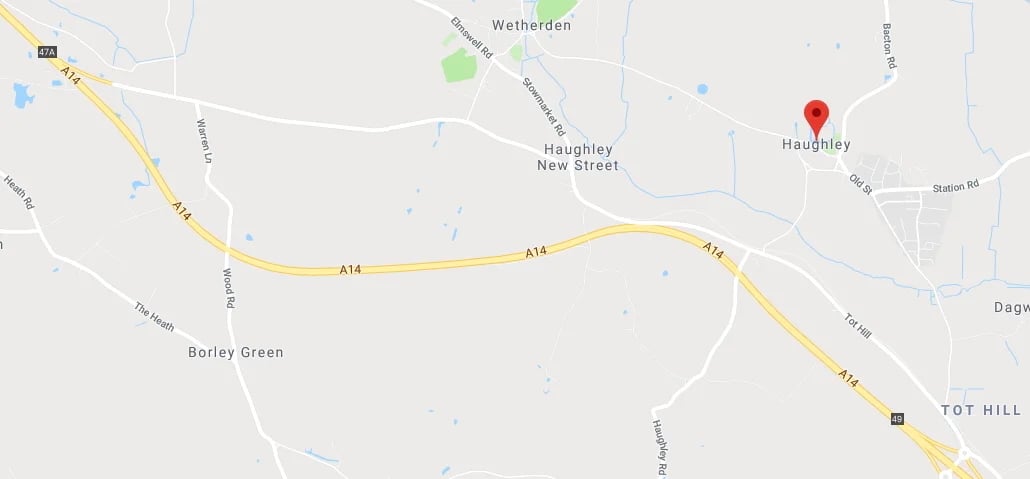
Following a routine condition survey, a section of the A14 at Haughley was identified as having uneven concrete slabs that created an unsafe running surface. The deterioration was attributed to a combination of long-term traffic loading, water ingress, settlement, and surface wear.

Given the strategic importance of the A14 as a major commuter and freight route, the road operator required a solution that could rapidly restore surface levels while minimising disruption to traffic flow. The works formed part of a wider pavement renewal scheme, with slab stabilisation required ahead of resurfacing activities.

Challenge

The uneven pavement posed an immediate safety risk on one of the UK’s busiest roads. Highways England required the surface to be re-levelled as quickly as possible while limiting disruption to traffic flow.

Traditional dig-out and slab replacement methods would have required extended closures, significant excavation, and increased cost, making them unsuitable for this location and defect type.

Solution

Infrastructure contractor Osborne appointed Geobear to stabilise and re-level the affected pavement slabs using geopolymer injection.

Treatment areas were identified and marked in advance using pavement drawings. A total of 871 m² of concrete pavement across the eastbound and westbound carriageways between Junctions 47A and 49 was treated.

The solution involved:
  • Drilling 14 mm diameter holes through the slabs at 1 m centres
  • Injecting Geobear’s GP 1735 geopolymer directly beneath the slabs
  • Rapid expansion of the geopolymer to fill voids, displace water, and densify underlying soils
  • Continuous laser level monitoring, recording lift increments as small as 0.5 mm to ensure precise control

The fast-reacting geopolymer cured within minutes, allowing the carriageway to reopen quickly following each treatment phase.
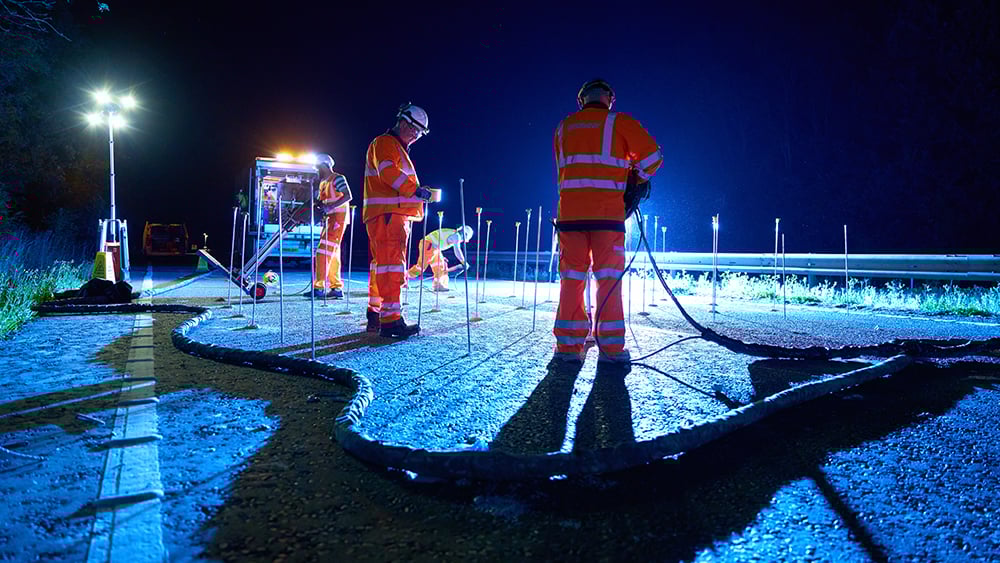
Geobear techs working injection points at night on a motorway with injection system hose in foreground


Results

  • Unsafe slab steps were eliminated, restoring a smooth and compliant road surface

  • Subgrade support was stabilised, reducing the risk of future settlement

  • All works were delivered within a two-week night shift programme

  • The road reopened to traffic within 30 minutes of injection completion, maintaining normal daytime operations

The project demonstrated how geopolymer injection can provide a rapid, non-invasive, and highly controlled solution for highway pavement stabilisation on critical transport routes.

Ready to discuss your project?

Get in touch with our expert team today and discover how Geobear can extend the life of your critical infrastructure assets.

Bear pointing Bear pointing