Challenge
Differential settlement and stiffness mismatches at the UBC4 rail transition caused recurring twist faults, yet Irish Rail needed a fast, non‑intrusive solution that avoided prolonged closures on the busy Dublin–Cork main line.
Solution
Geobear used high‑density geopolymer injection beneath the track to strengthen the subgrade, improve stiffness and stabilise the transition zone rapidly during night possessions without excavation or track removal.
Reduction in short and long twist faults post‑treatment
Total injection points across the transition zone design
Night‑time possessions used to deliver the works
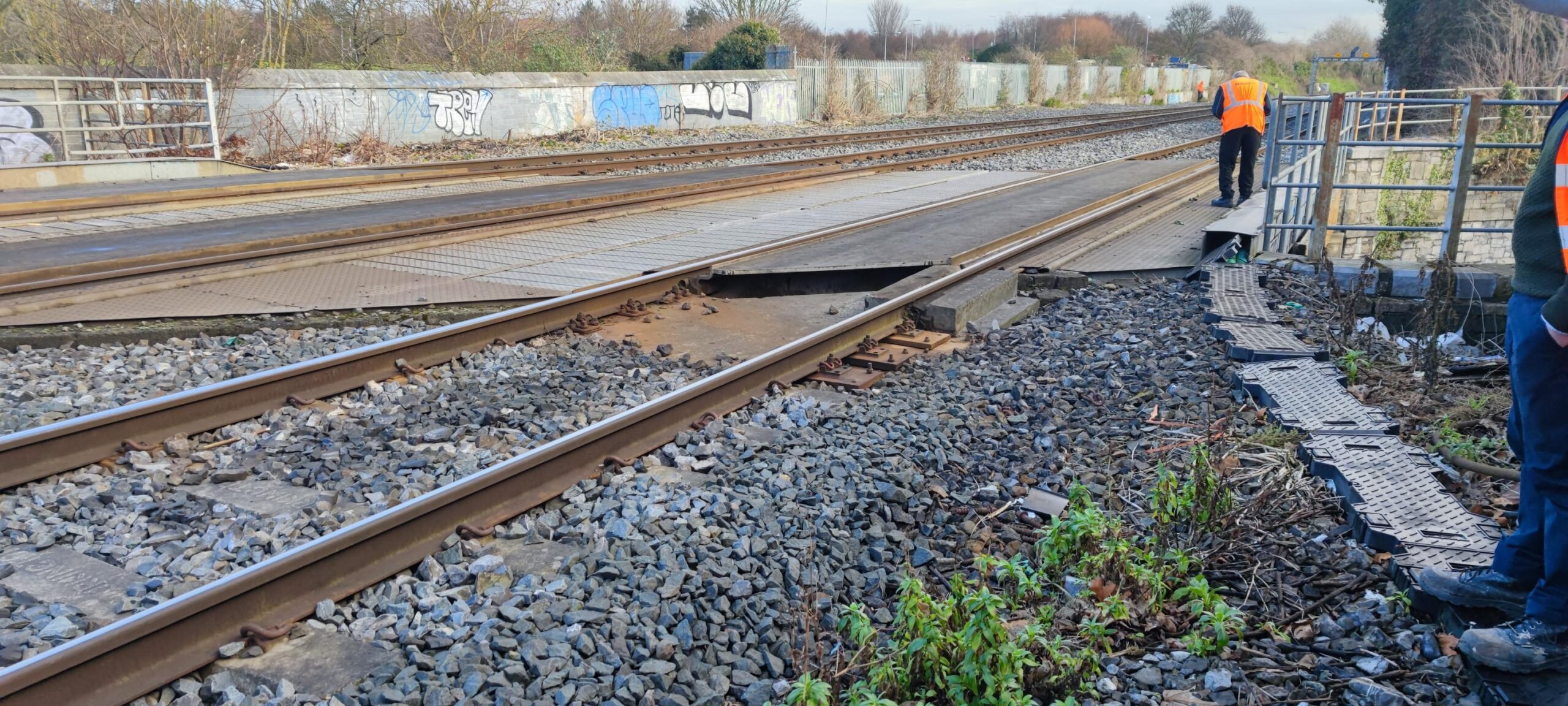
At UBC4 on the Dublin–Cork main line, a skewed single‑span bridge over Sarsfield Road experienced persistent differential settlement at the track transition zone. This led to rail distortion and twist faults that required frequent maintenance but without resolving the underlying subgrade stiffness deficit. A solution was needed that addressed the root cause without disrupting services on this key national rail route.
Irish Rail sought to eliminate recurring twist and warp faults in track geometry while avoiding major service interruptions. Traditional reconstruction would have required weeks of line closure, which was untenable on a busy main line. The intervention needed to improve subgrade stiffness reliably while fitting within restricted night‑time possession windows and without removing track or excavation.
Geobear deployed high‑density geopolymer injection to stabilise and strengthen the subgrade beneath the track in the transition zone. A ground model was developed from borehole data and PLAXIS analysis, and the transition zone length was calculated based on line speed.
The design focused treatment within the top 1.5 m of soil, where over 90 % of strain was observed, and specified 528 injection points spaced at multiple depths.
Works were executed over 19 night‑time possessions without the need for excavation or track removal. Real‑time lift monitoring and laser levelling ensured precise control. Approximately 10 tonnes of geopolymer were installed with zero safety incidents.
Dynamic Cone Penetrometer testing confirmed that soil stiffness targets were met consistently across the transition zone, with increased stiffness near the bridge abutments. Track geometry monitoring showed a 59 – 69 % reduction in twist faults, and 75 % of red fault locations were downgraded to less severe categories.
No tamping was required between monitoring intervals. The treatment delivered a consistent stiffness profile and improved track performance without excavation or extended closures.
Get in touch with our expert team today and discover how Geobear can extend the life of your critical infrastructure assets.