Utilities

Ground improvement and permeability reduction for pipeline renewal

Challenge

A leaking pipeline caused soil washout and instability within water-bearing silty sands, creating settlement risks around the proposed cofferdam and nearby residential infrastructure.

Solution

Geobear delivered targeted geopolymer injection to strengthen the ground and reduce permeability, enabling safe cofferdam excavation while controlling water ingress and surface movement.

14 ejector wells

installed — 17 m deep, 20 m diameter

~60 mm

settlement induced, soils consolidated to design density

Zero service disruption

interruption or property movement recorded

Background

The project involved the renewal of a large-diameter water pipeline located within silty sand deposits susceptible to erosion and loss of fines.

The pipeline leak had created the potential for soil washout and ground instability. To allow replacement works to proceed safely, a cofferdam structure was designed to isolate the working area. Two pipelines passed through the cofferdam, resulting in openings in the sheet piles forming the cofferdam walls.

Prior to installing sheet piles, the ground required treatment to:

  • Increase soil strength to improve stability of the excavation area surrounding the pipe
  • Reduce material permeability to limit water ingress

Geobear was appointed to carry out ground improvement and permeability reduction.


Challenge

Variable silty sand deposits

The ground conditions consisted primarily of water-bearing silty sands with variable consistency, presenting several geotechnical challenges:

  • Migration of fines due to groundwater movement
  • Borehole instability during drilling
  • Risk of uncontrolled grout migration without careful injection control

A precise injection strategy was therefore required to achieve the specified ground improvement and permeability reduction.


Permeability reduction requirement

The project specification required measurable reduction in soil permeability within the treatment zone to limit water ingress during excavation within the cofferdam.

Initial permeability estimates were derived from CPT profiles, which provide interpreted estimates of soil permeability based on derived soil type, which is itself derived from cone and shaft resistance and pore pressure measurements obtained during testing. The permeability of the layer was shown to range between 6x10^-7 and 6x10^-5 m/s, with a 50th Percentile typically in the order of 6x10^-6 m/s.

Further testing of the initial conditions was carried out using variable head testing, which measured an average permeability of 1.5x10^-5 m/s for the silty sand. Verification testing was required to confirm treatment performance following the Works.


Control of ground heave

At the outset of our Works, Geobear carried out a trial to develop our understanding of anticipated ground heave in the local ground conditions. The trial demonstrated that injections within 2 m of the ground surface could generate noticeable ground heave.

When injections were undertaken at 1.5mBGL, surface movement of 5–20 mm was recorded.

To mitigate this risk:

  • injection depths were controlled
  • injection sequencing was optimised
  • monitoring procedures were implemented during the works.

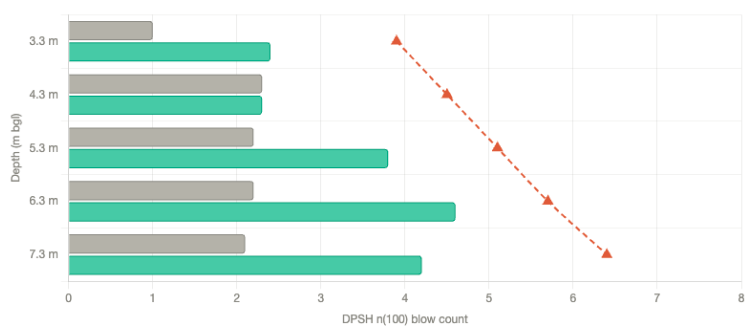
In addition to observations of surface heave, densification of the ground was measured using the Pagani 30/20 probe prior to and following injections. The post-injection measurements were on average 60% greater, indicating significant betterment.
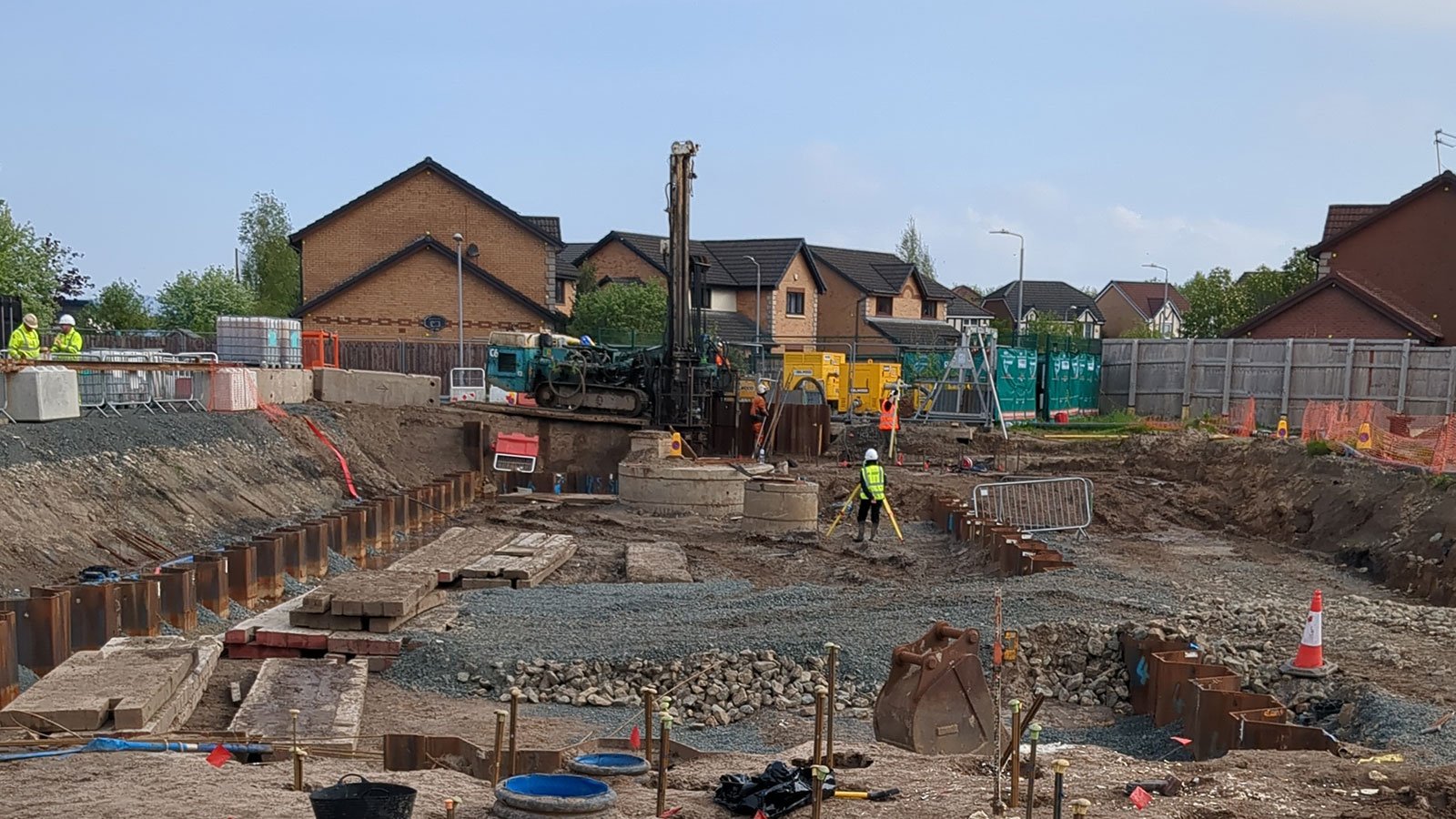
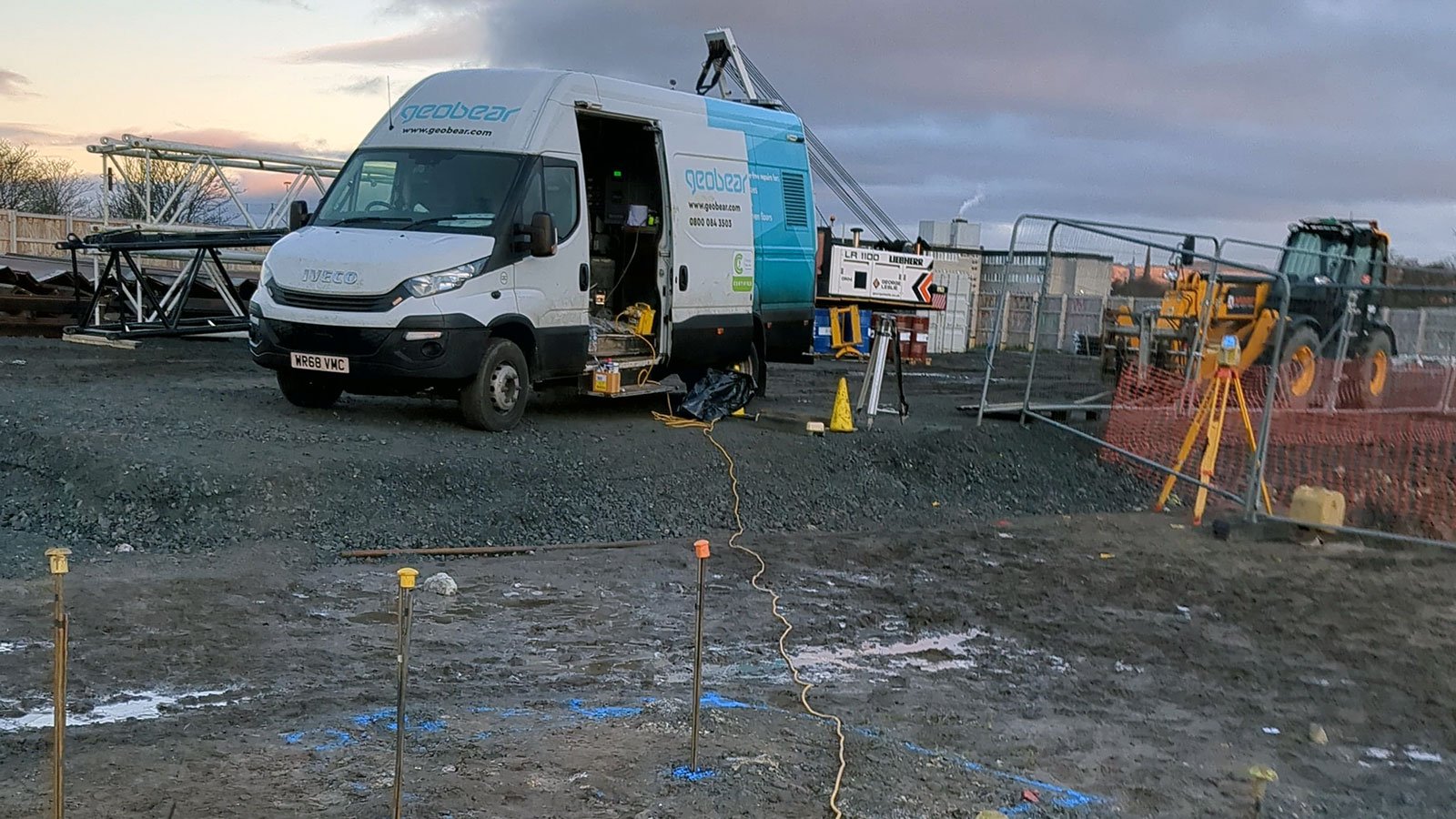
 

Precision, control, and safety — Geobear stabilised Renfrew’s pumping station without excavation, sealing leaks and protecting homes above fragile alluvial ground.

Solution

Geobear designed a targeted geopolymer injection programme to deliver both soil strengthening and permeability reduction.

The injection design was developed based on:

  • CPT data interpretation
  • Trial injection results
  • Observed surface heave behaviour.

Our permeability reduction design involved a grid of injections carried out on a closely spaced staggered grid. Similarly, our ground improvement solution involved injections on a regular grid using our another geopolymer resin.


Delivery method

Vibrating our injection tubes to depth was found to be viable, however drilling was selected as the preferred installation method to improve positional accuracy around existing pipeline infrastructure.

To limit surface heave, our works were carried out in a series of passes and ground improvement derived following each pass. The ground was progressively densified while heave was kept within acceptable limits.


Verification

Verification of permeability reduction was undertaken using variable-head testing, which demonstrated that permeability within the treated zone was five times lower than the average permeability of the surrounding untreated ground. The resulting permeability achieved the specification requirements for permeability reduction.

Verification of ground improvement was undertaken using conversion and interpretation of super heavy dynamic probing. The specification necessitated progressive increase with depth, increasing from a minimum of n(100) = 3. Our ground improvement solution achieved or exceeded the specified values in all test locations, achieving n(100) = 5+ where the starting values were as low as n(100) = 0 or 1.


Provost date with Geobear

Results

The geopolymer injection programme successfully delivered the required ground improvement and permeability reduction.

Technical results included:

  • Significant densification, proven using super heavy dynamic probing, to achieve the specification requirements
  • Permeability reduced, as proven using variable head tests, to achieve the specification requirements
  • Surface heave limiting methodology successfully implemented

The works contributed toward the safe installation and excavation within the cofferdam and supported the successful progression of the pipeline renewal project.

Ground improvement chart showing DPSH probe results before and after geopolymer injection at Provost Driver Court

Screenshot 2026-05-13 at 11.46.58


Ready to discuss your project?

Get in touch with our expert team today and discover how Geobear can extend the life of your critical infrastructure assets.

Bear pointing Bear pointing