Challenge
An over-steepened clay embankment carrying a cycleway beside the A272 risked slip failure, holding up adoption of the development road.
Solution
Geobear engineers designed a Geobear clay solution that strengthened the weak clay fill without soil nails or excavation, in six days.
Embankment treated
On site
Factor of safety
There was an issue at a residential development on the eastern edge of Billingshurst, West Sussex, built by a consortium of developers. Alongside the new homes, an A-road was upgraded with a new roundabout, a shared cycleway and a spine road into the estate.
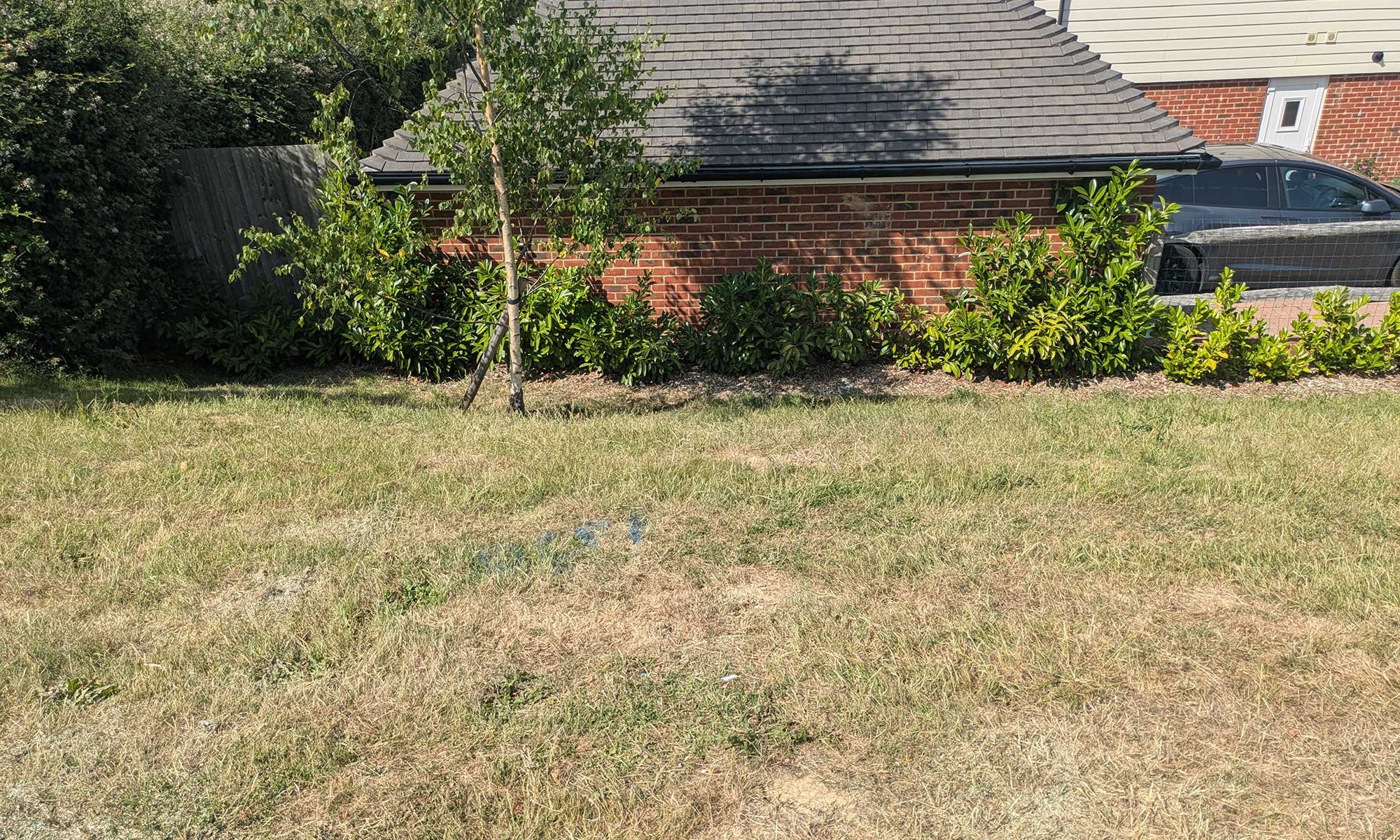
Between the road and the homes sits a grassed earth embankment around 80m long. Before development it sloped gently at around 5°. To make room for a new plot at its base, the lower slope was cut back and steepened to around 17°, with a low brick retaining wall between 0.55m and 0.8m high at the toe. The shared cycleway crosses the embankment roughly two-thirds of the way up, with the carriageway at the crest.
During a site inspection, West Sussex County Council (WSCC) Highways noted that the slope appeared over-steep. Stability assessments carried out between 2020 and 2023 confirmed that the embankment did not meet current engineering standards and was at risk of slip failure. Because the cycleway and part of the slope form adoptable highway land, WSCC Highways required the embankment to be stabilised, with the method formally accepted and the result verified, before it would adopt the development road. The developers needed a solution that could be delivered without disruption to residents and path users.
The embankment sits on the Weald Clay Formation. Boreholes found 0.5m to 1.3m of reworked clay fill containing brick and concrete fragments, over stiff clay and extremely weak to very weak mudstone. Plasticity index results of 39% to 42% placed the clay in the high plasticity range. During construction of the nearby spine road, shear surfaces from historic slope movement were found in the shallow natural clays, so the upper metre of soil was assessed at residual (post-failure) strength. Monitoring recorded groundwater at around 1.0m below ground level at the toe of the slope and 2.5m at the crest, rising to 0.6m at the toe in winter, which reduces the effective stress in the clay and with it the soil’s resistance to sliding.
Slope modelling of the steepest section returned a factor of safety of 1.07 in normal groundwater conditions, below the required 1.3, and just 0.53 if the slope became saturated. Geobear’s own back-analysis identified the critical failure mechanism as a shallow rotational slip through the near-surface clay fill, with a factor of safety of 0.97 when the fill was assessed at residual strength.
No strength testing had been carried out in the clay fill itself. When Geobear probed the slope before treatment, most of the fill proved very soft to soft and highly variable beneath a firmer, desiccated crust, with zones returning zero blows that pointed to possible voids. The embankment was materially weaker than earlier reports had indicated, so the slope stability parameters had to be re-analysed before and after treatment. Two linear cracks were also visible, one mid-slope and one along the crest parallel to the cycleway; Geobear’s assessment concluded they were historic features linked to construction and clay shrinkage rather than tension cracks from active movement.
The working area was a narrow strip between a private garden fence at the toe, with no access to the property beyond, and a live public cycleway at the top, with low-voltage electricity, telecoms and water services beneath it. Permanent remedial elements had to stay out of the adoptable land alongside the path, and WSCC Highways required formal written acceptance of the stabilisation method before work began, and verified results afterwards, before road adoption could proceed.
A 2023 feasibility study for the client recommended soil nailing.
Soil nailing would have stabilised the slope, but it carried clear drawbacks on this site. It had only reached feasibility stage, and the study called for further ground investigation, test nails, a full geotechnical design and highway authority acceptance before detailed design could be completed. Installation needed drilling plant working top-down on a narrow slope beside a live cycleway and buried services, with a clearance zone from the garden fence. A 120-year design life in a roadside environment exposed to de-icing salts pointed to sacrificial steel and stainless components, while the mesh facing and nail heads would remain permanently visible and need ongoing inspection by the highway authority.
Rather than reinforcing the whole slope, Geobear designed a solution that targeted the cause of the instability: the weak clay fill. Geobear’s engineering team used the site investigation data to back-analyse the steepest 17° section at the point of failure. This confirmed that the critical slip surface ran through the clay fill and did not extend into the stronger natural clay and mudstone below, so treatment could be concentrated where it was needed. The model showed that raising the effective cohesion of the clay fill from 0kPa to 4.5kPa would lift the slope’s factor of safety above 1.3, and Geobear’s ground improvement design model indicated the treatment would increase the undrained shear strength of the fill by around 190%, exceeding the strength required.
The Geobear clay solution works by injecting an expansive geopolymer into the clay under high pressure. The material fractures the soil, flows along the fractures and into voids, then expands until it reaches equilibrium with the surrounding ground before hardening. The result is a network of hardened geopolymer running through the soil mass, which increases its shear strength and closes soft and voided zones without excavation or any change to the slope profile. The proposal was reviewed and approved by WSCC Highways, working alongside the client’s consulting engineer, TP&J, before works began.
Geobear designed a slope stabilisation and ground improvement solution using targeted geopolymer injection to strengthen the weak clay fill within the embankment, so that the slope met the factor of safety of 1.3 required by West Sussex County Council Highways.
Geobear acted as principal contractor and was on site from 16 to 21 June 2025, treating a 350m² area of embankment in 5 days. A three-person drilling and injection team worked from a van-mounted pumping unit parked on adjacent grassland, positioned to keep the main footpath clear. The working area was segregated from the public with barriers, and every injection position was cleared for buried services under a Geobear permit to dig before drilling began. Holes of 16mm diameter were drilled with lightweight hand-held equipment, and technicians controlled the volume of geopolymer placed at each position in line with the design. No excavation, spoil removal or heavy plant was needed, the grassed slope and retaining wall were left in place, and less material was used than the design allowed.
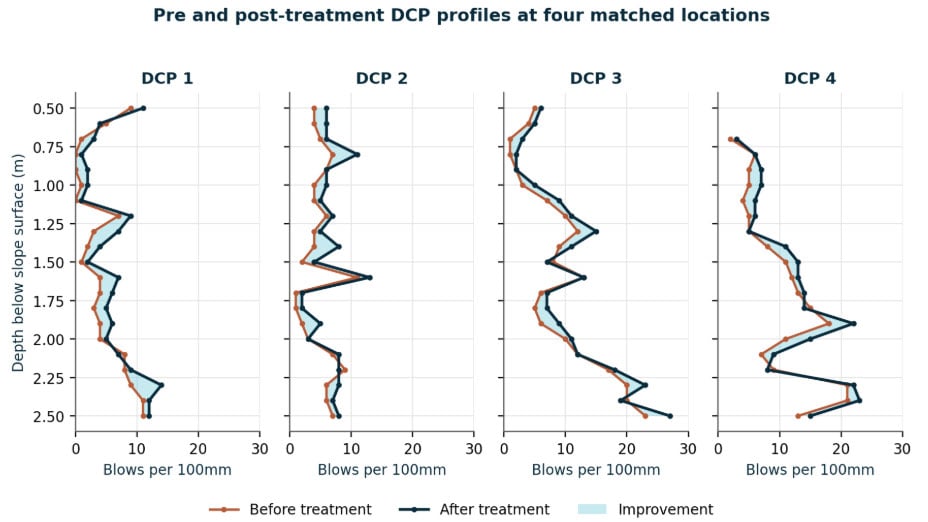
Pre and post-treatment dynamic cone penetrometer (DCP) profiles at four matched locations showed improvement in the weakest zones of the embankment. Zero-blow readings, which indicated possible voids, were eliminated. Readings of one blow or fewer per 100mm fell from 10 to 2, and average penetration resistance across all four profiles increased by 21%. The softest layers within the clay fill now have a minimum undrained shear strength of around 5kPa.
DCP probing gives a useful strength profile, but it is not precise enough on its own to confirm design shear strength in thin, variable clay fill. To verify the result directly, Geobear drilled new boreholes through the treated slope and recovered undisturbed samples of the treated fill for effective stress testing in a UKAS-accredited laboratory, using the small shear box method to BS 1377-7.
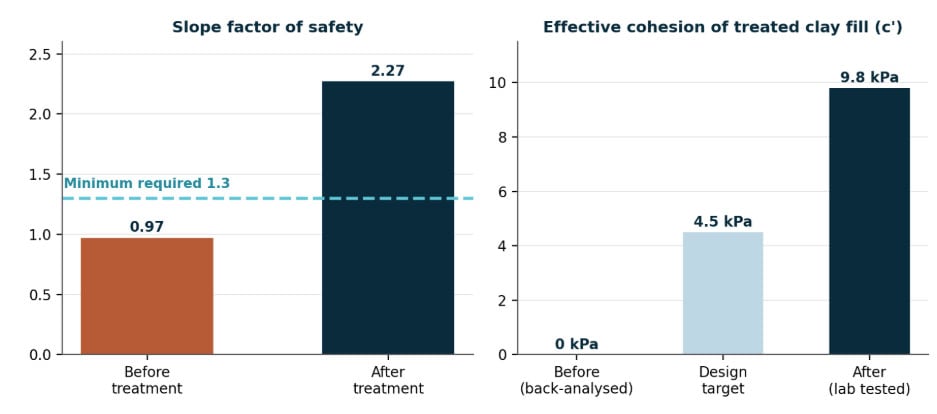
The treated fill returned an effective cohesion of 9.8kPa and an angle of shearing resistance of 26°, compared with the back-analysed 0kPa and 17° before treatment: more than double the 4.5kPa cohesion the design required. Re-running the slope stability model with these tested parameters, and groundwater at 1.0m below ground level, gave a factor of safety of 2.27, against the 1.3 required and 0.97 before treatment. The verification results were compiled into a post-treatment technical report and provided to WSCC Highways to support adoption of the road.
Published costs from comparable UK highway soil nailing schemes indicate the alternative would likely have cost significantly more, with the closest comparable scheme pointing to around three times the cost of the Geobear clay solution.
The Geobear clay solution also avoided the further investigation, test nails and detailed geotechnical design the alternative required, left no nails or mesh facing for the highway authority to inspect, and removed the obstacle to highway adoption.
Get in touch with our expert team today and discover how Geobear can extend the life of your critical infrastructure assets.