New build site ground improvement
Challenge
Ground settlement and voiding beneath estate roads, driveways, and garage foundations at a former landfill site in Chigwell threatened surface stability and buried services — while deep excavation of contaminated made ground would have caused major disruption to residents and infrastructure.
Solution
Geobear delivered a non-disruptive geopolymer ground improvement solution, injecting expanding materials to depths of 5m to fill voids, densify weak landfill soils, and stabilise the carriageway, driveways, and garage foundations without excavation.
Injection depth
target exceeded
Schedule of works
The residential development is situated on a site historically used for clay extraction. By the 1960s, the quarry had been backfilled with council refuse and waste materials. Although the development was constructed with a capping layer and piled foundations for the main dwellings, localised ground settlement and surface depressions emerged within the estate roadway, block-paved driveways, and an access route to a garage block.
Geotechnical investigations, including window sampling and dynamic probing, identified poorly compacted made ground, very soft cohesive soils, and voiding between 2.0m and 3.0m below ground level. The settlement was likely exacerbated by a leak in the surface water drainage network, causing the collapse of the low-density fill.
Traditional remediation would have required deep excavation of the contaminated landfill material and significant disruption to the buried service network, which included a water main, electrical and communications ducts, and a foul sewer. The principal contractor required a solution that could stabilise the ground and fill the voids with minimal impact on local residents and existing infrastructure.
Alternative solutions considered
Conventional remediation would have involved full-depth excavation and replacement of the unstable made ground with engineered granular fill, or the use of cementitious grouting. Both traditional methods were ruled out to avoid excavation and backfilling from the base of the made ground and to prevent impacting the critical buried services.
Geobear engineered an in-situ ground improvement strategy utilising proprietary expanding geopolymers. The works were executed using mobile, self-contained equipment integrated into a workshop vehicle, ensuring a minimal site footprint.
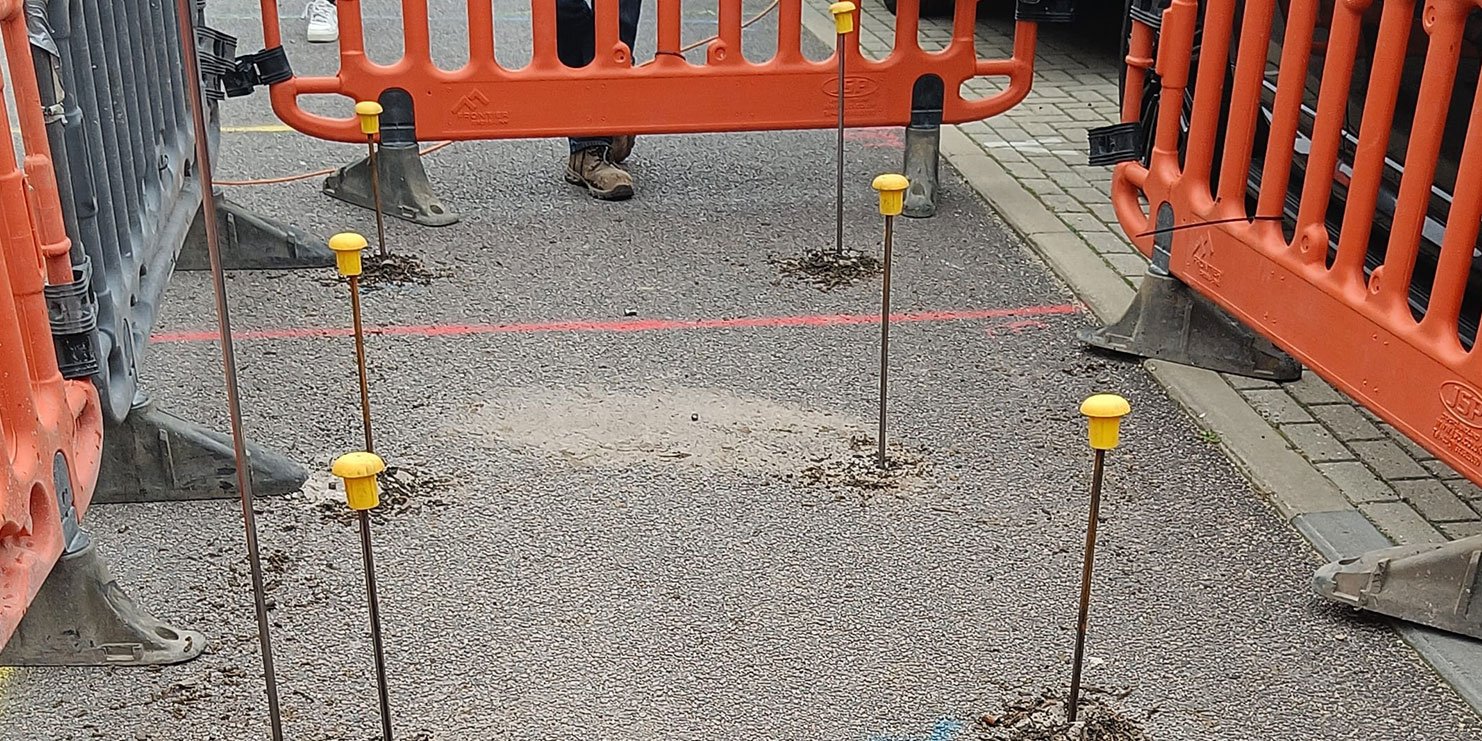
The treatment plan involved establishing a 1.0m by 1.0m injection grid across the affected carriageway, driveways, and the footprint of the garage at one unit. Geobear initially injected a void-filling material to target the specific collapse zones. Following this, a high-expansion material was used to consolidate the surrounding granular and cohesive made ground.
To achieve the required densification, Geobear injections were delivered at four vertical levels beneath the carriageway and driveway, and at five levels beneath the garage raft, treating the soils from 1.0m down to 5.0m below ground level. The injection process was closely controlled using laser level monitoring, allowing technicians to halt injection the moment upward surface movement of 0.5mm was detected, verifying that the sub-surface strata had been sufficiently compacted.
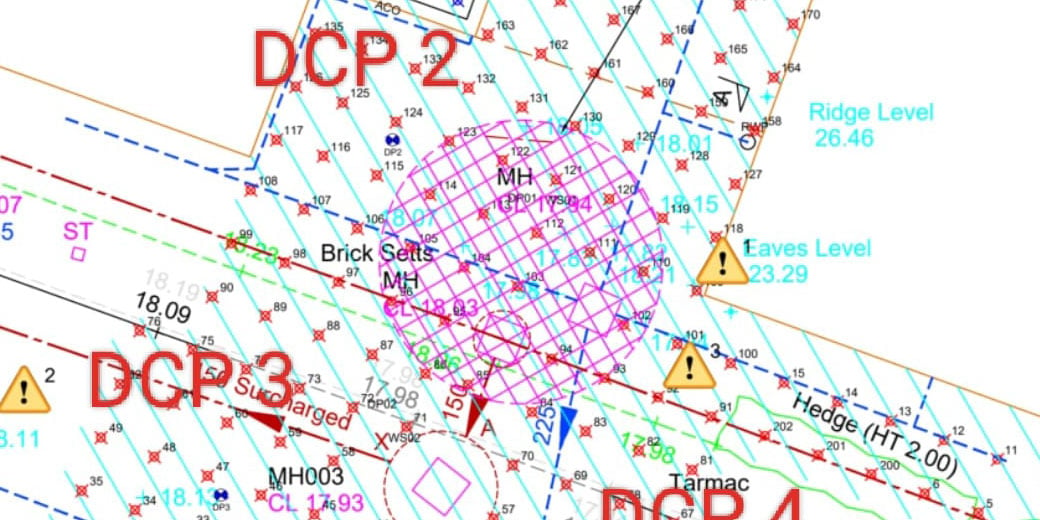
The programme successfully consolidated the made ground and filled the underlying voids within the planned three-week schedule.
To validate the engineering outcomes, pre- and post-treatment Dynamic Cone Penetrometer (DCP) testing was conducted. The post-treatment data was converted to equivalent SPT N1(60) values, confirming that the bearing capacity of the treated zone exceeded the design requirement of an 85% improvement across the tested areas.
By utilising the Geobear injection method, the client avoided disruptive excavations and mitigated the risks associated with handling the existing historical waste. The carriageway and garage foundations were fully stabilised, providing a long-term solution with negligible disruption to the residents.
Get in touch with our expert team today and discover how Geobear can extend the life of your critical infrastructure assets.