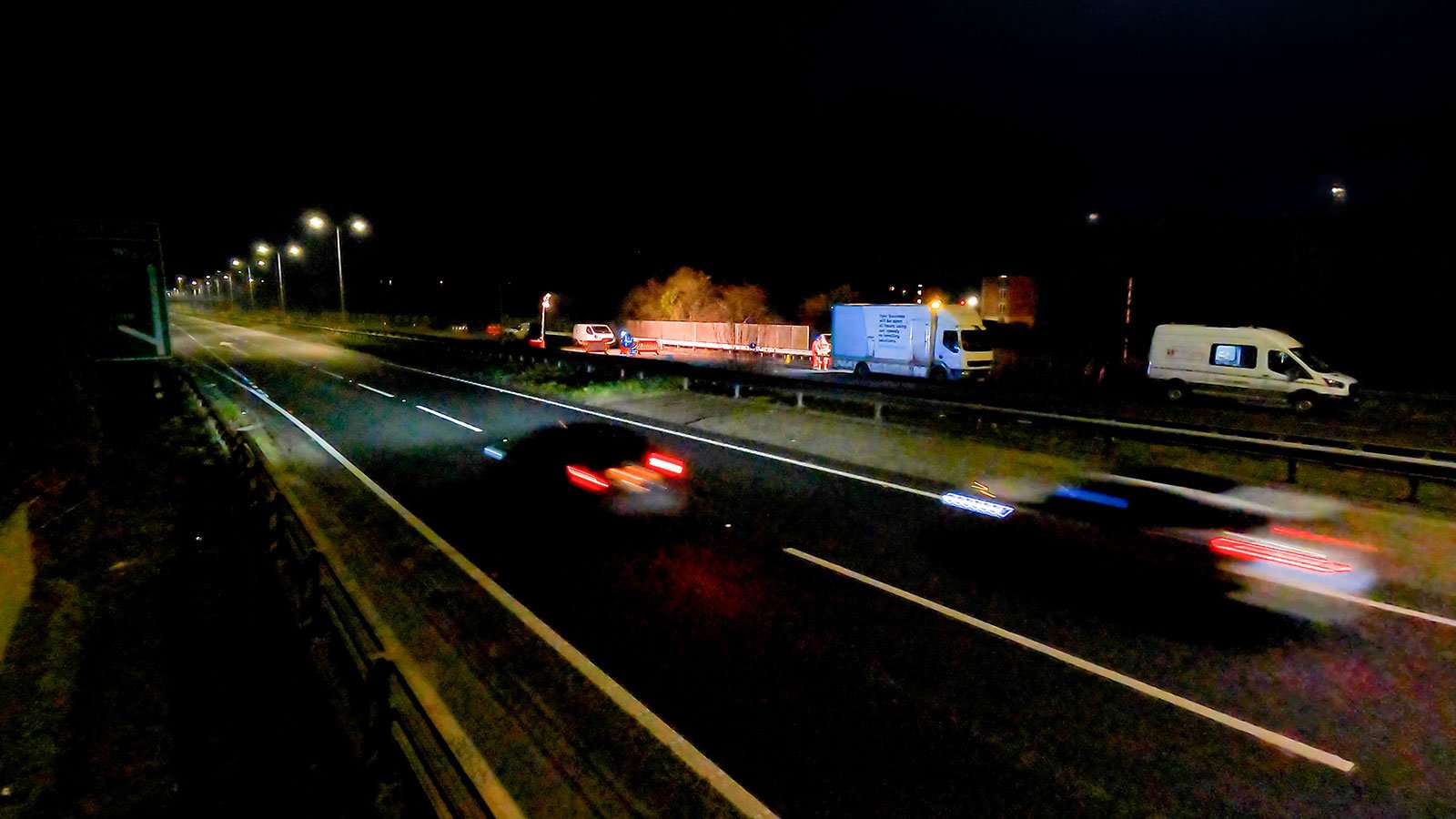
Highways
Challenge
A primary A-road dual carriageway suffered cracking and potholes as voiding and subsidence undermined 150 concrete bays, making repeated resurfacing ineffective and risking structural failure.
Solution
Geobear stabilised 150 bays using geopolymer injection, filling voids to 1.5 m depth, improving ground strength by 180% and completing works in six weeks onsite.
Carbon emissions avoided (62.4% reduction vs traditional replacement)
Completion time vs 5–10 months for full-depth reconstruction
Concrete bays stabilised across ~3 km of dual carriageway
The dual carriageway of a primary A road connecting London to the north experienced significant deterioration due to underlying soil instability. This resulted in extensive cracking and potholes, despite multiple resurfacing efforts. Investigations revealed that voids and subsidence beneath the rigid road were compromising its structural integrity. Geobear was engaged to provide a targeted, efficient solution to stabilise the road and prevent further degradation.
Traditionally, highway repair methods would involve full-depth reconstruction or deep excavation, both of which are time-consuming, costly, and disruptive.
Alternative approaches include:
Full-depth reconstruction: Involves completely removing and replacing the road foundation, leading to prolonged road closures and significant material waste.
Pavement structure placement: Would require breaking out sections of the rigid road and pouring new slabs, causing extended downtime and higher carbon emissions.
Cementitious grouting: A potential solution, but it lacks the precision of geopolymer injection and can result in excessive material use with slower curing times.
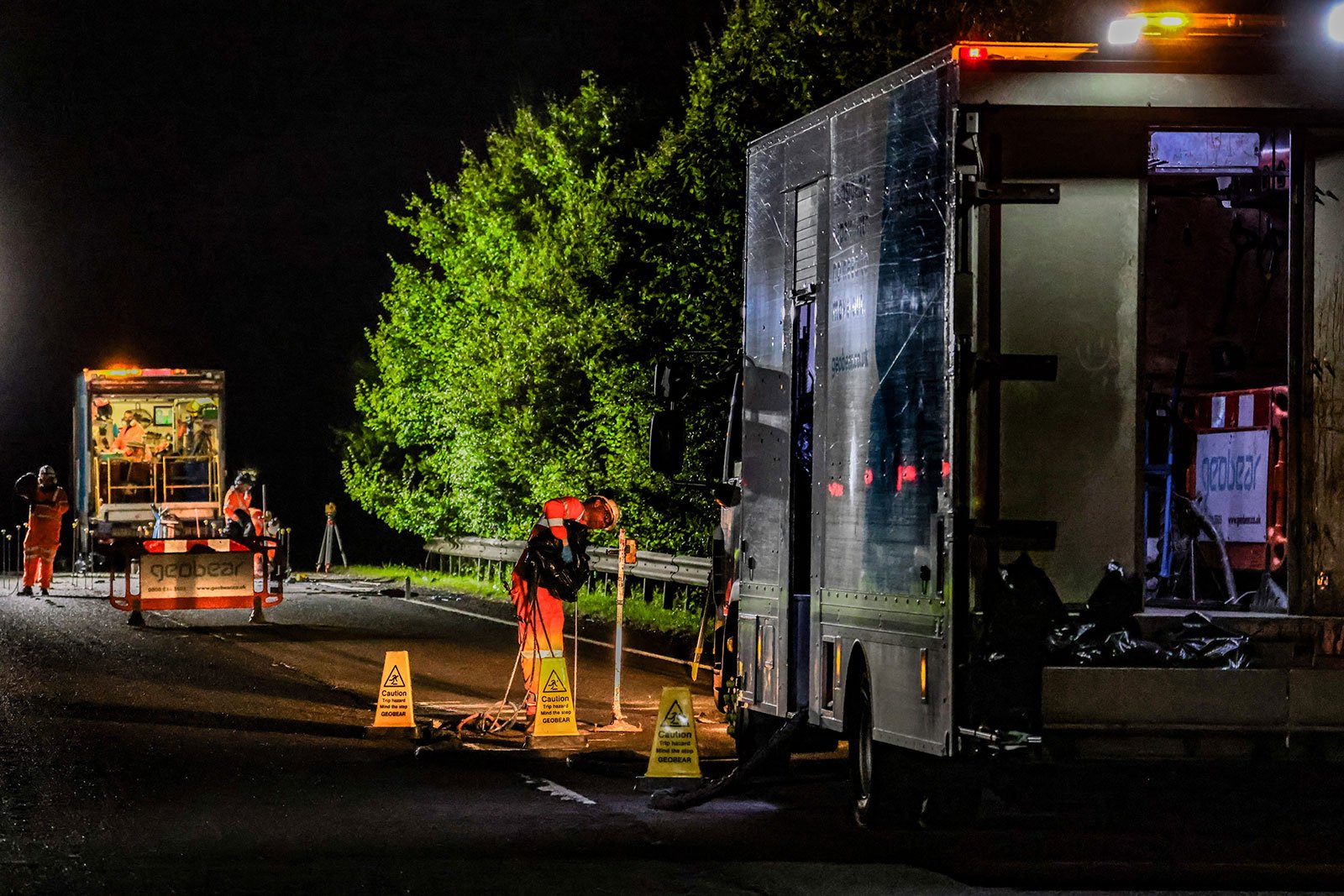
The project was divided into two phases, covering approximately 3km of the southbound carriageway. A high-quality Ground-Penetrating Radar (GPR) survey was subcontracted to identify areas of voiding and instability. Based on these findings, Geobear designed and delivered a bespoke treatment. throughout the affected areas.
For the affected areas, Geobear drilled through the rigid road into the sub-base at varying levels depending on the depth of the issue. A geopolymer material was then injected as a liquid and expands to fill the voids and strengthen the underlying soils. The expansion fills voids, consolidates the soils and reinstates the contact between the underlying soils and the pavement structure.
The works on this site entailed and achieved the following:
|
Method |
Carbon Emissions per Bay (kgCO₂e) |
Total Emissions for 150 Bays (kgCO₂e) |
Total Emissions for 150 Bays (tonnes CO₂e) |
|
Traditional Replacement |
3,490 |
523,500 |
523.5 |
|
Geobear Geopolymer Injection |
1,312 |
196,800 |
196.8 |
|
Carbon Savings |
- |
326,700 |
326.7 |
Total Carbon Reduction: 326.7 tonnes CO₂e (62.43% reduction)
This scheme involved Geobear’s geopolymer injection solution to strengthen the road foundation of 150 concrete bays, offering a sustainable alternative to traditional concrete bay replacement. With knowledge of the carbon emissions of Geobear works, we can outline the carbon savings achieved by using Geobear’s method instead of conventional excavation and reconstruction.
What This Means for Sustainability
By choosing Geobear’s geopolymer injection, the A10 project avoided the release of over 326 tonnes of CO₂e, a 63% reduction in carbon emissions; equivalent to:
Time Savings Compared to Traditional Replacement
Together with the carbon savings, Geobear’s method brings significant time savings to schemes of this nature. A full-depth replacement would result in a project duration of 5 to 10 months.
By contrast, Geobear completed the entire project in under 6 weeks, making the solution at least 4 to 7 times faster than traditional methods. This drastically reduced disruption, allowing the road to remain operational during the day and significantly improving project efficiency.
Get in touch with our expert team today and discover how Geobear can extend the life of your critical infrastructure assets.