Challenge
Upgraded gantry cranes required existing pad foundations to carry 200 kN/m², almost double the 110 kN/m² allowed in their original design.
Solution
Geobear ground improvement solution designed to strengthen the clay beneath 10 existing crane pads in five shifts, without enlarging or replacing foundations.
Pad foundations treated
Bearing pressure required
Programmed on site
UK Power Networks (UKPN) operates a depot on Barton Road in Bury St Edmunds, Suffolk, formerly an EDF Energy site. The depot includes a gantry crane building whose steel frame and crane rails are carried on reinforced concrete pad foundations beneath the ground-floor slab.
UKPN planned to upgrade the crane. The heavier crane loads meant the existing pad foundations would need to carry an allowable bearing pressure of 200 kN/m², compared with the 110 kN/m² used in their original design. Freedom Group, acting for UKPN, asked Geobear to propose a way of increasing the bearing capacity of the ground beneath ten of the pads. Geobear visited the site in April 2025 and was awarded the contract in November 2025.
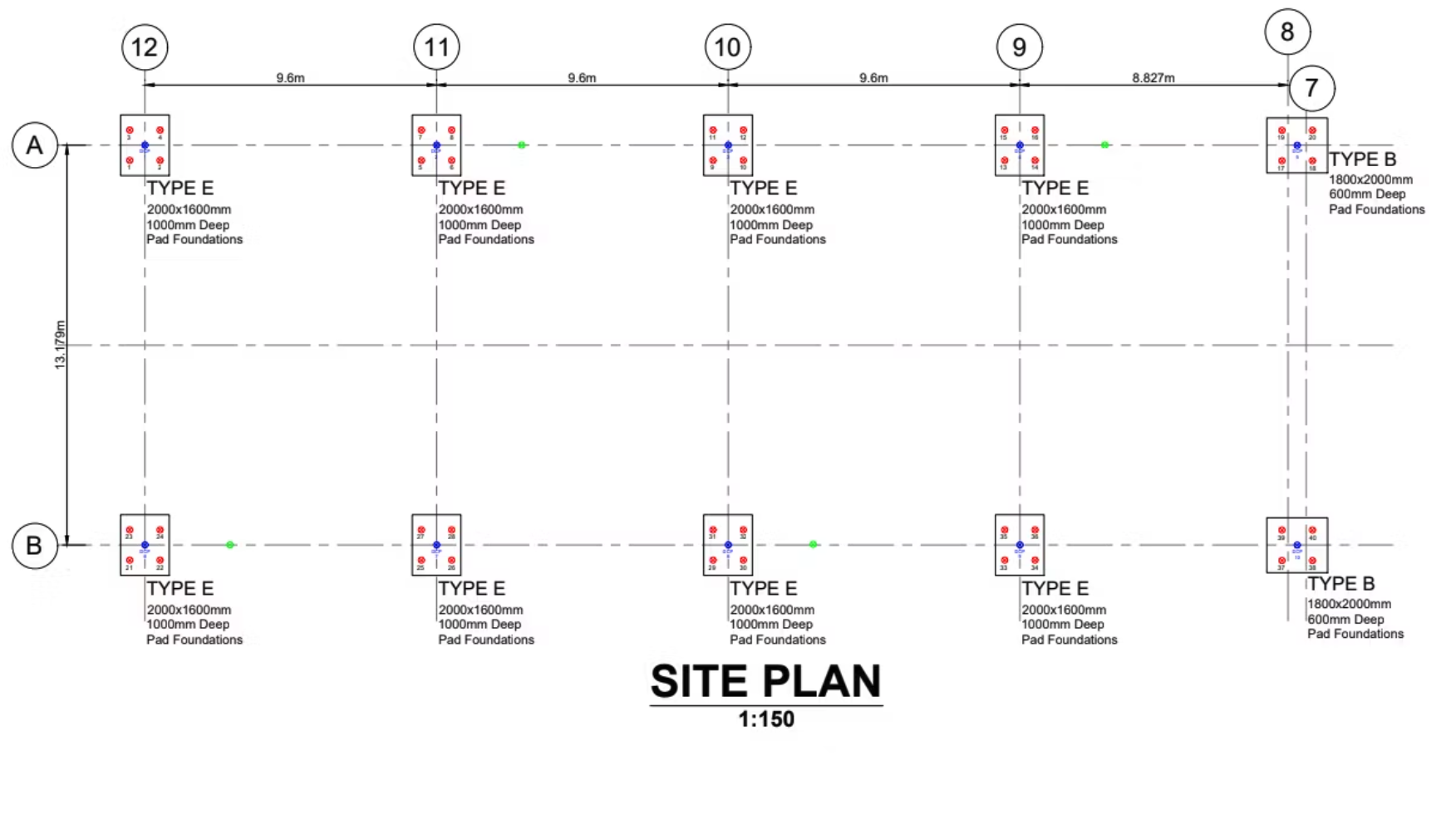
Ten pads required treatment: eight measuring 2 m × 1.6 m × 1 m deep, with their base at 1.9 m below ground level, and two measuring 2 m × 1.8 m × 0.6 m deep, with their base at 1.5 m below ground level. All ten sit beneath the floor slab and a layer of fill, so the ground below them could only be reached through holes cored through the slab and the pads themselves.
A 2006 ground investigation for the depot, comprising four boreholes, recorded Boulder Clay over Upper Chalk. Near-surface soils were typically stiff clay, but one borehole found loose sand and clayey sand to 2.5 m, with SPT N values of 5 and 11, and perched water at 2.0 m. The investigation recommended limiting bearing pressure to about 110 kN/m² to control differential settlement, because of the variable near-surface soils.
Geobear's design assessment estimated an existing bearing capacity of about 140 kPa beneath the pads: adequate for the original 110 kPa loading, but short of the new 200 kPa requirement. Achieving the new loading required the undrained shear strength of the clay below the pads to be raised to about 100 kPa. The works also had to fit around an operational depot, with crane and plant movements nearby and one pad partly obstructed by an adjoining building.
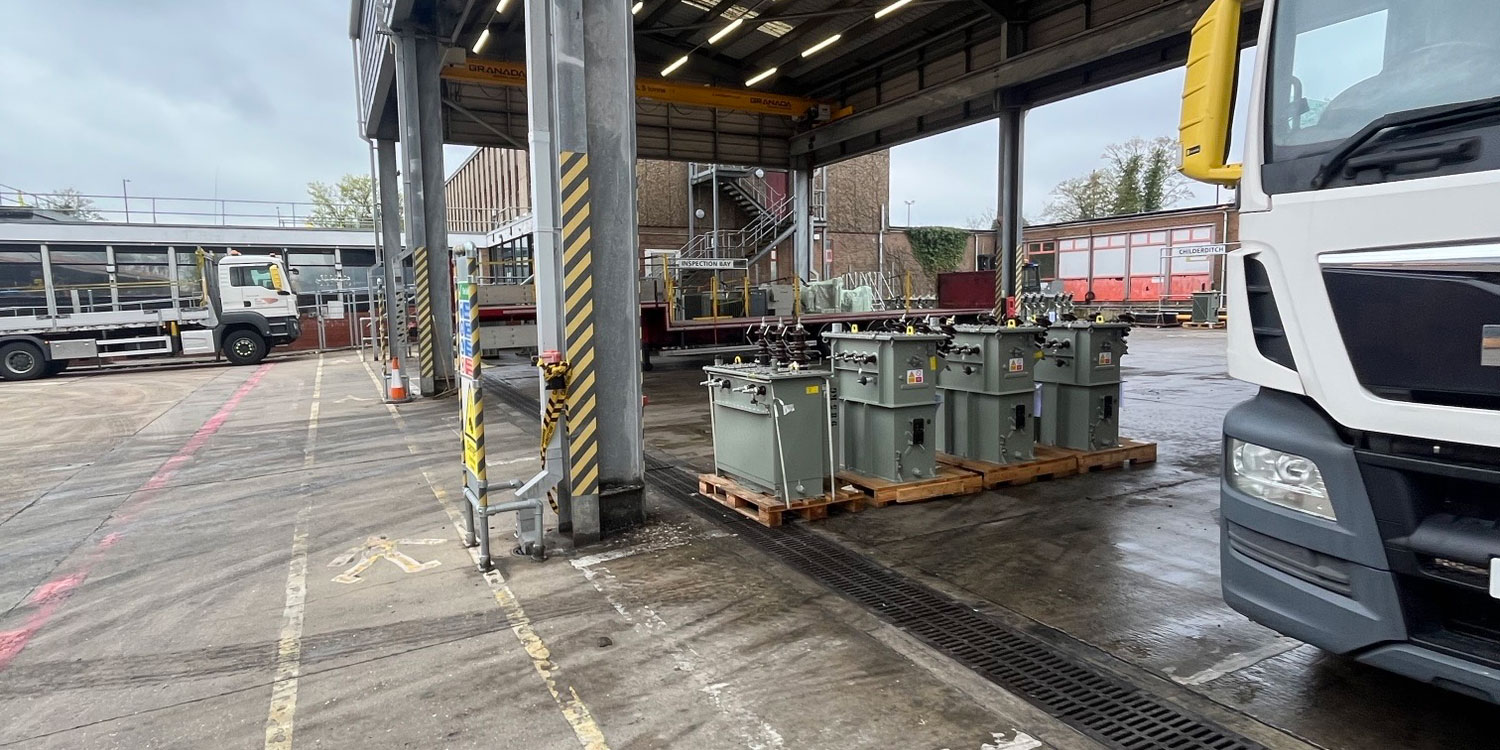
The conventional ways to increase the capacity of an existing pad foundation are to enlarge it, underpin it with mass concrete to a stronger stratum, or transfer the load to mini piles. Each is technically credible, but at Bury St Edmunds each would have meant breaking out the floor slab around ten pads inside a busy working environment, excavating to around 2 m or more next to the existing foundations and the crane structure, and casting and curing new concrete before the cranes could rely on it.
The Geobear ground improvement solution instead strengthens the soil beneath the existing pads through small holes cored through them, leaving the foundations, slab and crane structure in place.


Geobear designed a ground improvement solution using targeted geopolymer injection to increase the undrained shear strength of the clay beneath the ten pad foundations, so that they could carry the 200 kN/m² required for the gantry crane upgrade. The design assessment estimated a post-treatment bearing capacity that met the project requirements.
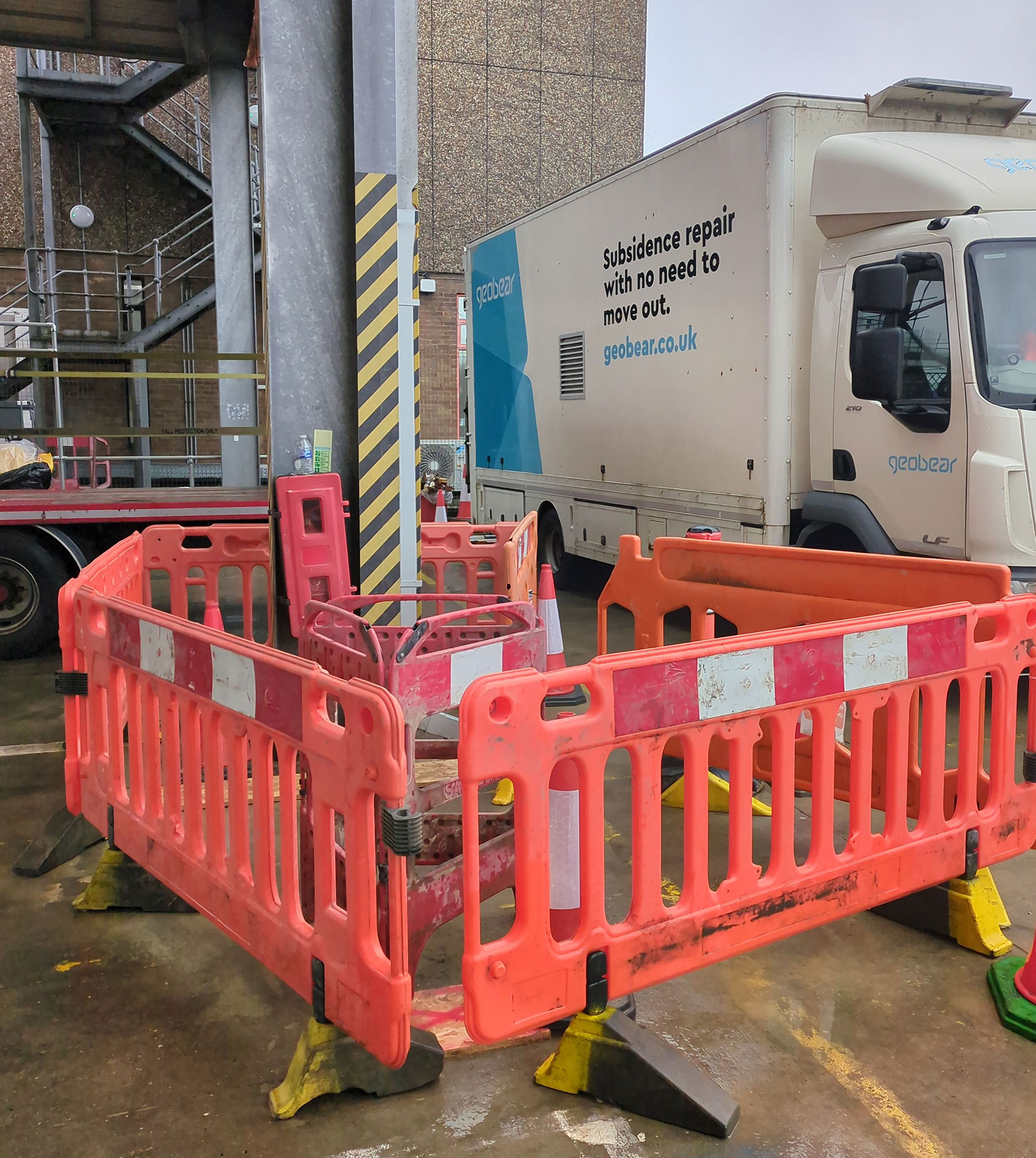
Coring through the slab and pads was carried out by others before Geobear arrived, so Geobear's site work was limited to installing injection tubes, injecting and testing. The works were programmed as five shifts with one injection unit: pre-treatment testing and tube installation, two days of injection, then post-treatment probing. Angled injection points were designed where an adjoining building blocked vertical access to one pad. A CCTV drainage survey was carried out before the works, and drains were monitored by others.
Pre-treatment dynamic probing was carried out at four locations in December 2025. Post-treatment probing at ten locations was to be compared against blow-count targets set in the design: more than 23 blows per 100 mm within 1 m of the pad base and more than 28 blows per 100 mm between 1 m and 2 m below it.
Get in touch with our expert team today and discover how Geobear can extend the life of your critical infrastructure assets.