Rail
Challenge
Groundwater infiltration and loose surrounding soils were causing deterioration of the historic tunnel lining and creating waterlogged track beds, resulting in reliability issues and increasing service disruption.
Solution
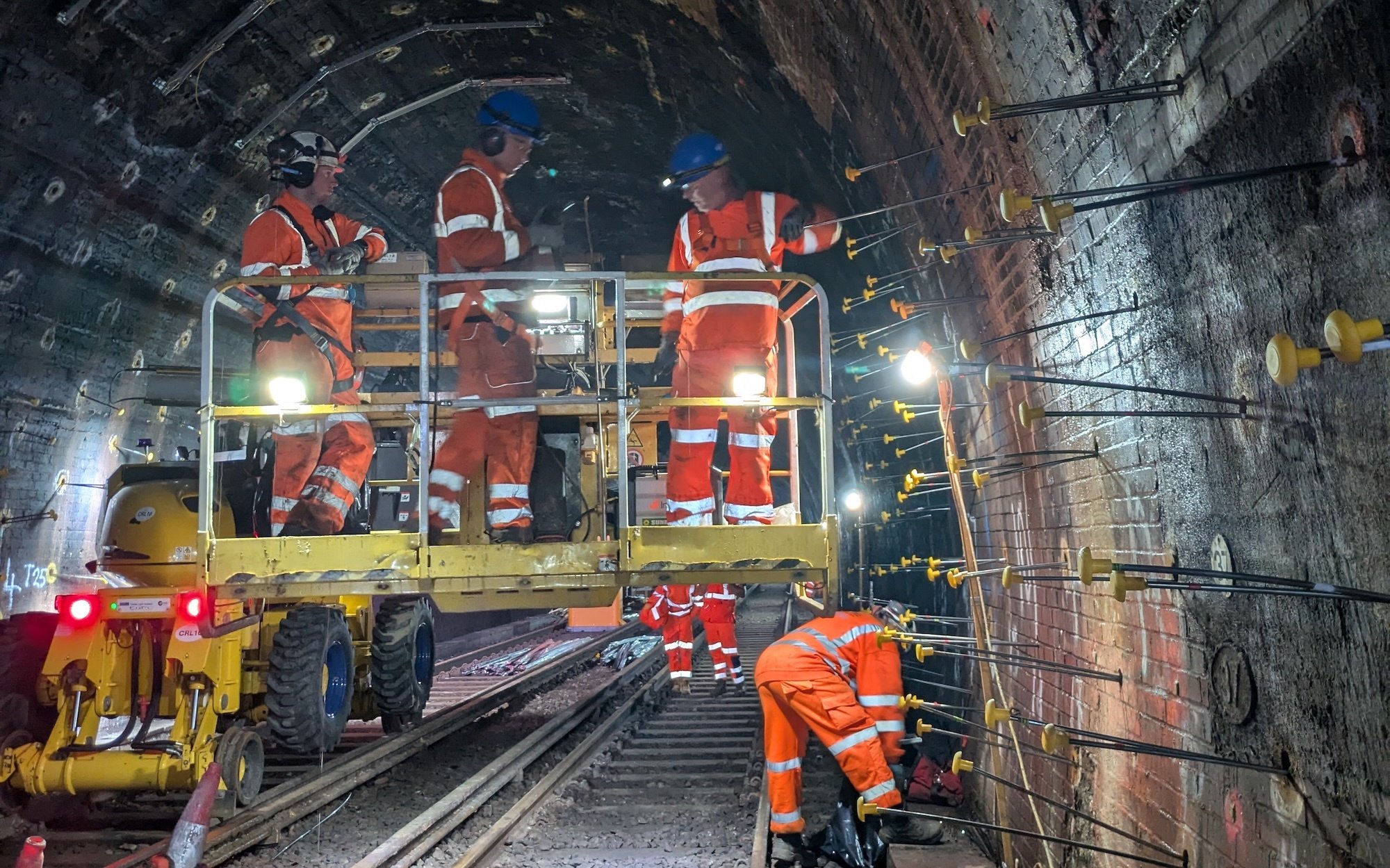
Geobear stabilised surrounding soils and sealed groundwater pathways by injecting expanding geopolymer through precision tubes installed behind the tunnel lining, strengthening the ground while minimising structural disturbance.
Geopolymer injected
Injection tubing installed
Movement monitoring during works
Blackheath Tunnel is a historic Victorian railway tunnel in southeast London forming a key link between Kent and central London. Constructed in 1849, the one-mile tunnel carries a high volume of passenger services and is critical to the reliability of the Southeastern rail network.
Over many decades, groundwater infiltration through surrounding soils began to affect the tunnel’s structure and railway infrastructure. Water entering through the ground caused deterioration of the brick lining and contributed to unstable track conditions within the tunnel.
To address these issues, Network Rail initiated a major infrastructure programme designed to strengthen and waterproof the tunnel while preserving its historic masonry structure and minimising long-term disruption to rail services.
The project team needed to resolve several complex issues affecting the tunnel’s long-term performance.
Persistent groundwater infiltration was weakening the tunnel lining and damaging railway equipment. At the same time, loose sand and gravel pockets surrounding the structure allowed water to travel through the ground and accumulate beneath the track.
This led to the formation of waterlogged ballast zones, commonly known as “wet beds”, which can cause track instability, operational faults and speed restrictions.
Traditional repair methods such as structural reconstruction or large-scale excavation would have required extended closures of a critical rail corridor. The challenge was therefore to stabilise the ground and prevent further water ingress while protecting the historic tunnel structure and delivering the works within a limited engineering possession.
Testimonial
David Davidson, Chief Operating Officer for Southeastern Railway
Engineers deployed a ground improvement and waterproofing approach using geopolymer injection technology to stabilise the surrounding ground and create a barrier against groundwater ingress.
More than 1,000 core holes were drilled through the tunnel structure to allow the installation of injection tubes behind the brick lining. In total, approximately 4,000 injection tubes and 13 kilometres of tubing were installed throughout the tunnel.
Through these injection points, 55 tonnes of geopolymer grout were injected into surrounding sand and gravel pockets. The expanding material filled voids and compressed loose ground, increasing soil strength and stability around the tunnel structure.
Additional injections were used to create a sealing layer behind the tunnel lining, reducing pathways for groundwater to enter the tunnel environment.
The works were carefully monitored throughout using high-precision instrumentation capable of detecting structural movement to 0.01 mm accuracy, ensuring the stability of the tunnel during the injection process.
Alongside the ground stabilisation works, complementary infrastructure improvements were carried out including brick replacement, drainage reconstruction and track renewal.
The programme was completed during a 10-week engineering closure between Blackheath and Charlton stations, with more than 100 engineers and specialists working around the clock to deliver the complex infrastructure upgrade.
The project successfully stabilised the ground surrounding the tunnel and significantly reduced water ingress, improving the long-term reliability of the railway.
Key outcomes included:
Services resumed in July 2025 with normal timetables restored for passengers.
The innovative repair methodology also delivered significant economic benefits. Compared with traditional reconstruction methods, the approach is estimated to have saved around £10 million, while avoiding prolonged disruption to rail services.
Get in touch with our expert team today and discover how Geobear can extend the life of your critical infrastructure assets.