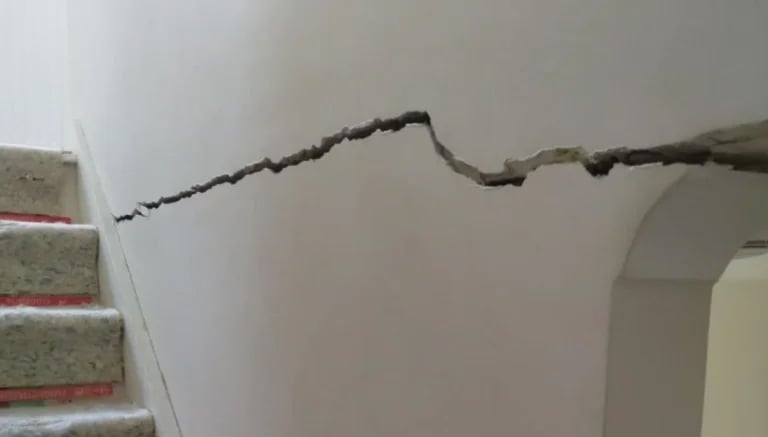
What are the early clues that point to active subsidence movement?
Catching signs of ground movement early is the best way to protect your home's value and prevent major structural issues. We understand the stress these discoveries cause, but by knowing what to look for, you can act quickly and decisively.
Early subsidence signs can be subtle, but they have distinct patterns that set them apart from normal house settlement. If you notice any of these indicators, it's time to seek expert assistance.
1. Small but significant cracks
While normal hairline cracks are a standard part of a home settling, subsidence cracks are very different and signal active movement.
In the early stages, look for cracks that are:
-
Running diagonally (rather than strictly vertically or horizontally).
-
Appearing around doors, window frames, or near extensions.
-
Wider at the top than at the bottom.
-
More than 3mm wide.
-
Getting wider and/or longer as time goes on—this is the strongest indicator of active subsidence.
2. Doors and windows begin to stick
This is a key early warning sign of subsidence that shows the structure is beginning to shift. When the foundation moves, it distorts the frames that support your doors and windows.
You may notice that your doors and windows:
-
Are harder to close or difficult to open.
-
Have newly-formed gaps around the frames.
-
Have latches that no longer line up.
If these problems start suddenly and coincide with the distinct crack patterns mentioned above, subsidence is the likely cause.
3. Hairline cracks in interior finishes
Turn your attention indoors. Early movement often reveals itself in the finishes and joints of your home.
Watch for:
-
Separation of coving from the ceiling.
-
Cracks appearing above doorframes or window frames.
-
Gaps widening between the skirting boards and the walls.
Though small, these signs can flag a very large problem with structural ground movement.
4. Sloping or slightly uneven floors
Subsidence can cause floors and ceilings to become uneven. It may be minor at first, but it points to a loss of consistent support beneath the foundation.
Your floors may feel like:
-
You are walking on a tilt.
-
Certain areas feel spongy or soft.
-
Parts of the floor feel noticeably lower than others.
These issues are often easiest to spot when comparing areas across the home, as one side may be affected more than the other.
5. Cracks or movement in external ground surfaces
Subsidence often becomes evident outside the home first, particularly near risk factors like large trees or drains.
Look for:
-
Cracks forming in or around patios or driveways.
-
Gaps appearing between the house and any attached paths or slabs.
-
Slight dips in the ground near the original building foundations.
6. Distortion of external brickwork
Before major cracking begins, you might see subtle shifts in the exterior walls:
-
Mortar lines in brickwork beginning to widen.
-
Individual bricks looking slightly offset from the rest of the wall.
-
Render pulling away from the original wall surface.
7. Plumbing or drainage issues
Faulty or damaged drains can contribute to ground movement by leaking water into the ground, causing the soil (especially clay) to repeatedly expand and contract.
Watch out for:
-
Persistent drain blockages that cannot be easily cleared.
-
Slow drainage.
-
Soft, damp, or mushy areas in the garden, particularly near the house or foundations.
Subsidence vs. normal settlement: Knowing the difference
It's vital to know if you are seeing normal movement or signs of a serious problem. We want to cut through the complexity and give you clarity.
| Feature | Normal settlement (new homes) | Subsidence (A structural problem) |
| Timing | Only occurs in the first few years after construction. | Has the potential to happen at any time, even in older homes. |
| Crack Appearance | Cracks are thin, hairline, and often vertical or horizontal. | Cracks are diagonal, wide (over 3mm), and wider at one point than another. |
| Progression | Movement ceases within the first couple of years. | Cracks worsen over time (lengthen and widen). |
Common causes of early subsidence
Understanding the cause helps us determine the right treatment plan:
-
Soil shrinkage and expansion due to changing weather and temperatures.
-
Tree roots extracting essential water from the ground (desiccation).
-
Leaking drains or old pipework adding water into the ground.
-
Poor, shallow, or old foundations that cannot handle the structure's load.
-
Heavy nearby construction or consistent vibrations in the vicinity.
If you recognise these signs, we are here to provide the expertise and solution you need with minimal fuss.