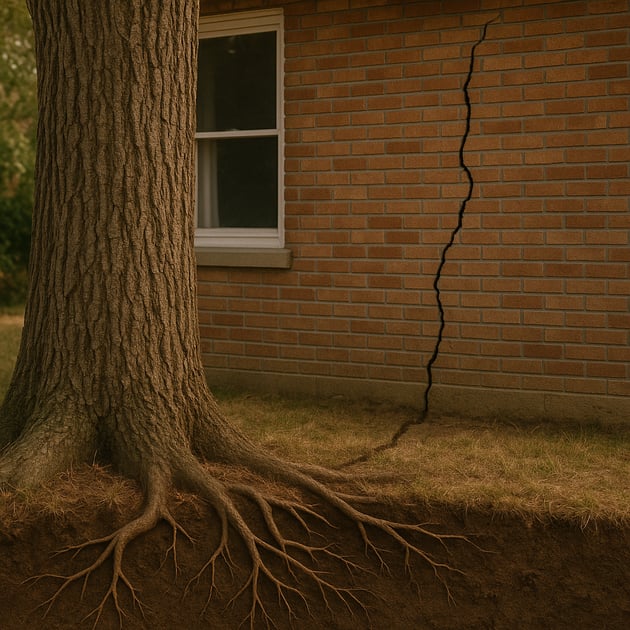
Can removing trees stop subsidence?
Short answer?
Yes — removing a tree can stop clay shrinkage subsidence.
But it can also create a brand-new problem.
If you’re dealing with cracks in your walls and you’ve been told a nearby tree is the cause, cutting it down might seem like the obvious fix. The reality is more complex — and the consequences aren’t always what homeowners expect.
Let’s break it down properly.
Why trees cause subsidence
In clay soils, the issue isn’t the tree itself — it’s moisture.
Trees extract water from the ground through their roots. During dry periods, this moisture loss causes clay to shrink. When clay shrinks, it reduces support beneath foundations. That’s when cracks appear.
If you remove the tree:
- Roots stop extracting moisture
- Clay stops shrinking seasonally
- Ongoing downward movement should stabilise
So far, so good.
But this is where things get interesting.
The hidden risk: Rebound heave
When you remove a mature tree that has been drying out clay for years, the soil doesn’t just “settle down”.
It rehydrates.
Clay absorbs water and expands. That expansion can push foundations upwards — a process known as rebound heave.
What is rebound heave?
Rebound heave happens when:
- A long-standing tree is removed
- Clay soil re-saturates
- The ground swells
- Foundations are forced upwards
In some cases, the upward movement can cause as much structural damage as the original subsidence.
You may have stopped downward movement — but now you’re dealing with uplift.
That’s why tree removal needs careful engineering consideration, not just a chainsaw.
Tree removal does not fix existing damage
Even if further movement stops, three key issues remain:
Cracks do not repair themselves
Structural cracks need professional repair and stabilisation.
Weak soil remains weak
If clay beneath your foundations has fissured or loosened, removing the tree doesn’t rebuild that lost strength.
Your home remains vulnerable
Future drought cycles, neighbouring trees, or changing climate conditions can still trigger movement.
Subsidence is rarely caused by one single factor alone.
Other practical complications
Tree removal isn’t always straightforward.
- Mature trees often add property value and character
- There may be environmental or planning constraints
- The tree may belong to your neighbour
- Root systems can extend well beyond visible canopy lines
In short: cutting down the tree may not even be within your control.
So what is the smarter approach?
At Geobear, we look at the root cause — but we also look at what happens next.
Our goal is simple:
-
Stabilise the ground.
-
Minimise disruption.
-
Protect your home.
Without creating a second problem.
How geopolymer injection controls clay shrinkage
Instead of excavating clay or removing trees, we strengthen and stabilise the soil beneath your foundations.
What happens during geopolymer injection?
We inject an expanding geopolymer resin deep into the ground beneath your home. The material:
- Fills fissures in the clay — both large and microscopic
- Binds and strengthens weakened soil
- Reduces the soil’s ability to shrink and swell seasonally
- Restores support beneath foundations
By filling the shrinkage cracks within the clay, we greatly restrict the ability of tree roots to extract moisture locally around foundations.
This helps reduce seasonal movement to acceptable limits — without removing the tree.
Does geopolymer injection harm trees?
This is a common concern.
Studies show that injection affects only a very small percentage of root volume. The vast majority of the tree’s root system remains untouched.
In most cases, tree health is not compromised.
So you protect both your home and your landscape.
Why this matters more now
Hotter summers and longer dry periods are increasing clay shrinkage across the UK. Removing one tree doesn’t change wider ground conditions.
Stabilising the soil gives you resilience against future climate cycles — not just a short-term reaction.
The balanced solution
Tree removal might seem decisive. But ground movement isn’t just about stopping one influence — it’s about stabilising the whole system.
Our approach avoids:
- Large excavations
- Removing and replacing clay
- Cutting down mature trees
- Turning your home into a building site
Instead, we deliver fast, targeted ground improvement with minimal disruption — so you can get on with life.
If you’re unsure whether removing a tree is the right move, we’ll tell you honestly. And if our solution isn’t right for your home, we’ll say that too.
Because solving subsidence properly means thinking two steps ahead — not just stopping what’s happening today. Learn more about subsidence.
Frequently asked questions
It is a recognised engineering risk, particularly with mature trees on shrinkable clay soils.