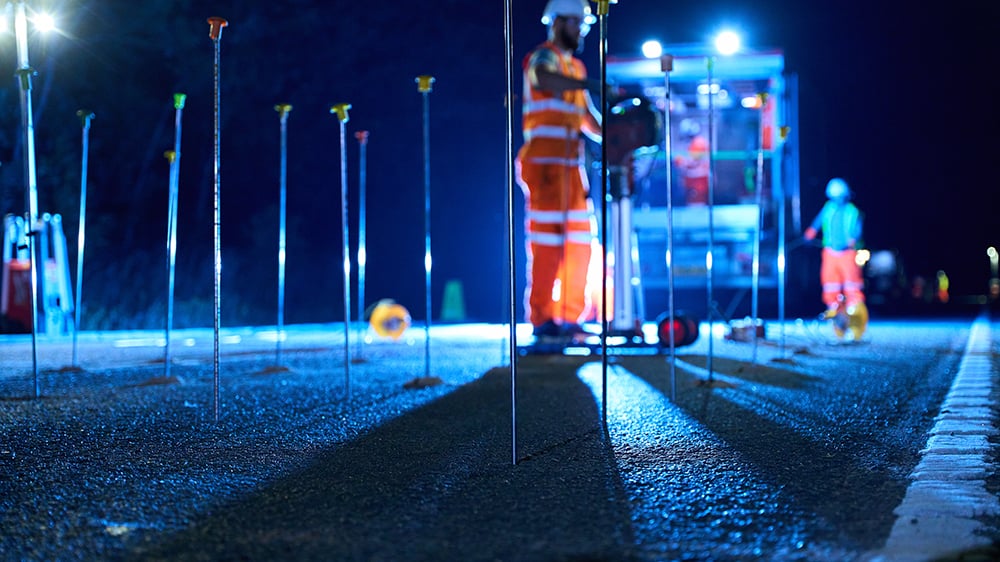
Highway owners, engineers, and asset managers are under constant pressure to keep roads safe and open while managing aging pavements, rising traffic loads, water-related subgrade damage, and limited maintenance windows. In our recent webinar, Geobear’s team explored how engineered geopolymer injection can stabilize weak ground, fill voids, re-level slabs, and extend pavement service life without the disruption of full-depth reconstruction.
Why Pavements Fail from the Ground Up - A Webinar Overview
Our recent 2026 webinar invited guests from a range of infrastructure asset management companies and groups to learn and ask questions regarding the use of geopolymer (resin injection) technology highway applications. This article provides a summary of the webinar and a link to watch.
The discussion focused on practical highway applications: concrete bay stabilization, flexible pavement support, bridge approach settlement, embankment strengthening, void filling, and proactive subgrade improvement. The common theme was clear: when the issue is below the surface, the right solution often needs to treat the ground - not just the pavement above it.
Surface defects such as depressions, alligator cracking, pumping, potholes, rocking slabs, or uneven bridge approaches are often symptoms of deeper ground problems. Water ingress can wash fines out of the subgrade. Poor compaction can leave voids beneath slabs or approaches. Repeated heavy loading can overstress older pavement structures that were not designed for today’s traffic volumes. In clay soils, shrink-swell behavior can create movement as moisture conditions change.
Traditional repairs often address the visible symptom by milling, resurfacing, excavating, replacing slabs, or reconstructing pavement layers. Those methods can be necessary in some situations, but they can also require lane closures, diversions, heavy equipment, long curing times, and significant carbon impact. Geobear’s approach is different: strengthen the ground beneath the asset through targeted injection, helping restore support while keeping disruption to a minimum.
How Geopolymer Injection Works
Geobear’s engineered geopolymer is injected through small-diameter holes into targeted zones beneath the pavement or structure. The material enters as a liquid, then rapidly expands and hardens in place. Depending on the project objective, the injection plan may be designed to fill voids, compact weak soils, reduce future settlement, improve bearing capacity, or gently re-level a slab or pavement surface.
One of the major benefits for highways is speed. Geobear’s highways content notes that engineered geopolymer can be injected through small holes to fill voids, compact weak soils, and re-level slabs with millimeter precision, with roads able to reopen quickly after treatment. This makes the method well suited for overnight possessions and projects where daytime traffic flow must be maintained.
Key Highway Applications Covered in the Webinar
- Concrete slab and bay stabilization: Filling voids beneath rigid pavements to restore support, reduce rocking, and improve ride quality.
- Flexible pavement subgrade improvement: Strengthening weak ground beneath asphalt to help address recurring cracking and settlement.
- Bridge approach and abutment support: Treating settlement where poor backfill, voiding, or erosion creates bumps at bridge transitions.
- Void filling: Filling washouts, abandoned pipes, culverts, sinkholes, animal burrows, and other subsurface cavities before they become safety risks.
- Embankment and slope support: Improving ground conditions behind approaches, slopes, and embankments affected by erosion, poor compaction, or moisture movement.
- Clay shrink-swell mitigation: Reducing the impact of moisture-related movement by filling fissures and improving ground behavior.
Design Control Matters: It Is Not “Just Inject and Go”
A major point from the webinar was the importance of engineering design and field control. The injection plan must account for soil conditions, void locations, target depths, injection spacing, material type, and sequencing. When lifting is required, surface movement is monitored in real time so crews can control the response and avoid over-lifting.
For highways, this is especially important because pavement systems behave differently depending on whether they are rigid concrete slabs, flexible asphalt pavements, cracked sections, or compromised structures. A controlled injection sequence helps distribute support uniformly and allows the team to verify performance through pre- and post-treatment testing such as DCP, CPT, density testing, or other project-specific methods.
Case Study Takeaway: Extending Pavement Life Without Reconstruction
The webinar highlighted a UK highway project where pavement defects pointed to deeper subgrade and drainage issues. Investigations found that water had contributed to the loss of fines beneath the road, weakening the pavement foundation. After drainage remediation, Geobear used a targeted injection plan to improve the capping and subgrade layers.
Post-treatment testing showed improved California Bearing Ratio values in both the capping and subgrade layers. The practical result was a stronger pavement foundation and a meaningful extension of asset life—demonstrating how proactive ground improvement can delay major structural maintenance and help agencies get more value from existing road infrastructure.
Why It Matters for Highway Owners and Engineers
Geopolymer injection is not intended to replace every traditional repair method. If a project has unrestricted access, no traffic constraints, and broad areas of unsuitable ground, another approach may be more appropriate. But where speed, access, carbon reduction, safety, and operational continuity are critical, geopolymer injection can be a valuable tool in the highway maintenance toolkit.
Geobear’s infrastructure materials emphasize the same advantages discussed in the webinar: minimal disruption, compact equipment, targeted treatment through small holes, rapid curing, lower carbon impact compared with many concrete-based alternatives, and the ability to help extend the service life of roads, bridges, utilities, and other critical assets.
What You’ll Learn in the On-Demand Webinar
- How geopolymer injection strengthens weak ground beneath highways and other infrastructure assets.
- Where the method fits best for rigid pavements, flexible pavements, bridge approaches, slopes, voids, and utilities.
- How injection plans are designed and controlled to manage lift, support, and treatment depth.
- Why field verification matters for engineers and asset owners.
- How proactive subgrade improvement can help extend pavement life and reduce the need for disruptive reconstruction.
Watch the Webinar
If your team is managing recurring pavement settlement, voiding, cracking, bridge approach movement, or subgrade instability, this on-demand webinar offers a practical look at how geopolymer injection can help stabilize the ground beneath the asset and extend service life with less disruption.
Watch the on-demand webinar to learn how Geobear helps highway teams solve subsurface ground problems quickly, cleanly, and with minimal impact to traffic.