Challenge
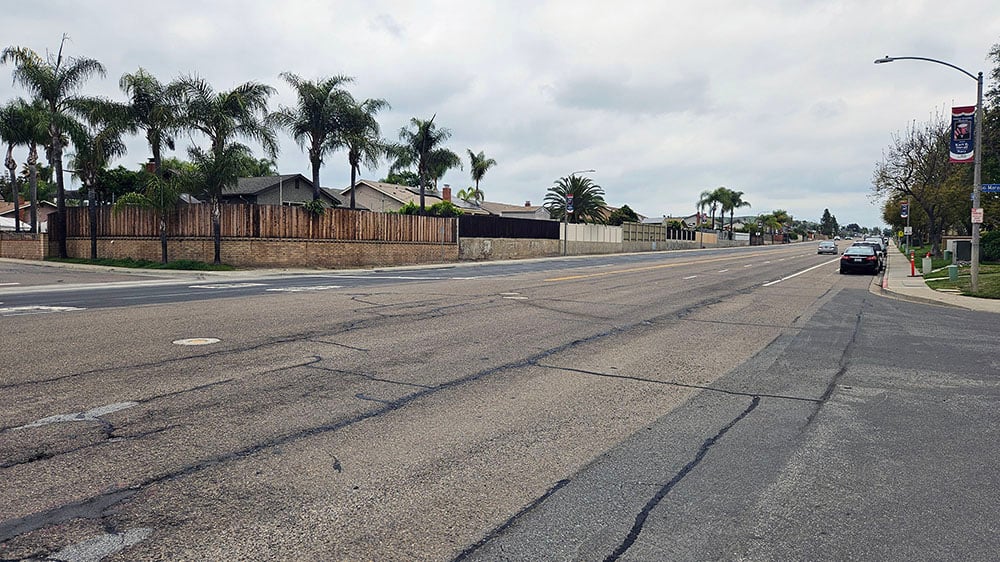
Up to 4 inches of road settlement developed along about 2,060 feet of backfilled trench above a newly installed 24-inch water pipeline.
Solution
Geobear ground improvement solution designed to densify the trench backfill and fill voids beneath the road without excavation or disturbing the pipeline.
Trench length treated
Settlement addressed
Treatment on site
The East County Advanced Water Purification (AWP) program includes a new 24-inch cement-mortar-lined and coated welded steel pipeline beneath Mast Boulevard in Santee, California. Orion Construction, the design-builder for Package 2, installed the pipeline in a cut-and-cover trench at a depth of approximately 8 feet below the road surface.
Mast Boulevard is a busy multi-lane arterial road with residential frontage along both sides. After construction, the pipeline trench was backfilled with excavated site soils, compacted to between 90% and 95% of maximum dry density and repaved.
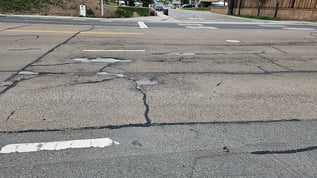
Surface settlement of between 1 and 4 inches later developed in the road above the trench. The affected pavement extends over about 2,060 linear feet of westbound Lane 2, in three treatment segments. Site photographs show settled and patched asphalt along the trench line, with cracking where the trench meets the surrounding pavement.
Orion Construction engaged Geobear to stabilize the trench backfill beneath the road. The program's joint powers authority, the City of Santee as road authority, and the design-builder reviewed Geobear's technical proposal before work began.
The engineering challenge on Mast Boulevard was to stabilize settled trench backfill above a new water pipeline, without excavating the trench or putting the pipeline at risk.
Ground conditions. The pipeline was constructed through highly variable ground. Geotechnical reports for the program describe alluvium of sands, silty and clayey sands, gravels and clays, from loose to very dense, overlain by fill of similar mixed composition. The excavated soils were reused as trench backfill. Required compaction dry densities varied from 113 to 130 pounds per cubic foot (17.7 to 20.4 kN/m³) along the route, reflecting the variability of the soils.
Cause of settlement. Nuclear density gauge tests carried out in November and December 2024 recorded that all compacted backfill met the specification. The cause of the later settlement has not been proven. The design-builder's position is that water entering the backfilled trench caused the settlement. No site investigation of the current trench soils was carried out before treatment, so their present moisture content and density were unknown.
Performance criteria. The objective was to densify the trench soils above the pipeline to at least a medium dense state, fill voids and restore load-bearing capacity, without lifting the road. The design also aimed not to substantially reduce the permeability of the backfill. The City of Santee asked how the treatment would affect permeability, and raised concerns about differing densities between trench and surrounding soils causing reflective cracking in the pavement.
Constraints. The work had to be carried out on a live public road, under traffic control, directly above a new drinking-water pipeline. Any material used had to be suitable for use near drinking-water infrastructure. Third-party utility locating was required before work, and the design-builder was responsible for monitoring the pipeline during treatment.
The conventional way to repair settled trench backfill is to re-excavate the trench, replace or recompact the backfill in layers, and reinstate the pavement. On Mast Boulevard this would have meant excavating to around 8 feet over about 2,060 feet of road, directly above a newly installed pipeline. The work would have needed shoring, extended lane closures, removal and handling of spoil, and pavement reinstatement to the City of Santee's trench repair standard.
Geobear's ground improvement solution avoided excavation. It treated the backfill in place through small holes drilled in the road surface, using lightweight equipment and a truck-mounted injection unit. This kept the work within a narrow lane footprint, removed the risk of excavation equipment working near the new pipeline, and left only small injection holes in the asphalt to repair.
The treatment material was also a consideration for a drinking-water project. Geobear selected a geopolymer certified to NSF/ANSI 61 for drinking water system components. If the treated trench needs to be excavated in future, for example for a utility crossing, the treated soil can be dug out with standard equipment such as a backhoe excavator.
Geobear designed a ground improvement solution using targeted geopolymer injection to densify the trench backfill above the 24-inch water pipeline on Mast Boulevard, fill voids and restore the load-bearing capacity of the soil beneath the road.
The treatment was designed to compact the backfill to at least a medium dense state at several depths within the trench, above the pipeline. As the geopolymer expands, it compacts the surrounding soil and fills voids. Geobear calculated the injection quantities needed to reach that state from its expansion model for granular soils. The design did not include lifting the road surface.
On site, injection points were set out to the design, cleared of buried services, and drilled through the asphalt. Technicians controlled the quantity injected at each point. Laser levels monitored the road surface throughout, so that any surface movement could be detected and injection adjusted. Orion Construction provided traffic control. Geobear completed the treatment in 3 days on site.
Verification. The agreed performance criteria were the injected quantities and laser-level monitoring of the road surface. Dynamic cone penetrometer (DCP) testing before and after treatment was also recommended to demonstrate the change in soil density.
Permeability. Geobear's design estimate indicated that the hydraulic conductivity of the treated backfill could reduce by a factor of between 2.2 and 3.0, assuming a silty sand backfill. This estimate depends on unverified assumptions about the starting permeability, and the effect will vary along the trench.
Cost and disruption. No cost comparison with excavation is documented. Treating the trench without excavation limited the work area to the treated lane and avoided spoil removal and full-depth reinstatement. A figure for the reduced disruption to road users and residents is difficult to calculate from the available information.
Treatment completed in 3 days on site.
About 2,060 linear feet of settled trench backfill above a 24-inch water pipeline treated in place.
Excavation of the trench above the new pipeline avoided.
Road surface monitored by laser levels throughout treatment, with no lift of the pavement.
Treatment material certified to NSF/ANSI 61 for drinking water system components.
Treated ground can be excavated with standard equipment for future utility work.
Get in touch with our expert team today and discover how Geobear can extend the life of your critical infrastructure assets.