infastructure
Challenge
A public water and sewer agency faced urgent ground instability after flash flooding caused severe washout beneath a sewer pipe, leading to settlement of up to 7.9 inches and the risk of a sinkhole. Traditional repair methods would have required deep excavation, road closures, and weeks of work, creating major disruption and delays.
Solution
Geobear engineers designed a faster, less invasive solution using geopolymer injections to stabilize the soil beneath the pipes. By combining advanced modelling, BIM integration, and a rod-driving technique instead of a traditional working platform, they achieved precise injections to 24-foot depths, saving time and reducing costs.
Road and sewer system settlement
Soil density increased 3x
Our client is a large public water and sewer service responsible for serving 4.3 million people with drinking water as well as providing water reclaimation, sewer services, and more.
After a flash flooding incident led to washout beneath the existing sewer pipe, a road and sewer system began to experience significant settlement of 3.9 to 7.9 inches. The washout caused the sewer pipe to bow and led to symptoms of joint failure. This created further soil erosion and led to an accelerated rate of settlement. The primary risk of this situation was that the loss of ground support created increased risk for a localized sinkhole.
Our client needed to stabilize the ground and reduce further settlement. Due to the impact of a potential public sewer and road failure, the client required urgent support so they could begin their complete pipe repairs and relining. Standard penetration tests revealed the ground conditions were classified as “very loose ground” and the client required improvement to at least medium density.
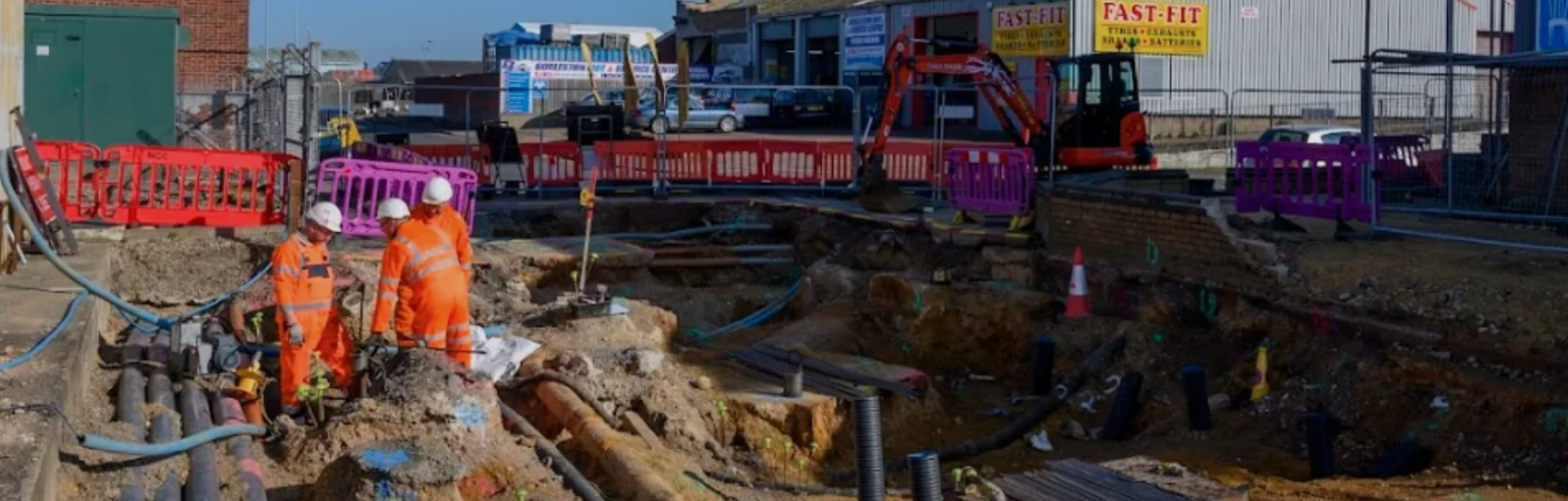
One of the biggest challenges was the location of the site. Traditional methods would have required excavation of the site to nearly 21 feet. As the area included a busy road with buildings and traffic, traditional methods would have required road closures, sheet piling, service diversions, and more. It would have taken weeks to complete the project.
After a review of the site, our engineers offered a solution that required less excavation and provided a shorter completion time. The solution plan used geopolymer injections to stabilize the soil. It involved injecting expansive resin at various depths to densify and compact the loose or eroded soil beneath the pipes.
Geobear engineers used modelling to illustrate the achievable improvement in ground conditions through a geopolymer material. Modelling allows Geobear’s engineers to plan each location and depth to plan the project. This data also reassured the client the proposal would achieve the desired outcomes.
Our team worked with the client in the engineering design phase. The teams used Building Information Modelling and overlaid our in-house engineers’ treatment drawings to ensure the accurate placement of injections to avoid clashes with buried services. The incorporation of a geopolymer injection design into a BIM model is a true industry first and the demonstrable success opens countless opportunities for future works.
Injection tubes needed to be inserted to depths of 24 feet. To facilitate this, a working platform would have been required. However, the Geobear technical team concluded the use of a working platform could be avoided using rod-driving. The team successfully used the rod-driving method and saved five days of work and notable cost.
The project was completed on-time and ahead of the original schedule. The verified ground conditions post-treatment achieved 3 times increase in soil density as a result of the injections. Ground conditions on site based on initial penetration testing were classed as ‘very loose ground’. At the treatment depth, completion standard penetration testing results showed 0-1. Post-treatment with geopolymer, the improvement was between 5-15 – exceeding the client’s requirement. The work was completed on-site with no incidents reported.
Get in touch with our expert team today and discover how Geobear can extend the life of your critical infrastructure assets.