Challenge
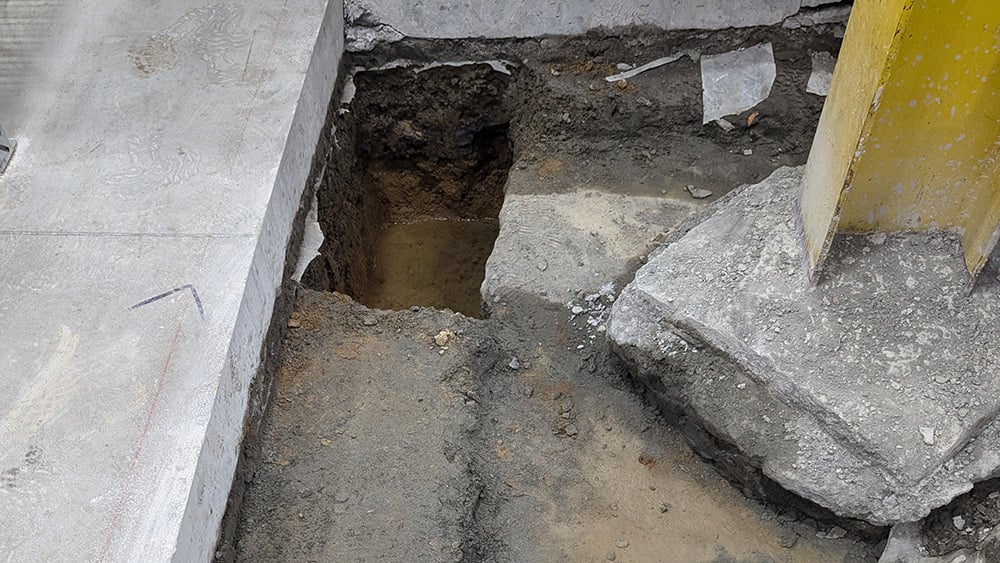
A burst pipe washed out voids beneath a busy manufacturing floor, undermining a wall footing and three crane-support columns.
Solution
Geobear ground improvement solution filled the voids and stabilized the footing and columns, with heavy equipment back on the floor within 48 hours.
Before heavy equipment was back on the floor
Crane-support columns stabilized
The client's facility in Corona, California, is a manufacturing site with a large workshop served by overhead cranes.
On July 31, 2024, a water pipe burst beneath the concrete floor slab on the west side of the building. The water flooded the ground under the floor, and the pressure washed out soil beneath the slabs, the building's west wall footing and the crane-support columns.
The facility was treated as an emergency from early August. A ground-penetrating radar survey commissioned by the client mapped voids and saturated ground across a large part of the floor.
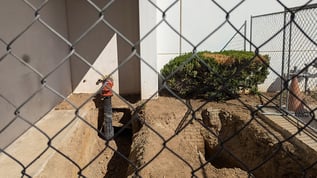
Geobear assessed the site on August 26, 2024, and its engineering team proposed a three-part repair: deep injection to support the foundations, filling an open trench next to the exterior wall, and filling the large voids beneath the slab.
The engineering challenge was to restore support beneath a working manufacturing floor quickly enough to get cranes and heavy equipment back in use, without breaking out and rebuilding the slabs.
Unknown voids. The radar survey showed where the voids were, but not how deep they went. Some reached about 3 feet beneath the slab, and the middle corridor of the workshop had significant voids.
Heavy loads. The floor carries heavy production equipment, and the crane columns carry concentrated loads, so any repair had to support significant weight, not just fill space.
Water in the ground. The ground near the burst was still wet, and a damaged vapor barrier needed sealing at the edges of an open trench beside the wall.
A facility in use. The client needed to complete crane repairs and restart production as soon as possible, so the work had to be fast and planned around the client's priorities, which changed as repairs progressed.
Supertitle
Attribution
The options were helical or push piers under the affected foundations, breaking out and rebuilding the damaged slabs, or filling the voids with another material.
Piers and slab replacement would have meant demolition inside a working workshop, heavy excavation around the crane columns, and weeks before the floor could carry equipment again.
Geobear's ground improvement solution worked through small holes drilled in the slab.
It used two geopolymer formulations: one for structural support beneath the footing and columns, and a slower-reacting, low-heat formulation for the largest voids near the burst.
The client's structural engineer agreed the choice of materials. The geopolymer expands as it reacts, filling voids and densifying the surrounding ground, and gains its strength quickly.
The plan changed as the client's priorities did. The original design was for widespread shallow injection across the floor; at the client's request it was refocused on deep injection beneath three crane-support columns and the west wall footing near the burst, with targeted void filling where the radar showed the largest voids, including the middle corridor.
Geobear carried out the work in two phases, with four days of injection in total.
Heavy equipment was back on the floor within 24–48 hours.
The stabilized slabs carried boom lifts and other heavy equipment within 24–48 hours of treatment, as shown in the client's own videos.
Crane repairs completed and production restarted. Stabilizing the crane columns allowed the client to complete its crane repairs and begin limited production around mid-October 2024.
Verification. Dynamic cone penetrometer (DCP) testing was carried out before and after injection and reviewed by the client's soils engineering firm.
It indicated that the native soil was dense and well compacted for the building's weight apart from the damage caused by the leak.
The building footing is covered by Geobear's 10-year warranty. Geobear recommended improving drainage around the exterior and installing simple markers to monitor stability over time.
Key project outcomes
Voids beneath the workshop floor filled without breaking out the slabs.
A wall footing and three crane-support columns stabilized by deep injection.
Boom lifts and heavy equipment back on the floor within 24–48 hours.
Crane repairs completed and limited production restarted around mid-October 2024.
Four days of injection, in two phases.
Don't let unstable ground put your business at risk. Our commercial team can provide a clear assessment and a fast, effective solution tailored to your operational needs.