Challenge
Weak saturated soils beneath a stator laydown area could not achieve required bearing capacity, threatening a critical maintenance outage.
Solution
Geobear injected geopolymer beneath the existing slab, increasing bearing capacity without excavation, dewatering or delays.
Target bearing capacity achieved and independently verified through post-treatment testing.
Peak equivalent undrained shear strength achieved.
Maintenance outage programme maintained, allowing stator removal and servicing to proceed as scheduled.
A major power generation facility in Ireland required urgent ground improvement beneath a designated stator laydown area ahead of a planned maintenance outage.
During turbine maintenance, stator assemblies – critical components at the heart of the power generation process – must be removed from the plant and temporarily positioned on an external laydown pad. These assemblies impose exceptionally high concentrated loads on the ground and require a stable, verified bearing platform to ensure safe handling and storage.
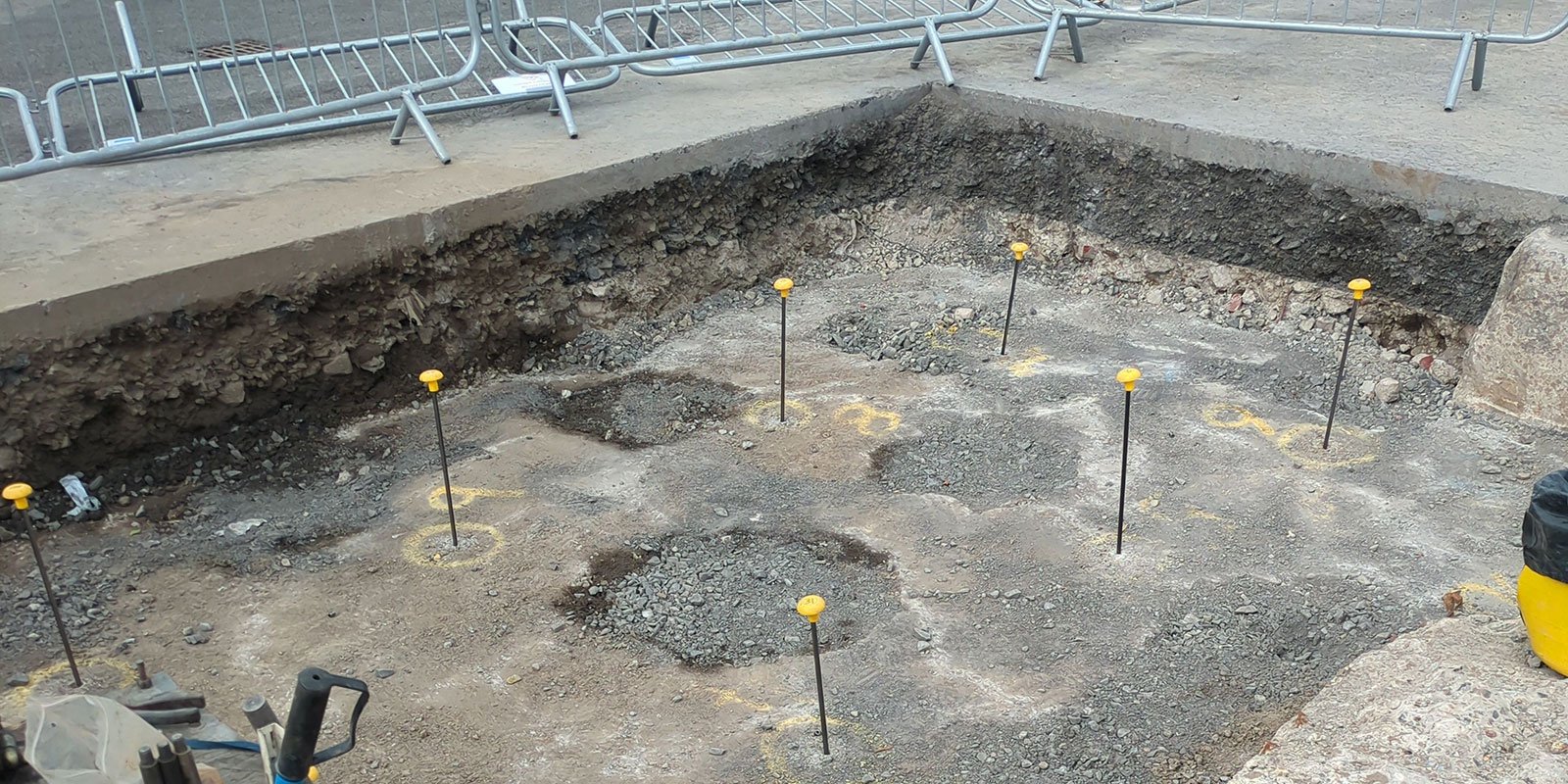
Ground investigations undertaken ahead of the outage identified unsuitable ground conditions beneath the laydown area. The existing ground was incapable of achieving the required bearing capacity of 100 kPa, creating a significant risk to the maintenance programme and the safe handling of the stator assembly.
With the outage date fixed and no opportunity for programme delays, the client required a rapid and reliable solution that could be delivered within a very narrow operational window.
The project presented several technical and operational challenges:
Site investigations revealed medium dense sandy fill in the upper 1–2m overlying soft to very soft silts and clays interbedded with loose sand and gravel. Dynamic probing recorded cone resistance values as low as 1–2 MPa, confirming inadequate bearing capacity for the proposed load.
Several conventional ground improvement methods were assessed.
Excavation and reconstruction of the laydown area with engineered fill and a reinforced concrete slab would have required significant earthworks, groundwater management, material imports and concrete curing time.
A structural steel load-spreading system was also considered. However, the solution would have involved extensive temporary works, higher material costs and additional programme complexity.
Both options presented significant programme risks due to the fixed outage schedule and operational constraints of the live power station environment.
Geobear's geopolymer injection technology offered a rapid, non-intrusive alternative capable of improving the ground in situ without excavation, dewatering or prolonged site occupation.
The solution could be designed, installed and verified within the available outage preparation window while maintaining full operational continuity across the wider facility.
The compact installation methodology also minimised health and safety risks, site disruption and the potential impact on buried services and existing infrastructure.
Following review of the geotechnical investigation data, Geobear engineers designed a bespoke ground improvement solution using a specialist geopolymer selected for its performance in variable, moisture-affected soils.
The treatment targeted the upper 2.5m of the soil profile beneath the laydown area to create a stiffened load-bearing zone capable of safely supporting the stator assembly.
| Metric | Outcome |
|---|---|
| Target bearing capacity | 100 kPa |
| Treatment area | 1.75m x 3.5m |
| Injection grid spacing | 1.2m |
| Groundwater level | 1.8m below ground level |
| Excavation required | None |
| Dewatering required | None |
| Existing slab retained | Yes |
Injection was carried out through the existing surface, allowing the concrete slab to remain fully intact throughout the works.
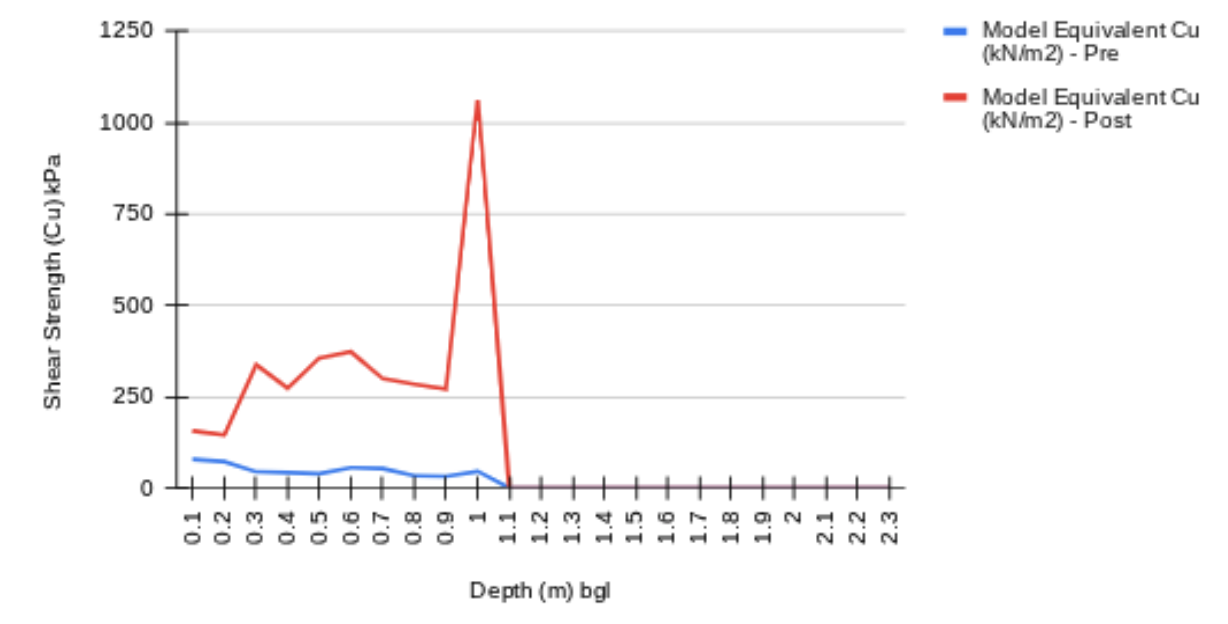
Independent pre- and post-treatment Dynamic Probing Tests confirmed a substantial increase in ground strength throughout the treated area.
As illustrated, pre-treatment results recorded only 2–3 blows per 100mm, consistent with the weak and compressible soils identified during the site investigation.
Following treatment, blow counts increased to between 6 and 70 blows per 100mm, demonstrating a significant improvement in ground resistance.
Equivalent undrained shear strength values increased from negligible pre-treatment levels to more than 1,000 kN/m² at 1.0m depth, confirming that the target bearing capacity of 100 kPa had been achieved and significantly exceeded.
The stator laydown area was successfully prepared ahead of schedule, allowing the planned maintenance outage and stator removal works to proceed without delay.
The Geobear solution eliminated the need for excavation, dewatering, material imports and concrete curing periods.
Ground improvement was completed within the limited programme window available ahead of the outage, allowing a concrete topping to be installed just days after treatment.
This would not have been achievable using conventional excavation or structural foundation solutions.
By avoiding excavation, spoil disposal, groundwater management, imported fill materials and heavy construction plant, the client significantly reduced project costs and programme risk.
The rapid installation methodology also minimised labour requirements and reduced disruption to the wider maintenance programme.
The project avoided substantial excavation activities and the associated transportation of spoil and imported construction materials.
The use of compact equipment, reduced material consumption and minimal site traffic resulted in a significantly lower carbon footprint than conventional ground replacement or structural foundation alternatives.
Get in touch with our expert team today and discover how Geobear can extend the life of your critical infrastructure assets.