Stabilising rocking and broken airside concrete slabs at an international airport in Ireland

Challenge

Rocking, sunken and corner-broken concrete slabs on an airport’s airside needed stabilising within short overnight closures, without breaking out the pavement.

Solution

Geobear slab stabilisation solution restored support beneath four airside slabs over four night shifts, avoiding repeat asphalt patching or slab replacement.

4 nights

Time on site

31

Injection points treated

18 mm

Maximum controlled lift

Background

Airside concrete pavements carry aircraft, tugs and heavy service vehicles around the clock. When a slab loses support from the ground beneath it, it begins to rock under load, its corners break and the joints open, creating foreign object debris risk and an uneven running surface on stands and taxiways.

At least one of the defective slabs had previously been patched with asphalt. In early 2026 the airport’s airfield maintenance team asked Geobear to provide slab stabilisation at four representative locations, to test whether treating the ground beneath the slabs could provide a longer-lasting repair within the airport’s operating constraints.

Geobear reviewed the locations by site visit, designed a treatment for each and delivered the project in May and June 2026.
Challenge

slab-drop-airport


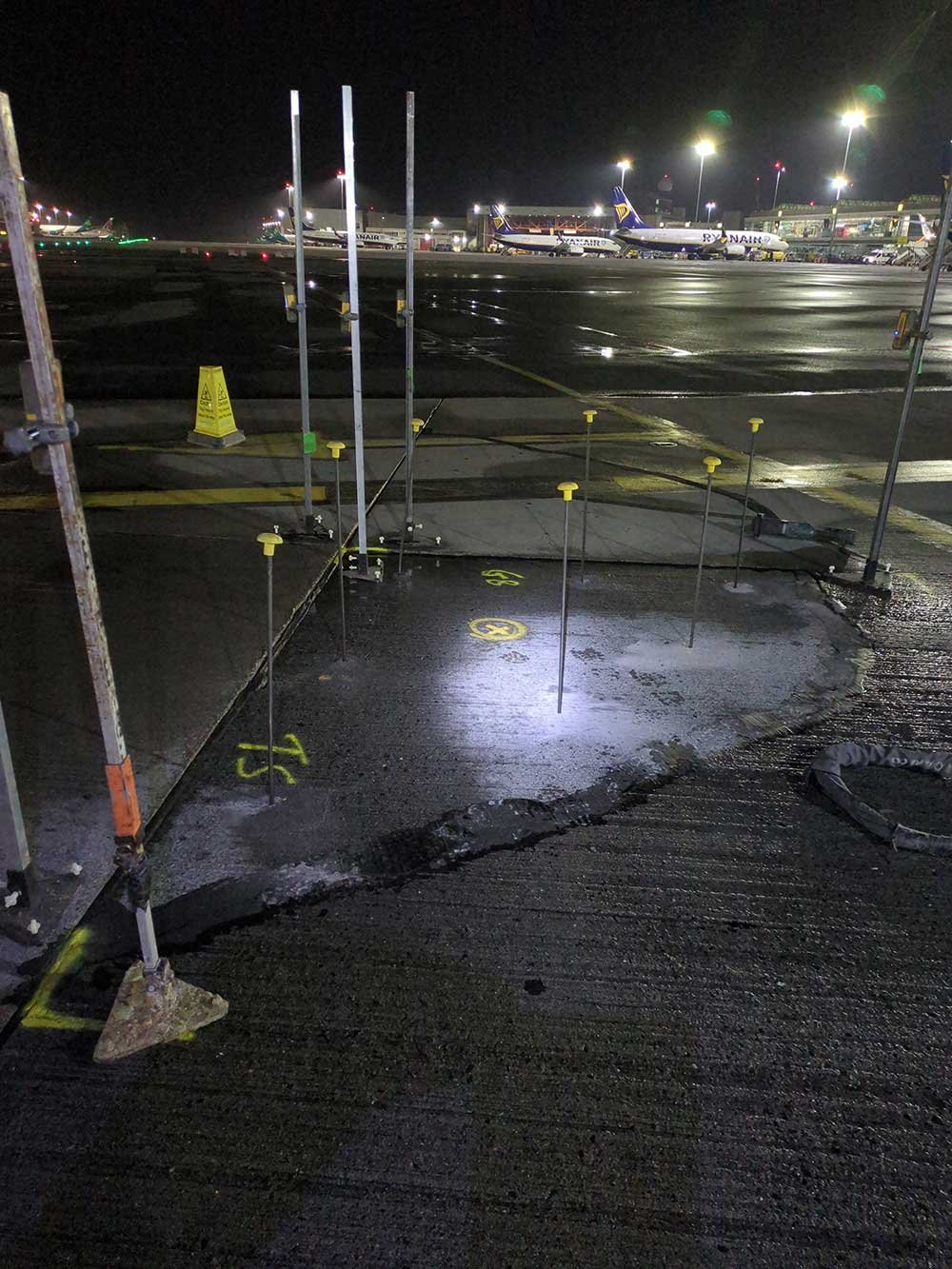
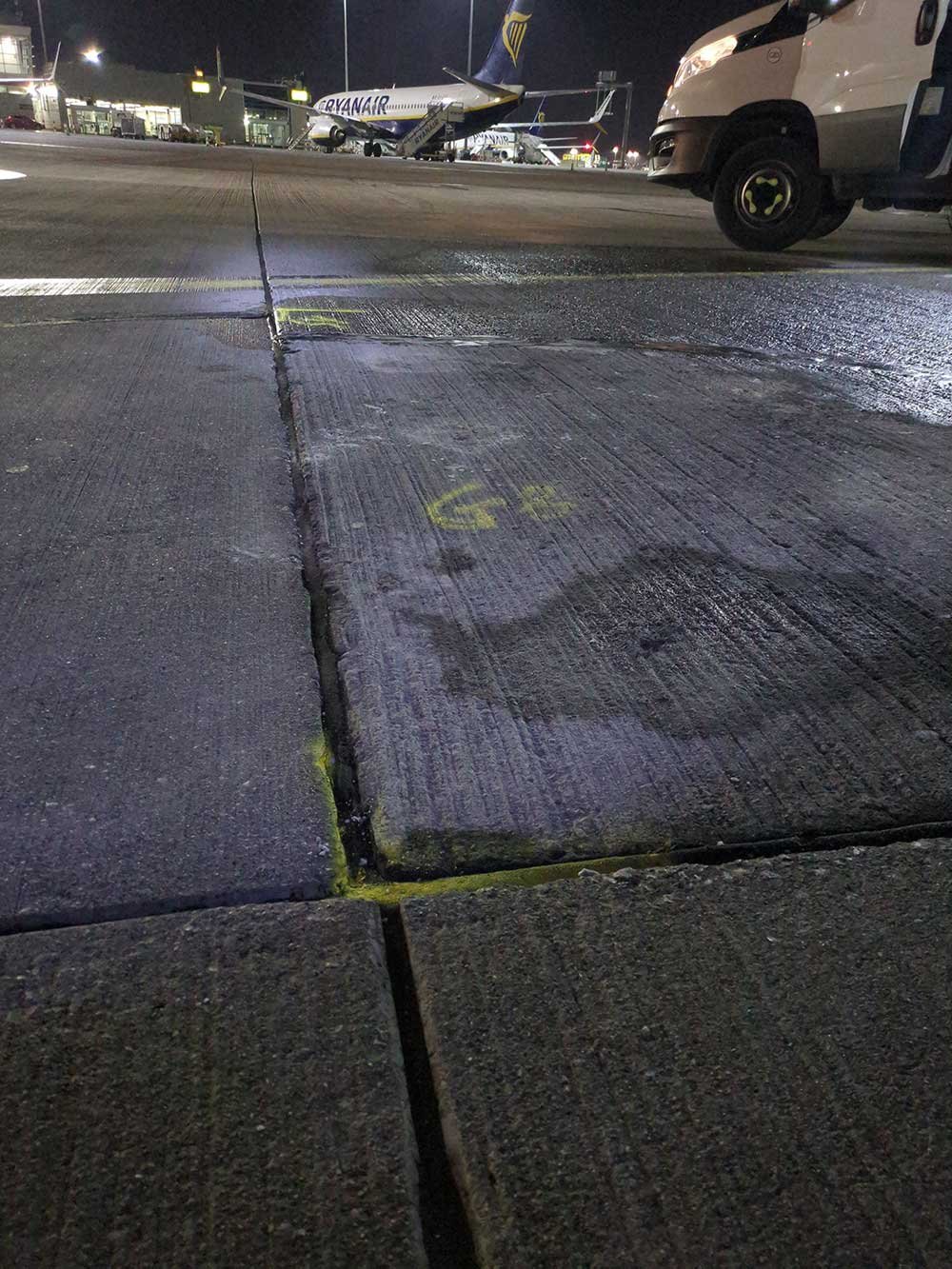
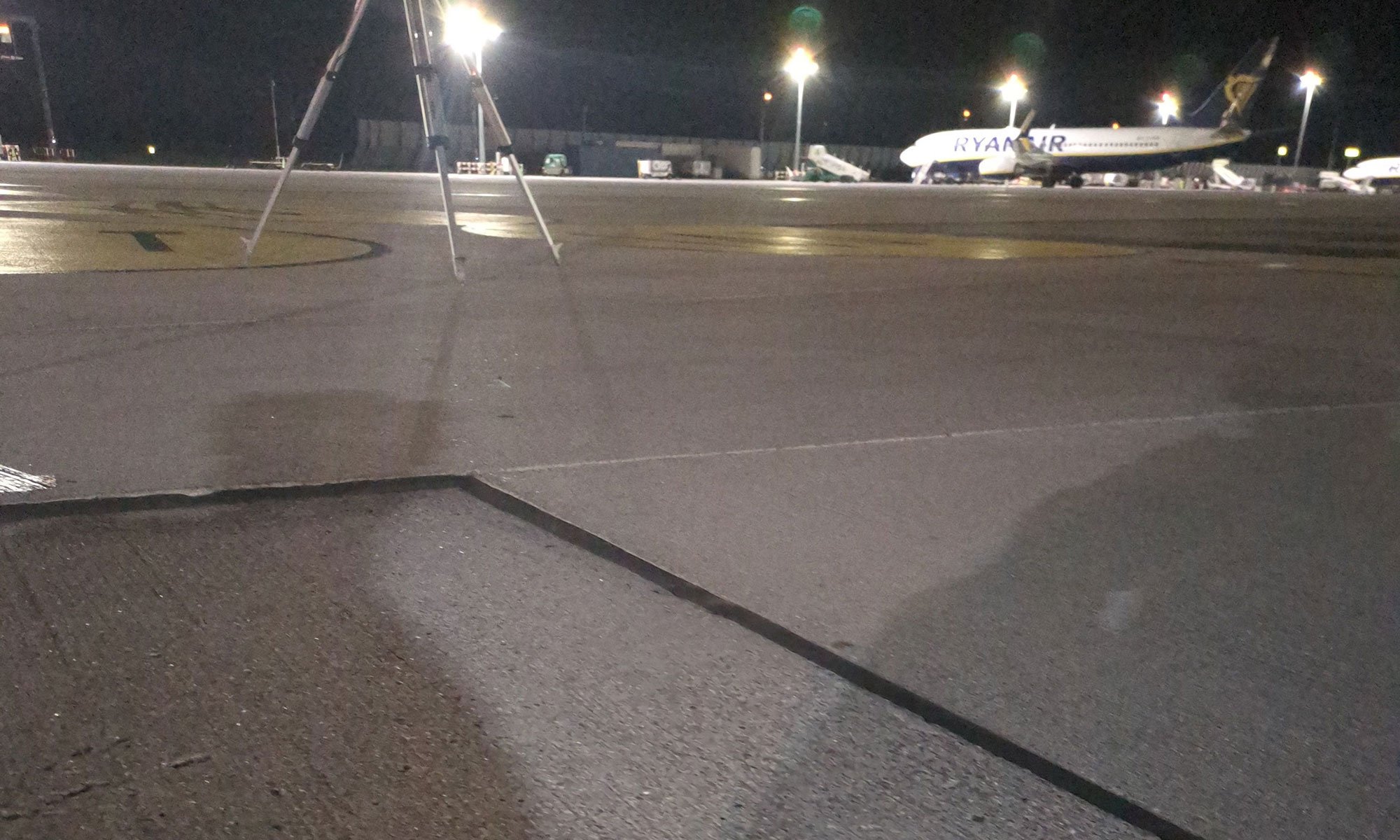
The four trial locations covered the common forms of slab failure on the airfield:

  • a sunken slab on an interstand clearway, partly patched with asphalt
  • a stand slab with all four corners broken
  • a slab around a manhole that rocked under traffic
  • a slab with a corner break

Each of these defects is typical of a slab that has lost contact with its sub-base, so that load is carried on part of the slab only. Geobear’s design aimed to re-establish full contact between the underside of the slabs and the ground. No site investigation was available, so slab thicknesses and ground conditions were assumed from the airport’s engineering information and confirmed during drilling.

Access was the main operational constraint. Airfield locations could only be worked inside overnight closures; for one area the closure ran from 23:30 to 04:30, giving a working window of about four hours. Each location had to be drilled, treated and cleared before the closure ended.

Solution

slab-airport-tubes


The usual short-term response to these defects is surface treatment, such as asphalt overlay and patching, which had already been used on part of one trial slab. These repairs restore the running surface but do not address the loss of support beneath the slab, so the defects tend to return and need repeated treatment. The conventional permanent repair is to break out and replace each failed slab, which needs a longer closure for breaking out, sub-base preparation, concreting and curing before the stand or clearway can be reopened.

A Geobear slab stabilisation solution treats the cause rather than the surface. Small holes are drilled through the existing slab and a fast-setting expanding geopolymer is injected beneath it, filling voids and restoring contact with the ground. The material sets within minutes, so the pavement can be reopened at the end of the same shift.

Results

slab-lifted


Geobear designed a slab stabilisation solution using targeted geopolymer injection beneath the four airside slabs. The engineering objective was to fill the voids under each slab and restore uniform contact with the supporting ground, stopping the slabs rocking and reducing the load concentrations that had broken their corners.

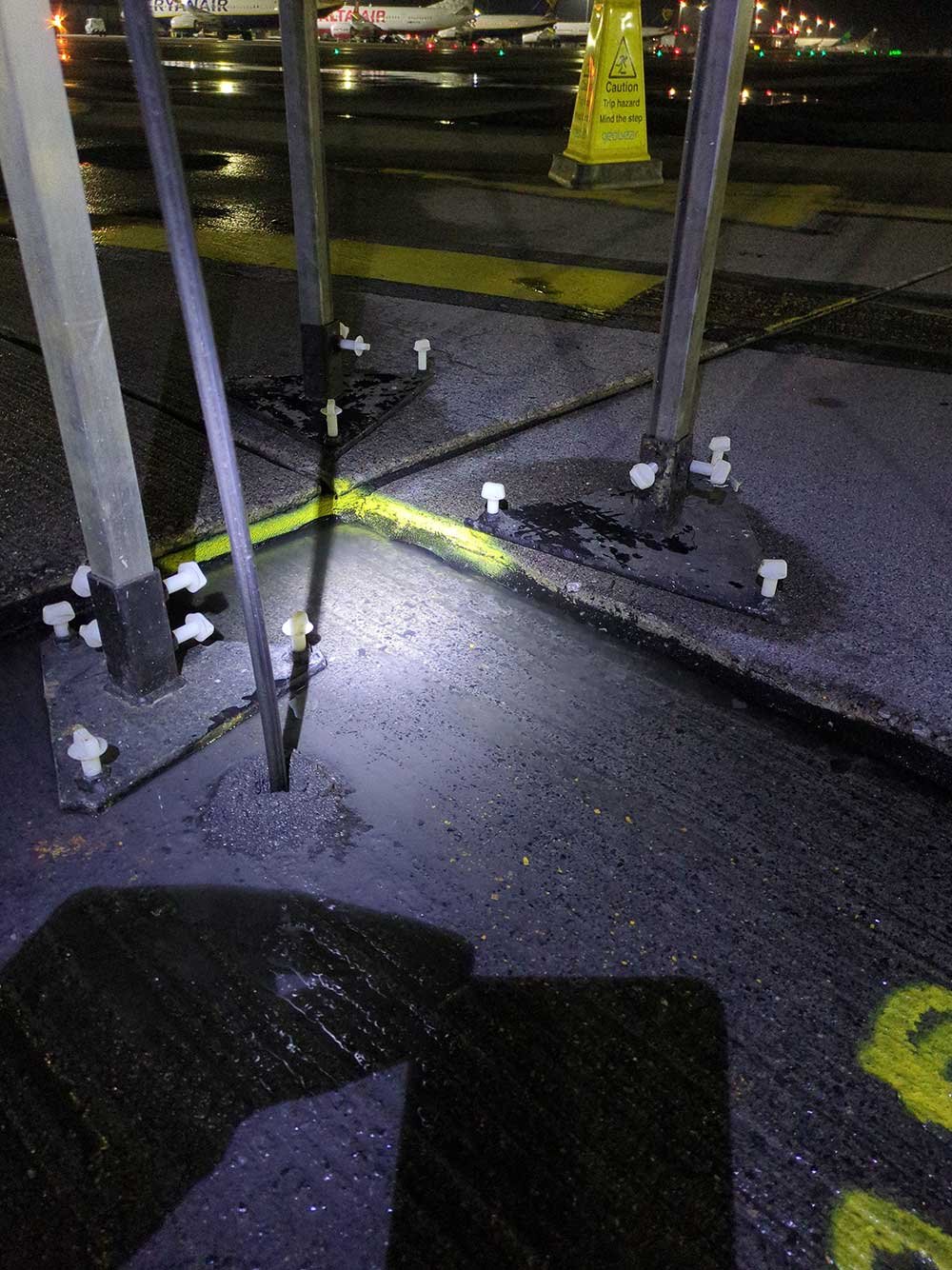
A three-person Geobear crew delivered the works over four night shifts in May and June 2026. Injection points were marked out and checked for services, then 16 mm holes were drilled through each slab. Material quality tests were carried out at the start of every shift before injection. Each point was injected while laser levels monitored the slab surface continuously, and the reaction was recorded: either measurable lift, showing the void had been filled and the slab was being brought back into bearing, or ‘flicker’, a minor surface movement with no measurable lift showing that the zone was fully filled and stabilised, at which point injection stopped.

Ready to discuss your project?

Get in touch with our expert team today and discover how Geobear can extend the life of your critical infrastructure assets.

Bear pointing Bear pointing